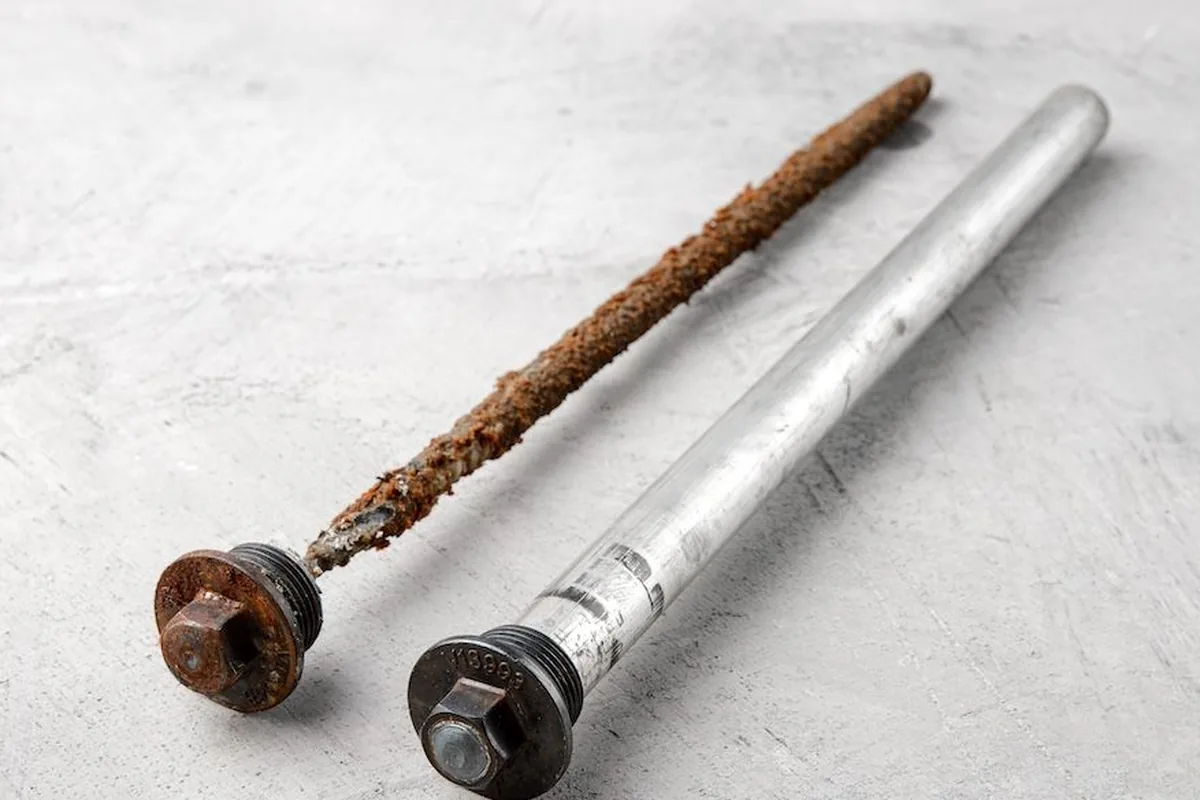
Signs Your Anode Rod Needs Replacing
The anode rod is a long metal rod — usually magnesium or an aluminum-zinc alloy — threaded into the top of your water heater tank. Its job is to corrode so the steel tank does not: it sacrifices itself to the electrochemical reactions that would otherwise eat through the tank lining. Because it is designed to dissolve, every rod has a finite life, and several symptoms tell you when yours is spent.
The classic sign is a rotten-egg or sulfur smell in your hot water. This happens when naturally occurring sulfate-reducing bacteria in the water react with a magnesium anode rod, producing hydrogen sulfide gas. If the smell shows up only in hot water and not in cold, the rod is almost always the culprit. Rusty or discolored hot water is another warning — once the rod is gone, the tank's steel interior begins to corrode and rust tints the water coming off the top of the tank.
Age is the third indicator. In average water conditions a rod lasts roughly three to five years, but Westfield's mineral-heavy supply shortens that window. If your heater is more than a few years old and the rod has never been checked, assume it needs attention. Other clues include a metallic taste in hot water and visible thinning or heavy pitting on the rod itself, which we check during service by extracting it and measuring what remains of the sacrificial metal around the steel core wire.
Why Anode Rods Wear Out Faster in Westfield
Westfield draws its water from the same limestone aquifers that supply much of Hamilton County, and that geology shows up directly in your plumbing. Dissolved calcium and magnesium make the water hard, and hard water is more electrically conductive and chemically aggressive toward sacrificial anodes. A rod that might last five years in soft-water regions can be down to its core wire in two to three years here.
Many Westfield households run water softeners to deal with the hardness, which solves the scale problem but creates a different one for the anode rod: softened water is even more aggressive toward magnesium, accelerating depletion. Homes with softeners and high hot-water demand — large families, frequent laundry — see the fastest rod consumption in our experience.
Temperature plays a role too. Households that keep the thermostat set high drive faster electrochemical activity inside the tank. Combined with mineral content, the result is that Westfield rods live hard, short lives, and replacing them on schedule is one of the most effective things a homeowner can do to extend a tank's service life.
Our Step-by-Step Replacement Process
We follow the same careful sequence on every anode rod replacement so the tank is never stressed and the new rod seals properly:
- Step 1 — Confirm the diagnosis. We ask about smell, water color, and the heater's age, then check the model and rated tank life to make sure a rod replacement makes sense versus a heater near the end of its life.
- Step 2 — Shut everything down. We switch off the breaker for electric units or turn the gas control to pilot/off for gas units, then close the cold-water inlet valve above the heater.
- Step 3 — Relieve pressure and drain. We open a hot-water tap somewhere in the house and drain a few gallons from the tank through the drain valve, just enough to drop the water level below the rod port.
- Step 4 — Extract the old rod. Using a 1-1/16 inch socket and breaker bar, we loosen the hex head at the top of the tank and lift the rod out, inspecting how much sacrificial metal remains.
- Step 5 — Select the replacement. Based on your water conditions — smell history, softener use, clearance above the tank — we choose magnesium, aluminum-zinc alloy, or a flexible segmented rod.
- Step 6 — Install and seal. We wrap the new rod's threads with Teflon tape, thread it in by hand to avoid cross-threading, then torque it to a firm seal without over-tightening.
- Step 7 — Refill and purge air. We reopen the inlet valve, let the tank fill completely, and bleed air from the hot taps until water runs smooth and steady.
- Step 8 — Restore and test. We restore power or relight the pilot, check the rod port for any seepage, and run hot water to confirm normal operation.
Rods and Materials We Install
Not all anode rods are the same, and matching the rod to your water is what makes the replacement last. We carry magnesium rods, the standard choice that provides strong cathodic protection and suits most Westfield homes without odor issues. For households battling sulfur smells, we install aluminum-zinc alloy rods, which discourage the bacteria-rod reaction that creates hydrogen sulfide while still protecting the tank.
Clearance matters: many utility closets and low basement ceilings in Westfield homes leave too little room above the heater to slide in a rigid 40-inch rod. For those installs we use flexible segmented rods that bend through the port and straighten inside the tank, delivering full-length protection where a rigid rod physically cannot fit.
On the tools side, we use a dedicated 1-1/16 inch socket with a breaker bar for seized hex heads, Teflon tape and pipe thread sealant rated for potable hot water, and a calibrated approach to torque — tight enough to seal under pressure, never so tight that the tank's threaded spud is stressed.
Safety and Precautions
Anode rod replacement involves a pressurized vessel holding scalding water, so we treat every step with care. Power stays off at the breaker — not just the thermostat — on electric units until the tank is fully refilled, because energizing an exposed element will destroy it in seconds. On gas units, we manage the pilot and burner according to the manufacturer's lighting instructions and verify stable flame before leaving.
Seized rods deserve respect: a hex head that has been in place for a decade can resist strongly, and excessive force can twist the tank's spud or damage internal lining. If a rod will not break loose safely, we stop and discuss options with you rather than risk the tank. We also confirm the temperature-pressure relief valve functions before and after service, since we have disturbed the system.
Local Factors: Westfield and Hamilton County Water
Westfield's growth tells the story of its water heaters. Subdivisions built from the 1990s through the 2020s — the era that shaped neighborhoods across Hamilton County — largely went in with builder-grade tank heaters whose original anode rods were sized for average water, not limestone-aquifer hardness. Many of those units are now at the age where the factory rod is long gone and the tank is corroding unprotected, which is why we see a steady stream of mid-life heaters with rusty water and sulfur smells.
The local mineral profile matters for rod selection. Because hardness here is high, magnesium rods deplete quickly but protect aggressively; in homes with water softeners, we lean toward checking rods more often rather than assuming the softener solved everything. Well water on the outskirts of town can carry higher sulfur content, making aluminum-zinc rods the better call from the start.
Freeze-thaw cycles enter the picture indirectly: Westfield winters push heaters in garages and unconditioned spaces to work harder, and thermal cycling stresses every connection, including the rod port. A rod replacement visit is a good moment to have the whole unit given a once-over before the heating season.