Atlanta, IN 46031 is one of the smallest incorporated towns in Hamilton County — a quiet railroad town of just a few hundred homes set among the farm fields of northern Hamilton County, straddling SR-19 a few miles north of Arcadia. The houses here tell the town's story: Victorian-era and early-1900s farmhouses, modest frame cottages, and a scattering of newer builds on the outskirts. Many of these older homes carry original-era plumbing and water heaters that have been soldiering on for well past their expected lifespan, fed by some of the hardest groundwater in central Indiana. A leaking water heater in Atlanta often looks like rust-colored water at the tap first, then a damp spot on the basement floor, then a full failure at the tank base. Water Heater Leak Repair Co. serves the entire 46031 ZIP — the town itself and the surrounding rural routes — with leak diagnosis and repair built for exactly these conditions.
Historic Homes, Well Water, and Hard Water: Atlanta's Leak Recipe
Atlanta's housing stock is older than the county average and proud of it. The town grew up with the railroad in the 19th century, and many of its homes date to the late 1800s through the 1940s — the kind of houses with full basements, stone or block foundations, and plumbing that has been repaired, extended, and adapted across generations. A water heater in one of these homes may be threaded into galvanized supply lines installed decades ago, venting through a masonry chimney built for a coal furnace. When a tank starts leaking here, the surrounding plumbing often needs attention in the same visit, and we plan for that rather than being surprised by it.
The water chemistry is the bigger story. Much of the Atlanta area sits on limestone and dolomite aquifers, and the regional USGS estimate for Hamilton County hardness runs around 19 grains per gallon — very hard by any standard. Homes on the town system get that mineral load straight through the meter; rural properties on private wells get it plus iron, which is common in the groundwater north of the White River. Iron shows up as orange staining in sinks and tubs and as accelerated corrosion inside the tank. An Atlanta homeowner who notices hot water turning rusty — while the cold runs clear — is seeing the classic signature of a tank whose anode rod is exhausted and whose steel lining is starting to go. That discoloration is a warning shot: the leak usually follows within months.
The third ingredient is how these houses are heated and plumbed for winter. Older Atlanta homes with crawl spaces or unconditioned basements expose supply lines and heater connections to real cold snaps. A tank itself rarely freezes — forty gallons of hot water has thermal mass — but the exposed copper and PEX feeding it can freeze and split, and the resulting leak gets blamed on the heater until someone traces it properly. Part of every diagnostic visit in 46031 is confirming the water is actually coming from the heater and not from a frozen supply line a few feet away.
Finally, there is the seasonal rhythm of a farming town. Spring thaw and summer storms raise the water table, and we see more calls from basements where a weeping tank fitting meets seasonal seepage — two water sources, one wet floor. Sorting out which water is which matters, because a tank repair will not fix a foundation seep, and a sump pump will not fix a tank leak. We diagnose both before recommending anything.
How a Leak Repair Visit Works in Atlanta, IN 46031
Call (833) 713-2101 and the first thing we will ask is the location of the water: under the tank, at the top pipes, from the side discharge pipe, or somewhere ambiguous in the basement. In Atlanta's older homes, 'ambiguous' is common — water travels along floor joists and block walls — so we also ask about water color (clear vs. rusty), whether the hot water itself looks discolored, and whether the unit is gas or electric. Those answers shape what we bring: replacement valves and nipples for a repair call, or a correctly sized tank if the description points to a failed unit.
While you wait, the shutoff drill is the same one we teach everywhere in the 46031 ZIP: close the cold-water supply valve above the heater, kill the heat (breaker off for electric, gas control to pilot or off for gas), and if water is spreading, hook a garden hose to the drain valve and run it to a floor drain or sump pit. In homes with older gate valves that have not been turned in years, we warn you not to force a frozen valve — tell us, and we will deal with it on arrival.
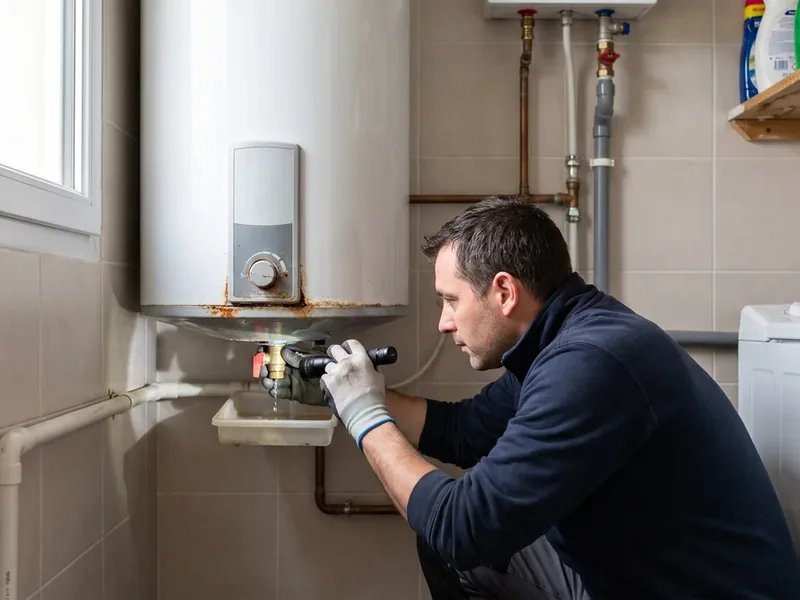
On site, we work top to bottom. The inlet and outlet connections get checked first — in Atlanta's vintage homes, the dielectric unions that should separate copper from steel are often missing, and the resulting galvanic corrosion is a prime leak source. Next the T&P relief valve and its discharge pipe: we check whether it is weeping from thermal expansion pressure or genuinely failing. Then the drain valve, which on hard-water tanks is frequently clogged with sediment and seeping around its threads. Finally the tank body itself — the base seam, the bottom head, and the jacket for rust streaks. If the steel is perforated, we say so plainly and talk replacement; if a component failed on a sound tank, we repair it and you keep your heater.
Replacement in an older Atlanta home sometimes means upgrading the connections around the tank at the same time: new shutoff valve, new supply flex lines or properly soldered copper, an expansion tank if the plumbing is a closed system, and a drain pan with a proper drain line where the layout allows. Doing it once, doing it right — that is the standard for 46031.
Leak Patterns We See Again and Again Around Atlanta
The rusted tank base leads the list, and hard water is the reason. Sediment bakes onto the tank floor, the burner or element overheats the steel beneath it, the glass lining cracks, and corrosion takes hold. The early signs in an Atlanta home: a faint popping or rumbling when the burner fires (water flashing to steam under the sediment layer), hot water that runs rusty for the first few seconds, and a damp ring on the basement floor that comes and goes with the heating cycle. When the ring stops coming and going and stays wet, the tank is done.
T&P valve discharge is second. Many homes in town are on a closed plumbing system — a pressure-reducing valve or check valve on the main means heated water cannot push back into the supply, so pressure climbs with every heating cycle until the relief valve does its job and dumps water. Homeowners find the discharge pipe dripping outside the foundation and assume the valve is broken. Sometimes it is; often the valve is fine and the system needs an expansion tank. We test rather than guess.
Corroded top fittings are third, and they are almost a signature of Atlanta's older housing. Decades of galvanic corrosion at copper-to-steel joints, accelerated by mineral-rich water, thins the tank nipples until they weep. The tell is the crust: white-green mineral buildup around the joint that slowly turns into an active drip. Caught early, this is a repair — cut back to sound pipe, install dielectric unions, done. Caught late, the nipple can snap off inside the tank fitting and turn a simple job into a complicated one, which is why we tell 46031 homeowners not to ignore that crust.
Well Water, Iron, and Your Water Heater in the 46031 Area
A large share of the homes we serve around Atlanta run on private wells, and well ownership changes the water heater equation. Municipal water in this region is very hard; well water is very hard plus iron, plus whatever sediment the well itself contributes. Iron is the visible part — orange rings in the toilet tank, rusty laundry, metallic taste — but inside the water heater it is doing quiet damage, feeding the corrosion cells that eat through the tank lining once the anode rod is spent.
Well owners should know three things. First, the anode rod in a well-fed heater depletes faster, so inspection every two to three years is wise — when the rod is gone, the tank is next. Second, sediment from the well settles in the tank alongside the mineral scale, so flushing matters even more; we recommend it at least annually for well systems in this ZIP. Third, a water softener helps enormously with the hardness but does not remove all iron, and an iron filter ahead of the softener protects both the softener and the heater. If you are replacing a tank on a well system, that is the right moment to look at the whole treatment chain — heater, softener, and filtration as one system rather than three separate headaches.
For homes on the town system, the advice is simpler: the water is very hard (around 19 grains per gallon regionally), so flush the tank yearly, keep an eye on the anode rod, and consider a softener if you are tired of scale on fixtures and short-lived appliances. Either way, the mineral load is the background condition every water heater in 46031 lives with, and every repair or replacement we do here is planned around it.
What to Do the Moment You Find a Leak in Atlanta
Water on the floor and a heater that might be the source — here is the order of operations. Shut the cold-water supply valve above the heater to stop feeding the leak. Kill the heat: breaker off for electric, gas control to pilot or off for gas. If water is actively spreading across a basement floor, thread a hose onto the drain valve and run it to the nearest floor drain or sump pit, then crack the valve open. Do not repeatedly lift the T&P valve lever as a test — a weakened valve may not reseat and you will create a second leak. Note what you see: where the water starts, what color it is, whether the hot water at the tap is discolored. Then call (833) 713-2101 with that description. For Atlanta and the surrounding 46031 rural routes, active leaks get priority scheduling because a failed tank does not wait politely.
Atlanta, IN 46031 — Area Fact Box
Water Heater Leak Repair Co. serves Atlanta and the surrounding northern Hamilton County farmland. Key local facts:
| Detail | Atlanta, Indiana |
|---|---|
| Verified ZIP code | 46031 |
| County | Hamilton County |
| Housing type and era | Victorian-era and early-1900s farmhouses and cottages; modest mid-century homes; newer builds on town outskirts |
| Key routes and landmarks | SR-19 corridor; small historic railroad town center; surrounding farmland and county roads |
| Water conditions | Very hard groundwater (~19 grains per gallon regional estimate); town system plus many private wells with iron |
| Typical heater setup | Basement tank installs in older homes; galvanized-era supply plumbing; some crawl-space units |
Water Heater Leak Repair FAQs for Atlanta, IN 46031
My hot water runs rusty but the cold is clear. Is my heater leaking?
Not yet — but it is warning you. Rusty hot water with clear cold water means the inside of the tank is corroding, which happens when the anode rod is exhausted. The leak usually follows within months as the corrosion reaches the steel. Call (833) 713-2101 now and we can inspect the anode and the tank; catching it at the discoloration stage sometimes buys time, and at minimum it lets you plan a replacement instead of reacting to a flood.
Can you repair a heater connected to old galvanized pipes?
Yes — most of Atlanta's older homes have galvanized supply lines, and we work with them regularly. We will assess whether the pipes near the heater are sound enough to reconnect or whether the corroded sections should be replaced back to solid pipe while the system is open. If the galvanized is heavily restricted with scale, we will tell you honestly what that means for the repair.
I'm on a well with iron. Will a new tank just corrode again?
It will last far longer if the water treatment is right. A fresh anode rod, annual flushing, and addressing the iron — with proper filtration ahead of any softener — change the equation completely. When we replace a tank on a well system in 46031, we review the whole setup with you so the new heater is not fighting the same water that killed the old one.
Water is on my basement floor but I can't tell where it's from. What do I do?
Start with the heater: shut its supply valve and see if the water stops accumulating. Check whether the water is warm (points to the heater) or cold (could be a supply line or foundation seep), and whether the hot water at the tap is discolored. Describe all of it when you call — in Atlanta's older basements, water travels, and part of our diagnostic visit is tracing it to the true source before recommending any work.
Should I drain my water heater myself before you arrive?
Only to control active flooding — hook up a hose and drain enough to stop the spread. Do not fully drain and abandon the tank, especially a gas unit, without killing the heat source first; a burner or element firing in an empty tank destroys it in minutes. If you are unsure about any step, leave the tank alone and call us.
How fast can you get to Atlanta, IN 46031?
We cover the SR-19 corridor through northern Hamilton County daily, including Atlanta and the surrounding township roads. Active leaks — water flowing now — get priority scheduling. Call (833) 713-2101, describe what you see, and we will get a technician to your 46031 home as fast as the schedule allows, with same-day diagnosis as the goal.
From a weeping fitting on a vintage farmhouse heater to a fully failed tank in a mid-century basement, Atlanta's water heaters fail in patterns we know well. The next step is simple: call (833) 713-2101, tell us where the water is and what the hot water looks like, and let Water Heater Leak Repair Co. handle the rest for your 46031 home.