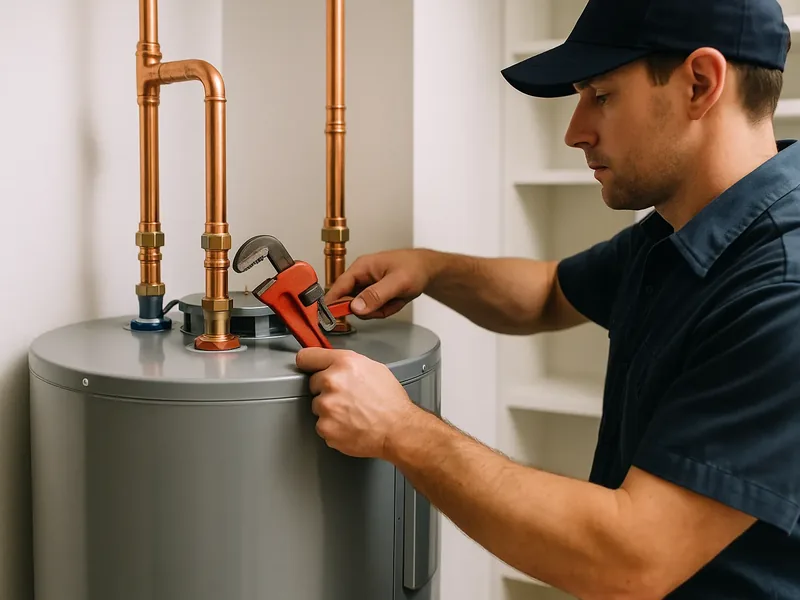
Danville, IN 46122 is the seat of Hendricks County — a classic Indiana courthouse-square town where the historic county courthouse anchors a downtown of brick storefronts, and the residential streets radiating from the square hold some of the oldest housing in the county. Victorian and early-1900s homes line the older blocks; postwar ranch homes and newer subdivisions fill in toward the edges of town along the US-36 corridor. That age gradient is exactly what shapes water heater work in Danville: the closer to the square, the older the plumbing, the more original-era the installation, and the more likely a 'water heater leak' involves the pipes and valves around the tank as much as the tank itself. Water Heater Leak Repair Co. serves the full 46122 ZIP — the historic core, the newer subdivisions, and the surrounding Center Township countryside.
Courthouse-Square History and What It Means for Your Plumbing
Danville's identity as the county seat goes back to the 1820s, and the housing stock around the square reflects nearly two centuries of building: Victorian-era homes with full basements and stone foundations, early-1900s foursquares and bungalows, postwar ranches, and then the modern subdivisions that have grown up along US-36 and toward the town's edges. A water heater in a Victorian near the square may be venting through a masonry chimney built for a long-gone coal furnace, threaded into galvanized supply lines from a mid-century repipe, and sitting on a basement floor that has seen a hundred Indiana winters. These are character-rich homes — and character-rich plumbing.
The practical consequence: leak diagnosis in Danville's historic homes has to account for the whole system. A weeping joint at the top of the tank might be a failed dielectric union — or it might be a galvanized nipple corroded thin inside the wall of the fitting, ready to snap. A damp basement floor might be the tank base — or seasonal seepage through an old stone foundation meeting a sweating cold-water line. We trace water to its true source before recommending anything, because in these houses the obvious suspect is wrong often enough to matter.
The newer subdivisions tell the simpler story: 1990s-and-later homes with PEX or copper plumbing, code-era installs, and builder-grade tanks now entering the 12-to-18-year failure window. Clean diagnostics, straightforward replacements, same hard-water story as the rest of Hendricks County. Danville's growth has added plenty of these homes along the US-36 corridor, and their tanks are failing on the familiar schedule.
One more Danville note: the town's older homes often have the water heater in a true basement — full-height, sometimes with a floor drain, sometimes not — while the ranch homes and newer builds split between basements, crawl spaces, and garages. The setting changes the damage pattern and the repair logistics, and we ask about it on every 46122 call.
How Water Heater Leak Repair Works in Danville, IN 46122
Your call to (833) 713-2101 starts with the essentials — leak location, heater age, gas or electric — plus a Danville-specific question: roughly how old is the house, and has the plumbing near the heater ever been updated? A 1910 Victorian with original-era piping gets a different parts load and a different time estimate than a 2005 subdivision home, and we would rather arrive prepared than make two trips.
Immediate steps: close the cold-water supply valve above the heater, kill the heat (breaker for electric, gas control to pilot or off), and hose-drain to a floor drain, sump pit, or outside if water is spreading. In the historic homes, two cautions: do not force a frozen old gate valve (they snap, and a snapped valve is a bigger emergency than the heater leak), and do not assume the basement floor drain actually drains — test it with a bucket of water before depending on it. If the drain is clogged with a century of sediment, tell us and we will plan the water removal differently.
On-site diagnosis runs top to bottom: supply connections and the condition of the surrounding pipe, dielectric unions, T&P valve and discharge piping, drain valve, expansion tank, and the tank body — base seam, bottom head, jacket. In Danville's oldest homes we also check the venting path on gas units, because heater replacement is the moment deteriorated flues and oversized chimneys get discovered. After any repair or replacement, the system is refilled, purged of air, brought to temperature, and checked at every joint under pressure. We also replace suspect shutoff valves and connectors while the system is open — in a historic home, putting a new tank on a failing 40-year-old valve is asking for a callback.
Leak Patterns in Danville's Historic and Newer Homes
In the historic core, fitting and connection failures rival tank failures. Galvanic corrosion at copper-to-steel joints made before dielectric unions were standard, galvanized nipples corroded from the inside, weeping solder joints on old copper — the mineral-rich water of Hendricks County (very hard, roughly 19 grains per gallon regionally) has had decades to work on these connections. The signature is the crust: white-green mineral buildup around a joint that graduates to a drip. Caught early it is a repair; ignored, the fitting fails structurally and the repair gets bigger.
Tank-base failures still happen in the old homes too, on the usual sediment schedule — hard water bakes onto the tank floor, the burner superheats the steel, the lining fractures. But there is a Danville-specific accelerant: many historic homes have water heaters oversized for the household (a 50-gallon tank for two people) that short-cycle thermally, or heaters set excessively hot to compensate for long pipe runs in big old houses. Both patterns stress the tank. We check the thermostat setting and the household's actual use during the visit, because right-sizing the replacement is part of doing the job well.
In the newer subdivisions, the pattern is the familiar builder-tank wave: 12-to-18-year-old 40- and 50-gallon gas tanks failing at the base seam, T&P discharge from closed-system pressure (pressure-reducing valves are standard in the newer builds), and brittle plastic drain valves weeping at the threads. Straightforward diagnostics, same-visit repairs where the tank is sound, honest replacement recommendations where it is not.
Across both eras, one seasonal pattern: spring basement moisture. Danville's older stone and block foundations seep in wet springs, and a weeping tank fitting plus foundation seepage makes for a confusing wet floor. We separate the two sources during diagnosis — dye, timing, water temperature — because fixing the tank will not fix the foundation, and vice versa.
Hard Water and Heater Maintenance in the 46122 Area
Hendricks County's limestone-aquifer water is very hard across the Danville area, and it is the background condition behind most local heater failures: sediment on tank bottoms, scale on elements, depleted anode rods. The maintenance program that beats it is unglamorous — annual flushing, anode inspection every few years, a working softener where one is installed — but it is the difference between an 8-year tank and a 13-year tank, and in a historic home where replacement means threading a new unit through a 1910 basement stairwell, those extra years matter.
A note for Danville's well owners on the township outskirts: private wells here commonly add iron to the hardness, which accelerates internal corrosion and stains fixtures. Well-fed heaters need the anode checked every two to three years and the tank flushed annually at minimum. If your hot water runs rusty while the cold runs clear, the anode is gone and the tank is corroding — that is the warning before the leak, and it deserves a call now, not after the basement floods.
For homes with softeners — common in the newer subdivisions, increasingly retrofitted in the older homes — the check is whether the softener is actually working: salt in the brine tank, no salt bridging, correct hardness setting, successful regeneration. A dead softener protects nothing, and we verify it during every 46122 leak visit because the replacement tank's lifespan depends on it.
What to Do Right Now If Your Heater Is Leaking in Danville
Close the cold-water supply valve above the heater — gently, if it is an old gate valve. Kill the heat: breaker off for electric, gas control to pilot or off for gas. If water is spreading, run a hose from the drain valve to the nearest working drain. Do not force stuck valves, do not cap a dripping T&P discharge pipe, and do not keep working the T&P lever on a compromised valve. Note the heater's age and fuel type, the house's era if you know it, and exactly where the water appears. Then call (833) 713-2101 — active leaks anywhere in the 46122 ZIP, from the square to the subdivisions along US-36, get priority scheduling for same-day diagnosis.
Danville, IN 46122 — Area Fact Box
Water Heater Leak Repair Co. serves Danville, the surrounding Center Township area, and the US-36 corridor. Key local facts:
| Detail | Danville, Indiana |
|---|---|
| Verified ZIP code | 46122 |
| County | Hendricks County (Center Township); county seat |
| Housing type and era | Victorian and early-1900s homes near the courthouse square; postwar ranch homes; 1990s-and-later subdivisions toward the town edges |
| Key routes and landmarks | US-36 corridor; historic Hendricks County courthouse square; brick downtown storefronts |
| Water conditions | Very hard groundwater from limestone aquifers (~19 grains per gallon regional estimate); town system plus private wells with iron on the outskirts |
| Typical heater setup | Basement tanks in historic homes with galvanized-era plumbing and masonry-chimney venting; modern basement/garage installs in newer subdivisions |
Water Heater Leak Repair FAQs for Danville, IN 46122
My house is from the 1920s. Can you even work on plumbing that old?
Yes — Danville's historic homes are a regular part of our 46122 work. We are set up for galvanized supply lines, old gate valves, masonry-chimney venting, and tight basement access. The diagnostic accounts for the whole system, not just the heater, and when replacement is needed we handle the connection upgrades (new shutoff valve, dielectric unions, proper venting) that an old installation requires.
How do I tell a tank leak from basement seepage in spring?
Check the water's temperature and timing: heater water is warm and appears with hot-water use; seepage is cold and follows rain. Shut the heater's supply valve — if the water stops accumulating, the heater is the source. During the visit we trace ambiguous basement water properly rather than guessing, because the fixes are completely different.
The valve above my heater is original to the house and won't turn. Now what?
Leave it alone and tell us when you call (833) 713-2101. Forcing a century-old gate valve risks snapping it and creating a much bigger emergency. We carry modern quarter-turn ball valves and replace seized shutoffs as part of the visit — you will end up with a valve that actually works next time you need it.
My hot water is rusty but only in the morning. Is the tank failing?
Rusty first-draw hot water with clear cold water is the classic sign of internal tank corrosion — the anode rod is exhausted and the steel is going. It often shows worst in the morning because the water has sat in the tank overnight. This is the warning stage before the leak; call now and we can inspect the anode and tank and help you plan rather than react.
Should the new tank be the same size as the old one?
Not necessarily. Many of Danville's older homes have oversized or undersized heaters relative to the current household — a 50-gallon tank for two people, or a 40-gallon struggling with a family of five. During replacement we look at bathrooms, occupants, and use patterns, and size by recovery rate and first-hour rating rather than just matching what the last installer happened to carry.
Do you serve the rural routes outside Danville?
Yes — the full 46122 ZIP including Center Township's rural roads and well-water properties. Well-system heaters get the well-specific diagnostic: anode condition, sediment load, and iron treatment. Active leaks get priority scheduling anywhere in the ZIP. Call (833) 713-2101 with the heater's age and the leak details.
Danville's homes range from Victorian-era to brand-new, and their water heaters fail accordingly — but the response is the same: shut the water, kill the heat, and call (833) 713-2101. Water Heater Leak Repair Co. will trace the leak to its true source and fix it right for your 46122 home, historic or modern.