Fishers, IN 46038 grew from a railroad stop into one of Indiana's largest suburbs in a single generation — a Hamilton County city of more than 100,000 where the neighborhoods along the I-69 corridor and around the Nickel Plate District are overwhelmingly products of the 2000s and 2010s building boom. Geist Reservoir glitters along the city's eastern edge, and the subdivisions stretching toward it are filled with large two-story family homes, finished basements, and the builder-grade tank water heaters installed when each neighborhood was new. Those tanks are now 12 to 20 years old, and they are failing across Fishers in waves — same street, same builder, same install year, same rusted base seam. Water Heater Leak Repair Co. serves the full 46038 ZIP with leak diagnosis, component repair, and replacement sized for Fishers' homes and households.
Boom-Era Subdivisions and the End-of-Life Tank Wave
Fishers' growth concentrated in the 2000s and 2010s, and the water heaters went in with the houses: tens of thousands of 40- and 50-gallon gas tanks, builder-grade, installed across neighborhoods from the I-69 corridor east toward Geist Reservoir and north through the city's newer sections. A tank installed when a subdivision was new in 2008 is now pushing 18 years old — well past the 8-to-12-year service life these units deliver in central Indiana's very hard water. The failure signature is consistent: sediment baked onto the tank floor over a decade-plus, the burner rumbling as water flashes to steam under the mineral layer, rusty first-draw hot water, and finally the damp ring around the base that stops being intermittent.
Fishers' homes raise the stakes of a leak. These are large households in large houses — four and five bedrooms, three-plus baths, finished basements with guest suites, home gyms, and media rooms. A failed tank base above a finished basement is a flooring-and-drywall event, not a mop-up. Many Fishers homes also put the heater in a garage or a main-floor mechanical closet rather than an unfinished utility room, which means leaks travel. We ask about the heater's location on every 46038 call, because a second-floor or main-floor leak gets priority dispatch and a different containment plan than a garage puddle.
The city's eastern neighborhoods near Geist Reservoir add a local wrinkle: some of the priciest homes in the metro area, with complex hot-water systems — pairs of tanks in parallel, high-capacity tankless units, recirculation loops serving long pipe runs. Multi-unit systems fail at their connections and controls as often as at the tank: recirc pump seals, mixing valves, isolation valves. Our diagnostic covers the whole system, because replacing one tank of a parallel pair without checking the other is only half a job.
How Water Heater Leak Repair Works in Fishers, IN 46038
Call (833) 713-2101 and the intake is quick: leak location, heater age, gas or electric, and where the unit sits in the house. In Fishers, 'original to the house' plus a 2005–2015 build date tells us most of what we need — the tank is at or past end of life, and the visit is likely a replacement consultation as much as a leak diagnosis. We still diagnose first, because a four-year-old replacement tank with a weeping drain valve is a repair, and we will not sell you a tank you do not need.
Immediate steps while you wait: close the cold-water supply valve above the heater, kill the heat (breaker for electric, gas control to pilot or off), and contain the water — hose from the drain valve to a floor drain or out the garage door for utility spaces; towels, wet-vac, and a bucket under any ceiling drip for finished areas. If drywall is sagging with trapped water, a small relief hole lets it drain controllably into the bucket instead of collapsing unpredictably. Note the heater's age from the rating plate, the water's color, and whether the hot water at the tap is discolored — then call with those details.
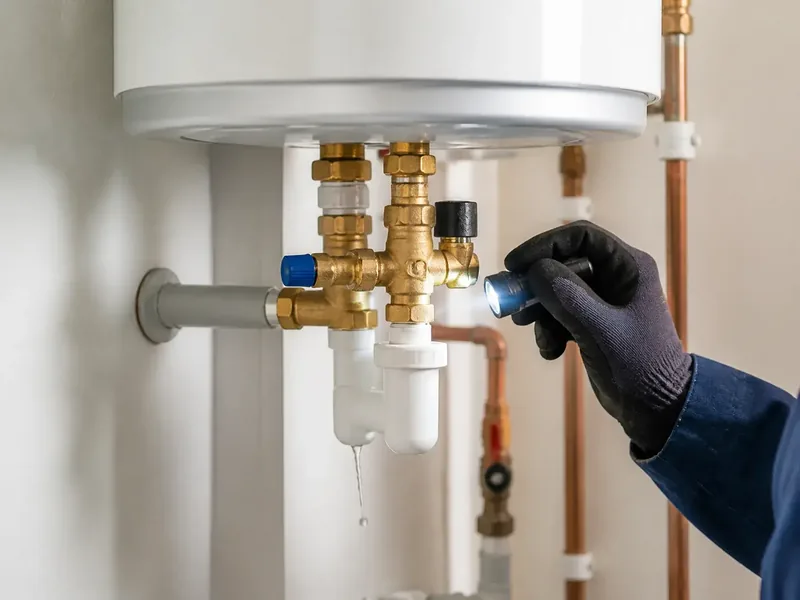
On site, we inspect top to bottom: supply connections and dielectric unions, T&P valve and discharge piping, drain valve, expansion tank, recirculation components where present, and the tank body — base seam, bottom head, jacket rust. Fishers' code-era installs are clean to work on: proper discharge piping, accessible shutoffs, labeled breakers. When replacement is the call, we size to the household — recovery rate and first-hour rating matched to bathrooms and occupants — and we discuss the finished-space protections that matter in these homes: drain pan with plumbed drain, leak-detection auto-shutoff, and connector and valve replacement while the system is open. Refill, purge, heat, pressure-check every joint: hot water restored the same visit.
Fishers' Most Common Leak Sources
Sediment-killed tank bases dominate, and the cause is no mystery: roughly 19 grains per gallon of hardness (the regional USGS estimate for Hamilton County's limestone-aquifer water) processed through a builder-grade tank for 15 years without flushing. The mineral layer insulates the tank floor from the burner, the steel overheats and the glass lining fractures, corrosion takes the seam. Fishers homeowners describe the same progression we hear across the boom suburbs: rumbling, rusty water, intermittent ring, permanent puddle. If your 46038 home still has its original 2008–2012 tank and you are reading this before it fails — call for an inspection. The sediment load and anode condition will tell us how much time is left.
T&P relief valve discharge is second. Fishers subdivisions were built with pressure-reducing valves as standard, making every home a closed system; thermal expansion drives pressure up each heating cycle until the relief valve dumps through the discharge pipe outside the house. Homeowners see the dripping pipe and assume a bad valve. We test house pressure and expansion-tank charge first — the valve is usually the messenger, and the fix is an expansion tank service or replacement, not just a new valve.
Third: failed drain valves and supply connectors. The plastic drain valves on boom-era tanks turn brittle and seep; braided connectors fatigue after 15 years of heat cycles. Both are same-visit repairs on a sound tank — a full-port brass drain valve and new connectors are cheap insurance. We do these constantly across 46038, often proactively during replacements so the new tank starts with all-new connections.
Fourth, specific to Fishers' larger systems: recirculation and multi-tank connection leaks. A failed recirc pump seal drips steadily and gets mistaken for a tank leak; a weeping union on a parallel-tank manifold does the same. The diagnostic has to cover the whole hot-water system, not just the tank with water under it — which is why we ask about the full setup on the call.
Hard Water, Softeners, and the Fishers Maintenance Picture
Most Fishers homes have water softeners — a rational response to very hard water — but softeners are maintenance items, not install-and-forget appliances. Resin exhausts, salt bridges form, settings drift, bypass valves get left open after service. We regularly find Fishers heaters dying of sediment while the softener sits idle in the corner, and the homeowner is genuinely surprised. During every 46038 leak visit we check the softener: salt level, regeneration function, hardness setting. A working softener adds years to a tank; a dead one protects nothing.
There is a subtlety worth knowing: in softened water, anode rods deplete faster, because soft water is more conductive and drives the galvanic protection harder. Softeners prevent scale but do not prevent corrosion — the anode still sacrifices itself, and in softened water it sacrifices faster. Annual flushing plus anode inspection every three to four years is the program that actually protects a Fishers tank, softener or not.
For the Geist-area homes on private wells (there are still some on the city's edges), add iron to the picture: iron accelerates internal corrosion once the anode is spent and stains fixtures visibly. Well-fed heaters need the anode checked every two to three years and benefit from iron filtration ahead of the softener. Rusty hot water with clear cold water is the warning — call at the warning stage, not the flood stage.
What to Do Right Now If Your Heater Leaks in Fishers
Close the cold-water supply valve above the heater. Kill the heat — breaker off, or gas to pilot/off. Contain the spread: hose-drain in utility spaces, towels and wet-vac on finished floors, bucket under ceiling drips with a small relief hole in sagging drywall. Do not cap a dripping T&P discharge pipe; do not force a stuck valve; do not keep testing a compromised T&P lever. Note the heater's age, fuel type, location in the house, and where the water appears. Then call (833) 713-2101 — active leaks anywhere in the 46038 ZIP, from the Nickel Plate District to the Geist-area neighborhoods, get priority scheduling, and finished-space leaks get the fastest dispatch we have.
Fishers, IN 46038 — Area Fact Box
Water Heater Leak Repair Co. serves all of Fishers and the surrounding Delaware and Fall Creek Township areas. Key local facts:
| Detail | Fishers, Indiana |
|---|---|
| Verified ZIP code | 46038 |
| County | Hamilton County (Delaware and Fall Creek Townships) |
| Housing type and era | 2000s–2010s subdivisions; large two-story family homes; many finished basements; upscale Geist Reservoir–area homes |
| Key routes and landmarks | I-69 corridor; Nickel Plate District downtown; Geist Reservoir along the eastern edge |
| Water conditions | Very hard groundwater (~19 grains per gallon regional estimate); most homes on softeners; some private wells with iron on the outskirts |
| Typical heater setup | Garage, utility-room, and mechanical-closet gas tanks; 50–75 gallon units; parallel-tank and tankless systems in larger homes; recirculation loops common |
Water Heater Leak Repair FAQs for Fishers, IN 46038
My subdivision was built in 2010 and my heater is original. How much time do I have?
Probably not much. Sixteen years is past the realistic service life of a builder-grade tank in Fishers' hard water, and we are seeing that exact vintage fail across 46038 right now. If you have any warning signs — rumbling, rusty water, a damp ring — call (833) 713-2101 for an inspection. We can read the sediment load and anode condition and tell you whether you are looking at months or weeks, and a planned replacement always beats a flood.
There are two water heaters in my house and one is leaking. Do both need replacement?
Not necessarily, but the healthy one deserves inspection. Parallel tanks installed together have lived the same life in the same water — if one base seam has failed, the other is on the same clock. We diagnose the leaking unit, inspect its partner's anode and sediment load, and give you the honest picture: replace one now and plan the other, or do both while the crew and the water are already managed. Your call, with real information.
Water is dripping from a pipe outside my garage. What is it?
That is the T&P relief valve's discharge pipe — the valve is opening to relieve pressure, which in Fishers' closed-plumbing subdivisions usually means thermal expansion with nowhere to go. Do not cap it. We test your house pressure and expansion tank and fix the cause, which is typically an expansion-tank service or replacement rather than just a new valve.
My home has a recirculation pump. Could that be the leak instead of the tank?
Yes — failed recirc pump seals and weeping manifold unions are common leak sources in Fishers' larger homes, and they sit right next to the tank so the water pools in the same place. Part of our diagnostic is checking the full hot-water system — pump, mixing valve, manifolds — before concluding the tank is the culprit. Fixing a pump seal is a very different job than replacing a tank.
Does a water softener mean I don't need to flush the tank?
No — this is one of the most expensive misconceptions we see in 46038. Softeners prevent scale but do not stop sediment entirely, and anodes deplete faster in softened water. Annual flushing and periodic anode checks are still required. We verify the softener is actually working during every visit, because a neglected softener plus a never-flushed tank is the fastest route to an early failure.
How fast do you serve Fishers, IN 46038?
We run the I-69 corridor and the Geist-area neighborhoods daily. Active leaks get priority scheduling; leaks in finished spaces get our fastest dispatch. Call (833) 713-2101 with the heater's age, location in the house, and where the water is — same-day diagnosis is the standard, with hot water restored the same visit whenever possible.
Fishers' boom-era water heaters are failing on schedule — if yours is leaking, you are part of a neighborhood-wide wave, not an isolated case. Call (833) 713-2101 and get the honest diagnosis: repair the component when the tank is sound, replace the tank when it is done, and protect your finished 46038 home while we restore your hot water.