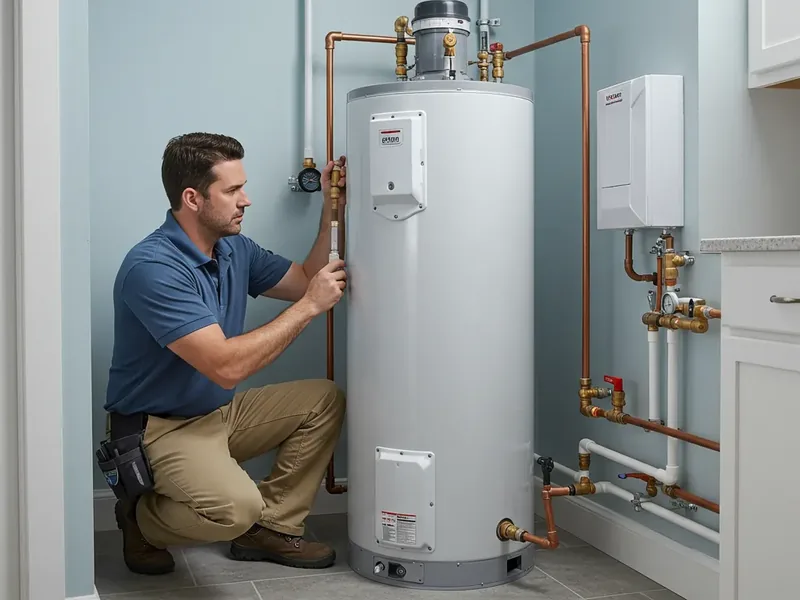
A water heater leak in Arcadia, IN 46030 rarely announces itself politely. It shows up as a damp ring around the base of the tank in the basement, a hissing T&P valve discharge pipe on the side of the house, or a slow seep from a corroded fitting that has been quietly soaking a crawl space for weeks. Arcadia is a small railroad-era town in northern Hamilton County where the housing stock runs older — farmhouses, bungalows, and modest mid-century homes built from the early 1900s through the 1960s — and many of those homes still run the original-style tank water heaters their plumbing was designed around. When a tank gives out here, hard groundwater and decades of sediment usually have something to do with it. Water Heater Leak Repair Co. handles leak diagnosis and repair for homes throughout the 46030 ZIP, from the older blocks near the center of town to the rural-suburban properties along the SR-19 and SR-32 corridors.
Arcadia's Older Homes and What Makes Water Heaters Leak Here
Arcadia's character is defined by its age. Much of the town grew up around the railroad in the early 1900s, and the housing reflects it: balloon-framed farmhouses, one-and-a-half-story bungalows, and brick ranch homes from the postwar decades. Those houses were built when water heaters were expected to sit in a basement corner or a crawl space and be replaced every decade or so — and many local tanks are older than that expectation. Steel tanks corrode from the inside out, and the corrosion accelerates wherever sediment is allowed to bake onto the tank bottom year after year.
Then there is the water itself. Central Indiana sits on limestone and dolomite bedrock laid down when shallow seas covered the region, and the groundwater in Hamilton County is famously hard — a USGS regional estimate puts it around 19 grains per gallon, firmly in the 'very hard' range. Every gallon that enters an Arcadia water heater carries dissolved calcium and magnesium. On a gas heater, that mineral load settles on the tank floor and acts like insulation between the burner flame and the water, which forces longer burn cycles and superheats the steel at the bottom. On an electric heater, scale coats the lower element until it overheats and fails. Either way, the mineral load shortens tank life, eats anode rods faster, and makes flush-and-maintain service far more important here than in soft-water regions.
Arcadia's rural-suburban mix adds another wrinkle. Homes inside town generally run on the municipal system, but properties on the outskirts — along county roads toward Sheridan, Cicero, and the farmland between — often rely on private wells. Well water in this part of Hamilton County can carry iron alongside the hardness, which shows up as rusty staining in tubs and toilets and as accelerated corrosion inside the tank. A well-fed water heater with an exhausted anode rod will start showing rust-colored water at the tap long before the tank body actually fails, and that discolored water is one of the most reliable early warnings of a coming leak.
Finally, there is the matter of where heaters live. Basements are common in Arcadia's older homes, and so are crawl spaces in the ranch homes and farmhouses that were built slab-on-grade or raised just a foot or two. A leaking tank in a full basement is annoying; a leaking tank in a crawl space can go unnoticed for months while moisture feeds mold in the floor framing and rusts the heater's own burner assembly from below. We see both layouts constantly in 46030, and the repair approach changes with the setting — access, drainage, and freeze exposure all factor into the call.
How Water Heater Leak Repair Works in Arcadia, IN 46030
When you call (833) 713-2101 from anywhere in the 46030 ZIP, the visit follows a straightforward sequence. First, we ask where the water is appearing — under the tank, at the top fittings, from the discharge pipe on the side of the house, or at a nearby valve. That one detail tells us whether we are likely chasing a failed tank body, a pressure problem, or a fitting that can be repaired in place. We will also ask whether the unit is gas or electric and roughly how old it is, because a twelve-year-old tank with rust streaks down its side is a different conversation than a four-year-old tank with a weeping drain valve.
Before we arrive, we talk you through the immediate shutoff steps: closing the cold-water supply valve above the heater, and — if you are comfortable — switching the breaker off for an electric unit or turning the gas control to pilot or off for a gas unit. If water is actively pooling, we will suggest threading a garden hose onto the drain valve and running it to a floor drain or sump pit to keep the area from flooding further. These steps take five minutes and they are the difference between a contained nuisance and a ruined finished basement.
On site, the diagnosis starts with reading the tank. We check the base seam and the bottom head for rust-through, which is the classic end-of-life failure: once the steel itself is perforated, no repair holds, and replacement is the honest recommendation. Then we check everything that is repairable without replacing the tank: the drain valve, the temperature-and-pressure relief valve, the inlet and outlet nipples on top, the dielectric unions, the expansion tank if one is installed, and the supply shutoff valve itself. A surprising share of 'leaking water heater' calls in Arcadia turn out to be a failed thirty-dollar valve or a corroded nipple on an otherwise healthy tank — and those are same-visit fixes.
If the tank has failed, we walk through replacement options sized to the household: recovery rate and first-hour rating for gas units, wattage and element configuration for electrics, and whether the home's plumbing would benefit from an expansion tank or a new shutoff valve while the system is already opened up. After any repair or replacement, the system is refilled, purged of air, brought up to temperature, and checked at every connection under pressure before we leave. You get hot water back the same visit, and a clear explanation of what failed and why.
The Leak Sources We See Most in Arcadia Homes
Certain failure patterns repeat across northern Hamilton County, and Arcadia is no exception. The single most common is the rusted tank base. Sediment settles, the burner or element superheats the layer, the glass lining cracks at stress points, and the steel starts to go. The first sign is often a faint rust-colored ring on the concrete around the tank, or water that only appears after a long hot shower when the tank has fully reheated and expanded. By the time the ring is visible, the corrosion is usually advanced.
Second is the T&P relief valve discharge. The temperature-and-pressure valve is a safety device: it opens to dump water when the tank overheats or when pressure climbs too high. In homes with a pressure-reducing valve on the main line — common where municipal pressure runs high — the plumbing becomes a closed system, and heated water has nowhere to expand. Pressure spikes, the T&P weeps or blows, and the homeowner finds the discharge pipe dripping outside the house. The fix is not to cap the valve (never do that) but to address the expansion: a properly charged expansion tank on the cold line, or a failing PRV that needs attention. We see this pattern in Arcadia's homes on the town system whenever pressure runs toward the high end of the range.
Third is fitting corrosion at the top of the tank. Where copper supply lines meet steel tank nipples, galvanic corrosion attacks the joint unless dielectric unions or brass fittings separate the metals. Many of Arcadia's older installs were made before dielectric fittings were standard practice, and after twenty or thirty years the nipples can be paper-thin. The leak starts as a slow green-white crust of mineral deposit around the joint and graduates to an active drip. This is a repairable failure — cut back to sound pipe, install proper dielectric unions, and the tank keeps serving.
Fourth, especially in crawl-space installs: condensation mistaken for a leak, and actual leaks hidden by condensation. In a humid Indiana summer, cold water entering a tank in a damp crawl space sweats heavily, and that sweat can pool under the unit and look exactly like a tank failure. Part of the diagnostic visit is telling the difference — a true leak leaves rust trails and mineral deposits; condensation leaves clean water with no staining. We would rather tell you it is condensation and save you a replacement than sell you a tank you do not need.
Hard Water in Hamilton County: What It Does to Your Water Heater
It is worth understanding exactly what roughly 19 grains per gallon of hardness does inside a water heater, because it explains so many Arcadia failures. Dissolved calcium and magnesium precipitate out of water as it is heated — the hotter the surface, the faster the scale forms. In a gas heater, the hottest surface is the bottom of the tank directly above the burner, so scale builds exactly where it does the most damage. The tank starts popping and rumbling as water trapped under the sediment layer flashes to steam, efficiency drops because heat must travel through the mineral blanket, and the steel at the bottom cycles through wider temperature swings that crack the glass lining.
In an electric heater, scale forms on the elements themselves. A scaled element cannot shed heat into the water efficiently, so it runs hotter than designed, and eventually the element burns out or the thermostat above it starts short-cycling. Homeowners in 46030 who go through lower elements every couple of years are usually looking at a hardness problem, not a heater-brand problem.
The practical defenses are unglamorous but effective. Annual flushing drains the sediment before it compacts into a solid layer — on very hard water, twice a year is better. The anode rod, a sacrificial magnesium or aluminum rod inside the tank, should be inspected every few years and replaced when it is down to a thin wire; in Arcadia's water it depletes noticeably faster than the national average. And a whole-house water softener, properly sized and maintained, removes the minerals before they ever reach the heater — which is why homes with working softeners in this ZIP routinely get several extra years out of a tank. During a repair visit we can read the sediment load and the anode condition and tell you honestly where your heater stands.
What to Do Right Now If Your Water Heater Is Leaking in Arcadia
If you are standing in water right now, do these things in order. First, close the cold-water supply valve on the pipe entering the top of the heater — usually a gate or ball valve within a few feet of the tank. That stops new water from feeding the leak. Second, kill the heat source: flip the dedicated breaker for an electric heater, or turn the gas control knob to the off or pilot position for a gas heater. A heating element or burner firing in a partially drained tank will destroy itself quickly. Third, if water is spreading, thread a garden hose onto the drain valve near the bottom of the tank and run the other end to a floor drain, sump pit, or outside — then open the valve to relieve the tank. Fourth, do not keep lifting the T&P relief valve lever to 'test' it while the tank is leaking; if the valve is already compromised it may not reseat. Then call (833) 713-2101 and tell us exactly what you see: where the water is coming from, how fast it is flowing, and whether the tank is gas or electric. That description lets us arrive with the right parts for your 46030 home.
Arcadia, IN 46030 — Area Fact Box
Water Heater Leak Repair Co. serves the full Arcadia area and the surrounding northern Hamilton County countryside. Key local facts:
| Detail | Arcadia, Indiana |
|---|---|
| Verified ZIP code | 46030 |
| County | Hamilton County |
| Housing type and era | Railroad-era farmhouses and bungalows (early–mid 1900s), postwar ranch homes; rural-suburban mix |
| Key routes and landmarks | SR-19 and SR-32 corridors; small historic town center; farmland and county roads toward Sheridan and Cicero |
| Water conditions | Very hard groundwater (~19 grains per gallon regional estimate from limestone aquifers); town system plus private wells on outskirts, some with iron |
| Typical heater setup | Basement and crawl-space tank installs; older galvanized supply plumbing common in vintage homes |
Water Heater Leak Repair FAQs for Arcadia, IN 46030
How do I tell if the leak is the tank itself or just a valve?
Look at where the water originates. Water seeping from under the tank body, rust streaks running down the jacket, or a rusty ring on the floor around the base points to tank failure — the steel has perforated and the unit needs replacement. Water dripping from the drain valve at the bottom, the T&P discharge pipe, or the pipe joints on top usually means a component failure that can be repaired. If you are unsure, describe it when you call (833) 713-2101 and we will diagnose it on site before recommending anything.
My water heater is in a crawl space. Does that change the repair?
It changes the logistics. Crawl-space heaters in Arcadia's ranch homes and farmhouses are harder to access, harder to drain without flooding the space, and more exposed to freezing in winter. We bring the right pumps and hoses for low-clearance work, and we will talk with you about whether the location itself is contributing to the failure — for example, chronic dampness corroding the burner assembly from below. Sometimes relocating the replacement to a better spot pays for itself.
Does Arcadia's hard water really shorten water heater life?
Yes, measurably. At roughly 19 grains per gallon, Hamilton County water is among the harder supplies in the state. The minerals settle as sediment, insulate the tank bottom from the burner, overheat elements, and eat anode rods faster than average. Regular flushing and anode checks are not optional extras here — they are the difference between a tank that lasts eight years and one that lasts twelve or more.
Should I shut off the gas or breaker before you arrive?
If you can do it safely, yes. Flip the dedicated breaker for an electric heater; for gas, turn the control knob to pilot or off. Also close the cold-water supply valve above the heater. These two steps stop the damage from growing while you wait. If anything about the shutoff feels unsafe — a corroded valve that will not turn, a gas smell — leave it alone and tell us when you call.
My home outside town is on a well. Does that matter?
It matters for diagnosis and for prevention. Well water around Arcadia often carries iron along with the hardness, which accelerates internal corrosion and stains fixtures. If your tank is fed by a well, we will check the anode rod and sediment load with that in mind, and we can advise on softener settings or pre-filtration that will protect the replacement. Bring any recent water test results to the visit if you have them.
How quickly can you reach a home in the 46030 ZIP?
We run service across northern Hamilton County daily, including the SR-19 and SR-32 corridors through Arcadia and the surrounding township roads. When you call (833) 713-2101, tell us whether water is actively flowing — active leaks get priority scheduling. Either way, the goal is same-day diagnosis so you are not waiting days without hot water.
Whether your Arcadia home has a weeping valve on a young tank or a rusted-out unit in a century-old farmhouse basement, the next step is the same: call (833) 713-2101. Describe where the water is coming from, and we will take it from there — diagnosis first, honest recommendation second, and hot water restored to your 46030 home as fast as the repair allows.