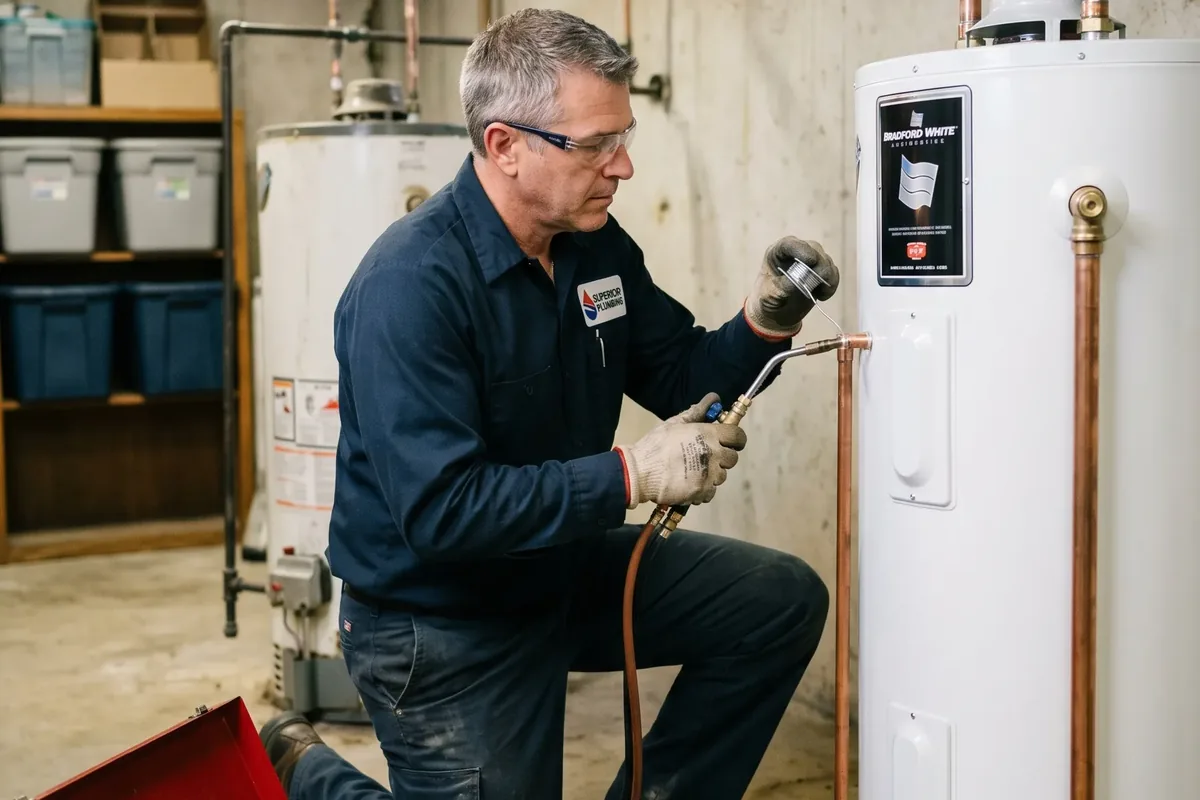
Every water heater reaches the end of its service life. When a tank starts leaking from the shell itself — not a fitting, valve, or connection — no repair will hold, and the only fix is replacement. Knowing when to replace versus repair saves you from pouring money into a dying tank, and choosing the right replacement for your Westfield home means reliable hot water for the next decade or more.
Signs Your Water Heater Needs Replacing
- Leak from the tank itself: Water seeping from the tank shell, seams, or base means the inner tank has failed. This cannot be repaired — replacement is the only option.
- Rusty or discolored hot water: Rust-colored water from hot taps only means the inside of the tank is corroding. The anode rod is spent and the tank is next.
- Age past 10–12 years: Check the rating plate for the manufacture date. A tank past its expected life is living on borrowed time.
- Rumbling or popping sounds: Hardened sediment at the tank bottom causes overheating and noise — and accelerates tank failure.
- Frequent repairs: Replacing thermostats, elements, and valves on an aging tank adds up fast. At some point, a new tank costs less than another year of repairs.
- Rising energy bills: Scale-insulated tanks work harder to heat water. A new, efficient tank lowers operating costs.
Repair vs. Replace: How We Decide
- Repair it: The tank is under 8 years old, the shell is sound, and the problem is a component — thermostat, element, TPR valve, drain valve, or fitting.
- Replace it: The tank shell leaks, the tank is over 10–12 years old with rusty water, or repair costs are approaching half the cost of a new unit.
- Consider upgrading: If your household has outgrown the tank's capacity, or you want the space savings and efficiency of a tankless unit, replacement is the moment to switch.
We give you an honest assessment based on your tank's age, condition, and the actual source of the problem — never a sales pitch.
Our Water Heater Replacement Process
Step 1: Assessment and sizing
We inspect your current unit, confirm the tank itself has failed or is at end of life, and size the replacement to your household — tank capacity or tankless flow rate matched to your bathrooms, appliances, and usage patterns.
Step 2: Safe removal of the old unit
Power or gas is shut off, water is drained from the tank, and all connections are disconnected. The old tank is removed from your home and hauled away.
Step 3: Site preparation
We install a new drain pan with a proper drain line, check the shutoff valves and supply lines, and verify venting (gas) or electrical capacity (electric) for the new unit.
Step 4: Install the new water heater
The new unit is set, leveled, and connected — water lines, gas line or electrical, venting, TPR valve with proper discharge piping, and expansion tank where required.
Step 5: Fill, start, test, and clean up
We fill the tank, purge air from the lines, restore power or gas, bring the unit to temperature, and test every connection for leaks. The work area is left clean, and we walk you through the new unit's operation and maintenance.
Equipment and Materials We Use
- Replacement tanks and tankless units: sized to your home's hot water demand, from standard tank models to high-efficiency and tankless options.
- New drain pans with drain lines: installed under every replacement so the new tank is protected from day one.
- Dielectric unions and new supply connectors: to prevent galvanic corrosion between dissimilar metals at the tank connections.
- Expansion tanks: installed or replaced where thermal expansion needs somewhere to go.
- Gas line and venting components: properly sized for the new unit's BTU input on gas installations.
- Haul-away equipment: the old tank leaves with us — you never deal with disposal.
Safety and Precautions
A leaking tank can fail suddenly — if water is pooling at the tank base and the tank is old, do not wait for it to get worse. Shut off the water supply to the heater and the power or gas, and call us at (833) 713-2101. Never try to patch or seal a leaking tank shell with epoxy or sealant; these hold briefly at best and mask a failure that can release the full tank. During replacement, we handle the heavy lifting — a full 40- or 50-gallon tank weighs hundreds of pounds, and moving one without equipment risks serious injury and property damage.
Westfield and Hamilton County Factors
Hard water: Westfield's mineral-rich water is the main reason local tanks die on schedule. Scale builds on the tank bottom and elements, causing overheating, noise, and premature tank failure — many Westfield tanks fail closer to 8–10 years than the 12-year rating. With a new tank, we recommend a maintenance plan that includes periodic flushing to protect your investment.
Housing stock: Westfield's 1990s–2000s subdivisions are hitting the wave of original water heaters failing all at once. If your neighbors are replacing tanks, yours is likely on the same timeline — check your manufacture date. Newer homes with finished basements need the replacement done cleanly, with full floor protection and a new pan, which is standard in our process.
Freeze cycles and placement: Tanks in Hamilton County garages face freeze risk during winter outages. When replacing a garage-installed unit, we discuss insulation, placement, and freeze protection so the new tank does not suffer the same fate as the old one.