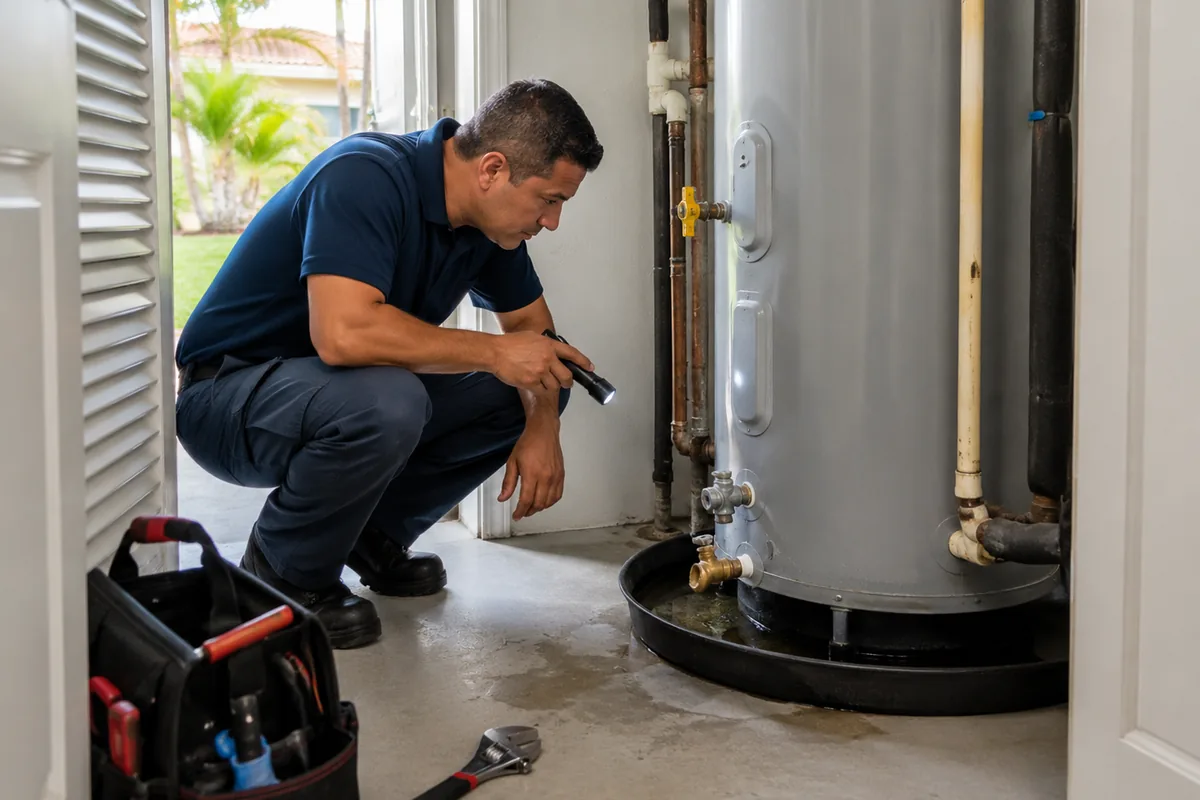
Signs You Have a Water Heater Emergency
Not every water heater problem is an emergency, but some demand immediate action. Active, spreading water is the clearest signal — a pool growing across a basement or utility room floor, water running from under the tank jacket, or a burst supply line spraying. A tank that has split or ruptured can release its full contents, and the cold-water inlet will keep refilling it until someone shuts the valve, so the flooding does not stop on its own.
Any smell of gas near a gas water heater is an emergency regardless of water. So is steam or scalding water spraying from the unit, which indicates dangerous pressure or temperature conditions. No hot water during a hard freeze can also be urgent: a frozen supply line may have burst inside a wall or attic, and the resulting leak sometimes appears far from the heater itself.
Less dramatic but still pressing: a temperature-pressure relief valve discharging continuously, or water dripping through a ceiling below an upstairs laundry or utility area. When in doubt, treat it as urgent — water damage compounds by the hour.
Common Emergency Causes in Westfield
The emergencies we see in Westfield follow patterns tied to local conditions. Corroded tank bottoms are the most frequent: years of hard-water sediment plus a long-depleted anode rod eat through the steel floor of the tank, and the failure often announces itself as a sudden large leak rather than a gradual weep. Many of the 1990s and 2000s-era heaters in Westfield subdivisions are reaching this stage now.
Freeze-related bursts are the winter pattern. Supply lines running through garages, crawl spaces, or exterior walls can freeze during Westfield's cold snaps; the expanding ice splits copper or PEX, and the leak appears when things thaw. Heaters themselves rarely freeze, but their piping does.
Other causes include failed temperature-pressure relief valves that stick open or discharge under excessive pressure, thermal expansion damage in homes with pressure-reducing valves and no expansion tank — common in newer Westfield subdivisions on municipal water — and supply connection failures where dielectric unions or flex connectors have corroded through.
Our Emergency Response Process
When you call with an active leak, we start helping before we arrive:
- Step 1 — Phone triage and shutoff guidance. We walk you through closing the cold-water inlet valve above the heater and shutting off power at the breaker or turning the gas control to off. If you smell gas, we tell you to leave the house and call the gas utility first.
- Step 2 — On-site assessment. We locate the exact source: supply connection, drain valve, relief valve, or tank body. Knowing the source determines everything that follows.
- Step 3 — Containment. We stop the active water — closing valves, capping lines — and direct remaining drainage where it can do no further harm.
- Step 4 — Repair or stabilize. Failed fittings, valves, and connections are repaired on the spot. If the tank body itself has failed, it cannot be patched; we make the unit safe, cap the lines, and explain your replacement options plainly.
- Step 5 — Testing and next steps. We pressure-test our repairs, verify the relief valve, and walk you through what to watch for — including checking areas where water may have traveled, like wall cavities and flooring.
Equipment and Materials We Bring
Emergency calls get a fully stocked response: brass ball valves, dielectric unions, flex connectors, temperature-pressure relief valves, copper and PEX repair fittings, pipe thread sealants rated for potable hot water, and drain pans. We carry parts for both gas and electric units across the common residential sizes, because an emergency visit that ends with a return trip for parts is a failure.
We also bring the diagnostic gear that matters under pressure: moisture tracing to find a leak's true origin when water has traveled, gas leak detection solution for any gas connection we touch, and electrical testers to confirm a wet electric unit is safe to work around before hands go near it.
Safety and Precautions
Water heater emergencies combine three hazards — scalding water, gas, and electricity — so our safety sequence is strict. If you smell gas, do not touch any switches or the heater itself: leave the building and call your gas utility from outside, then call us. Around a leaking electric heater, we verify power is off and test before touching anything, because water and 240 volts are a dangerous combination.
Scalding is the most underestimated risk: a ruptured tank releases water that can be 130 degrees or hotter. Keep children and pets clear of the area. We also never plug, cap, or restrict a discharging temperature-pressure relief valve — it is relieving dangerous pressure, and blocking it can turn a leak into an explosion risk. Finally, standing water near the heater's base can hide electrical hazards and structural damage to flooring; we assess the area before working in it.
Local Factors: Westfield Homes and Winter
Westfield's housing stock shapes its emergencies. The subdivisions that grew the town from the 1990s onward are full of original tank heaters now entering the failure window for corroded tank bottoms — hard water and original anode rods long depleted make this the leading local cause of sudden tank failure. If your heater is 12 to 15 years old and has never had its anode rod serviced, it is living on borrowed time.
Winter is the other local driver. Westfield's freeze-thaw cycles punish water lines in garages, crawl spaces, and exterior walls, and many local homes route the heater's supply piping through exactly those spaces. An unheated garage install also means the cold-water inlet and relief discharge piping see wider temperature swings, stressing joints over the years.
Basements — common in Westfield homes — are a mixed blessing in an emergency: they contain the water to one level, but they also hide slow leaks behind finished walls and storage for months before anyone notices. A finished basement with a 15-year-old heater deserves proactive attention before it becomes an emergency call.