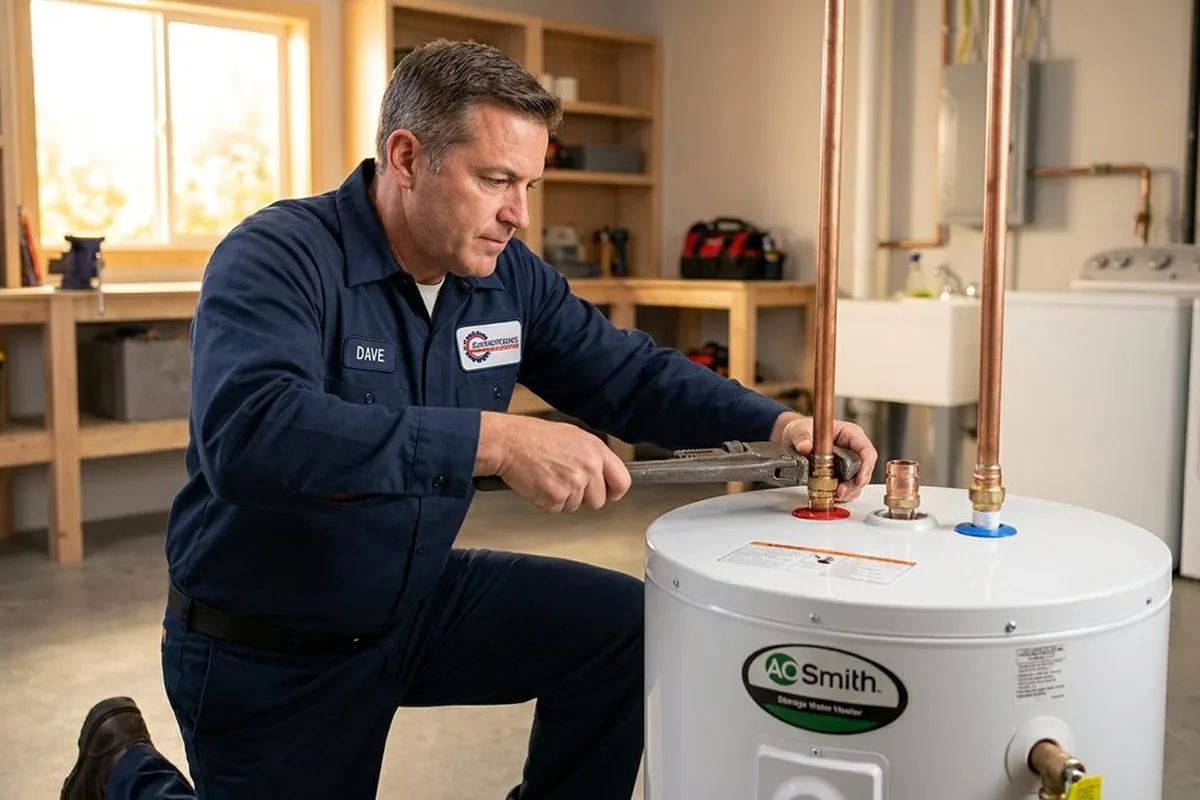
Where Tank Leaks Actually Come From
When a homeowner sees water around a water heater, the assumption is usually that the tank is leaking — but the tank body is only one of several possible sources, and most of the others are repairable. Supply connections at the top of the heater (hot outlet and cold inlet) are the most common culprits: dielectric unions and flex connectors corrode over years of condensation and minor seepage until they drip steadily. The drain valve at the tank bottom is next — its washer hardens or sediment jams the seat, producing a constant weep.
The temperature-pressure relief valve and its discharge pipe account for another share: a relief valve doing its job under excessive pressure, or one whose seat has failed with age, will run water down the discharge pipe to the floor. True tank body leaks — pinholes through the steel shell, usually at the bottom — are the serious ones: they cannot be patched or sealed, because the corrosion is structural and pressure will defeat any patch.
One impostor deserves mention: condensation. A cold tank filling with cold water in a humid basement can sweat enough to leave puddles that look exactly like a leak. We distinguish the two by drying the area and watching where water reappears — condensation forms broadly on the cold tank surface, while a real leak traces to a fitting, valve, or seam.
Common Causes in Westfield Homes
Westfield's hard water drives the dominant failure mode: mineral sediment blankets the tank bottom, a depleted anode rod leaves the steel unprotected, and corrosion eats pinholes through the floor of the tank. This is a slow process — years in the making — which is why it strikes the 1990s and 2000s-era heaters that fill Westfield's established subdivisions right about now.
Thermal expansion is the second local driver. Many newer Westfield neighborhoods are on municipal water with pressure-reducing valves at the meter, creating a closed system: when heated water expands with nowhere to go, pressure spikes stress every joint, valve seat, and the tank itself. Homes without an expansion tank feel this as weeping relief valves and prematurely failing connections.
Freeze-thaw cycles contribute through the piping rather than the tank: supply lines in garages, crawl spaces, and exterior walls split during cold snaps, and the resulting leak is sometimes mistaken for a heater failure. Age finishes the picture — flex connectors, dielectric unions, and valve washers all have finite lives, and on a 15-year-old heater they tend to fail in clusters.
Our Step-by-Step Repair Process
- Step 1 — Trace the source. We dry the heater and surrounding area completely, then watch where water reappears. This single step prevents the most common misdiagnosis in the trade: replacing a heater for a leaking fitting.
- Step 2 — Classify the leak. Fitting, valve, or connection leak: repairable. Tank body pinhole or seam seep: not repairable — the honest answer is replacement, and we say so plainly.
- Step 3 — Shut down safely. We close the cold-water inlet, switch off the breaker or set the gas control off, and relieve pressure before opening anything.
- Step 4 — Repair. Depending on the source: tightening or replacing supply fittings and dielectric unions, replacing the drain valve with a full-port brass unit, replacing a failed relief valve, or resealing threaded connections with proper sealants.
- Step 5 — Pressure-test and monitor. We restore water pressure, check every repaired joint dry, cycle the system through a heating run, and confirm the relief valve seats properly.
- Step 6 — Advise on what is next. If the tank is aging but the leak was repairable, we tell you what to watch for and what maintenance — anode rod check, flushing — will buy you the most remaining life.
Equipment and Materials We Use
Leak repair is fitting-and-valve work, and we arrive stocked for it: dielectric unions to rejoin dissimilar metals without galvanic corrosion, braided and corrugated flex connectors, full-port brass drain valves, temperature-pressure relief valves matched to the tank's ratings, and copper, CPVC, and PEX repair fittings for damaged supply piping. Threaded joints get Teflon tape plus pipe thread sealant rated for potable hot water — the combination that actually holds under thermal cycling.
We also carry drain pans and pipe for directing relief discharge safely, moisture-tracing tools for finding a leak's true origin when water has traveled along framing or flooring, and replacement insulation and access covers so the heater is left as we found it, only drier.
Safety and Precautions
Two safety rules govern this work absolutely. First: never plug, cap, or restrict a leaking temperature-pressure relief valve or its discharge pipe. The valve opens because pressure or temperature exceeded safe limits; blocking it converts a leak into an explosion hazard. If your relief valve is discharging, that is the system telling you something is wrong — listen to it and call.
Second: scalding and pressure. A leaking tank holds water hot enough to cause serious burns and under enough pressure to spray. We depressurize before opening fittings, route discharge away from people, and keep the work area clear. On electric units we verify power is off at the breaker before working around a wet heater; on gas units we manage the burner and pilot through the repair sequence.
And the honesty rule: a tank body leak means replacement, full stop. Any product claiming to seal a pressurized steel tank from the inside is selling false confidence — pressure cycling will defeat it, usually at the worst moment.
Local Factors: Westfield Water, Pressure, and Housing Age
Three local factors converge on Westfield tank heaters. First, the limestone-aquifer hard water that defines Hamilton County plumbing: heavy sediment plus original anode rods long depleted is the recipe for tank-bottom pinholes, and it is why so many local heaters fail at the base rather than at fittings.
Second, closed-system pressure. Westfield's newer subdivisions commonly have pressure-reducing valves on the municipal supply, and many of those homes were built without thermal expansion tanks. The resulting pressure spikes show up as relief valves that weep, drip, or discharge — symptoms homeowners often misread as a leaking water heater when the real fix is pressure management plus the valve service.
Third, housing age. The 1990s-through-2000s subdivisions that make up much of Westfield are exactly the vintage where original tank heaters reach end of life. If your heater is 12-plus years old, has never been flushed, and the anode rod was never serviced, a leak is not bad luck — it is the expected outcome, and the service visit should include a candid conversation about remaining life versus replacement planning.