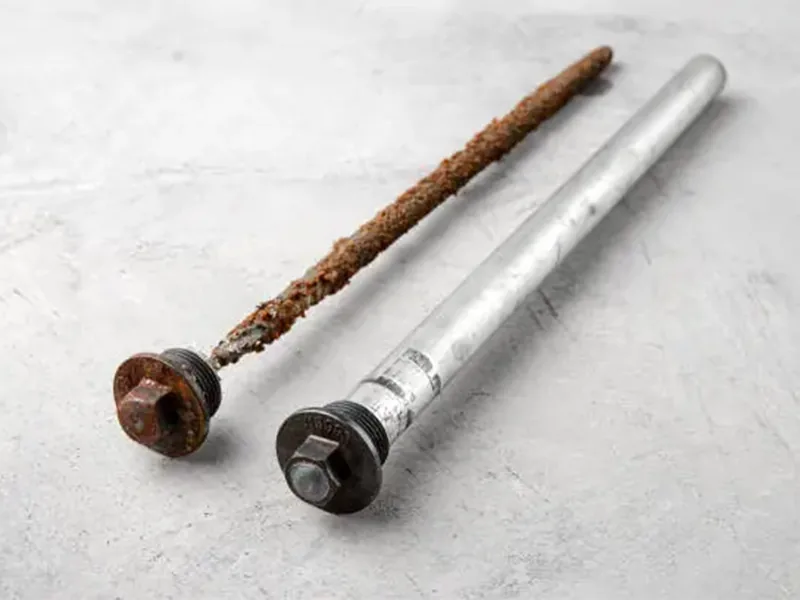
Anode rod replacement in Atlanta, IN 46031 is the single most cost-effective way to add years to a tank water heater that is otherwise healthy. The anode rod is a sacrificial metal rod, usually magnesium or an aluminum-zinc alloy, threaded into the top of the tank. It corrodes on purpose so the steel tank does not. In Atlanta, local water conditions decide how fast that sacrifice happens. Outside the town core, most Atlanta homes run on private wells pulling very hard, often 15 to 25 grains per gallon water, often with dissolved iron. That chemistry eats sacrificial anode rods fast, which is exactly why rod replacement is one of the highest-value services we perform in this ZIP code.
Atlanta is a tiny agricultural town in northern Hamilton County, the kind of place where the grain elevator is still a landmark. Housing is a mix of older frame homes and farmhouses, many of them built long before modern plumbing codes. Atlanta's housing stock skews old, with many homes from the 1900s through the 1960s. Original cast-iron-era plumbing, small utility rooms, and tanks that have been replaced piecemeal over the decades are the norm, and a lot of heaters are operating well past their expected service life.
IN SHORT
Anode rod replacement in Atlanta, IN 46031 swaps the sacrificial rod protecting your tank from rust, where iron-bearing well water can eat a rod in two to three years. Call (833) 713-2101 and we ask your tank's age, water source, and any sulfur smell, then schedule a same-day visit to inspect and replace the rod.
How Anode Rod Replacement Works in Atlanta, IN 46031
Every glass-lined steel tank has a weak point by design: the steel itself. The glass lining never covers one hundred percent of the interior, and at every microscopic gap the anode rod steps in. Through galvanic corrosion, the rod, made of a more reactive metal than steel, draws corrosive attack to itself. In Atlanta, where the water is very hard, often 15 to 25 grains per gallon, that electrochemical sacrifice runs at a faster pace than the national average the tank's warranty was written around. A rod rated for six years in soft water may be fully consumed in three here.
Well water adds two more enemies. Dissolved iron accelerates pitting wherever the rod is already thin, and iron-reducing bacteria can colonize a depleted magnesium rod and produce the rotten-egg sulfur smell many Atlanta homeowners notice first in the hot water only. When we pull a rod from a well-water tank in the 46031 area and find it coated in slime or eaten to a bare wire, we usually recommend switching to an aluminum-zinc alloy rod, which resists the bacteria that cause the odor while still protecting the tank. We also check whether the home has any treatment equipment, because a failing softener or iron filter changes what the inside of the tank looks like.
Atlanta's older housing stock shapes the job in a second way: tank age. Atlanta's housing stock skews old, with many homes from the 1900s through the 1960s. Many of the tanks we service in 46031 are eight to fifteen years old, which is exactly the window where a fresh rod still pays off. On a tank that age with no seam leaks and solid fittings, a new rod plus a flush can realistically add three to five years of service. Past about twelve years we inspect more skeptically, checking the base seam and the T and P valve area for weeping, because no rod can save a tank whose steel is already failing.
Access in Atlanta is its own consideration. Water heaters typically live in basements of the older farmhouses or in cramped utility closets in the smaller frame homes. Many rural addresses use propane instead of natural gas, and well pressure tanks sometimes share the same utility space, which affects how much room a technician has to work. A standard rigid rod needs roughly the tank's height in clearance above the heater to slide out and the new one to slide in. Where headroom is tight, and we see this often in 46031, we install segmented flexible rods that feed in link by link and perform identically once seated.
What the service visit includes
- Shutoff and depressurization: cold-water inlet closed, power or gas secured, tank pressure relieved through a hot tap.
- Rod extraction: the hex head is broken loose, sometimes with an impact wrench on older Atlanta tanks where years of heat cycling have seized the threads, and the old rod is pulled for inspection.
- Condition reading: we measure remaining diameter and check for calcium armor, bare-wire sections, or bacterial slime, which tells us how the local water treated it and what alloy to install next.
- New rod installation: magnesium for standard municipal water, aluminum-zinc alloy where sulfur odor or iron bacteria are factors, segmented flexible rods where Atlanta homes lack overhead clearance.
- Refill and check: tank refilled, air purged from lines, T and P valve tested, and the area around the base inspected for any seepage the visit may have revealed.
Local Factors That Change Anode Rod Service in 46031
Water chemistry first. Private wells dominate outside the town core, pulling from the same limestone formations that make central Indiana water famously hard. Hardness readings of 15 to 25 grains per gallon are common, and iron and manganese show up often enough that orange-stained fixtures are a familiar sight. For anode rods, the takeaway is simple: rods are a consumable here, not a lifetime part. Homeowners in Atlanta who have never had a rod inspected are usually running on whatever is left of the factory rod, which in this water is often not much after year four.
Housing age sets the schedule. Atlanta's housing stock skews old, with many homes from the 1900s through the 1960s. Original cast-iron-era plumbing, small utility rooms, and tanks that have been replaced piecemeal over the decades are the norm, and a lot of heaters are operating well past their expected service life. The practical rule we use in 46031: tanks under eight years old get preventive rod checks, tanks eight to twelve get rod replacement as life extension, and tanks past twelve get an honest assessment of whether the steel is worth protecting anymore.
Placement affects the install. Water heaters typically live in basements of the older farmhouses or in cramped utility closets in the smaller frame homes. Many rural addresses use propane instead of natural gas, and well pressure tanks sometimes share the same utility space, which affects how much room a technician has to work. We carry both rigid and segmented rods on the truck because Atlanta homes regularly present both situations in the same day.
Signs your rod is done in this area
- Rotten-egg smell in hot water only, the classic iron-bacteria plus magnesium-rod signature of well country.
- Hot water runs rusty for a few seconds then clears, meaning the tank interior is starting to sacrifice itself.
- Rumbling or popping from the tank, sediment boiling under the burner or elements, which buries the rod's lower half.
- Tank age past six years with no record of a rod inspection, which describes most tanks we meet in Atlanta.
What Happens When You Call (833) 713-2101
First, we ask three things: how old the tank is, whether the home is on a well or municipal water, and whether there is any sulfur smell or rusty hot water. That tells us which rod alloy to bring and whether to plan a flush at the same visit. On arrival in Atlanta, we shut the tank down safely, extract and read the old rod, install the correct replacement, refill and test. Most visits take under two hours, and you get a straight answer on how many good years the tank has left.