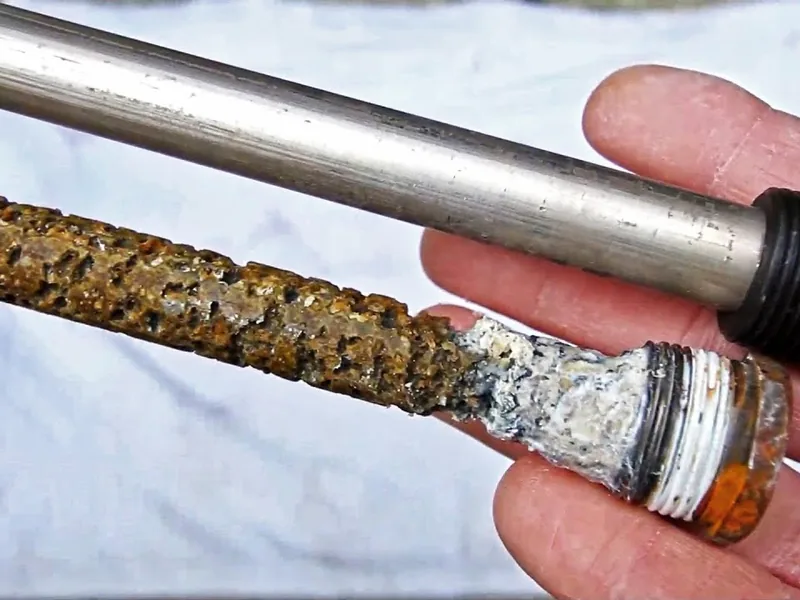
Anode rod replacement in Greenfield, IN 46140 is the single most cost-effective way to add years to a tank water heater that is otherwise healthy. The anode rod is a sacrificial metal rod, usually magnesium or an aluminum-zinc alloy, threaded into the top of the tank. It corrodes on purpose so the steel tank does not. In Greenfield, local water conditions decide how fast that sacrifice happens. Greenfield's municipal water runs very hard, typically 12 to 17 grains per gallon, and because so many homes here run whole-house softeners, anode rods face a double challenge: hard source water plus softened water that is more electrically conductive and consumes the sacrificial metal faster.
Greenfield is the Hancock County seat, a historic town on the National Road with a growing eastern edge as Indianapolis sprawl reaches it. The housing mix runs from Victorian-era homes near downtown to new subdivisions. Downtown Greenfield holds homes from the late 1800s through the 1950s, while the east side has 1990s-to-2020s subdivisions. That split means technicians see everything from century-old basements to modern garage installs within the same ZIP code.
IN SHORT
Anode rod replacement in Greenfield, IN 46140 swaps the sacrificial rod protecting your tank from rust, where hard municipal water and common softeners shorten rod life. Call (833) 713-2101 and we ask your tank's age, water source, and any sulfur smell, then schedule a same-day visit to inspect and replace the rod.
How Anode Rod Replacement Works in Greenfield, IN 46140
Every glass-lined steel tank has a weak point by design: the steel itself. The glass lining never covers one hundred percent of the interior, and at every microscopic gap the anode rod steps in. Through galvanic corrosion, the rod, made of a more reactive metal than steel, draws corrosive attack to itself. In Greenfield, where the water is very hard, typically 12 to 17 grains per gallon, that electrochemical sacrifice runs at a faster pace than the national average the tank's warranty was written around. A rod rated for six years in soft water may be fully consumed in three here.
Softeners complicate the picture in Greenfield. Ion-exchange softening swaps calcium and magnesium for sodium, which does not make water corrosive in the plumbing sense, but it does raise conductivity, and higher conductivity means the galvanic current between rod and tank runs stronger. The practical result we see across 46140: softened homes go through anode rods noticeably faster than identical homes on unsoftened water. That does not mean the softener is a mistake, it means the inspection interval should be shorter. We typically advise Greenfield homeowners with softeners to have the rod checked every two to three years instead of the four-to-five-year rhythm that works in soft-water regions.
Greenfield has two distinct tank populations, and each needs a different approach. Downtown Greenfield holds homes from the late 1800s through the 1950s, while the east side has 1990s-to-2020s subdivisions. In the older homes we treat rod replacement as life extension for tanks in the eight-to-fifteen-year range, inspecting seams carefully before committing. In the newer subdivisions we treat it as preventive maintenance, catching the original rod at year three or four before the tank ever starts sacrificing its own steel. The water is equally hard in both halves of town; only the strategy differs.
Access in Greenfield is its own consideration. Heater locations follow the era: stone basements downtown, standard basements or utility rooms in mid-century homes, and garages or basement utility rooms in the new subdivisions. Narrow basement stairs in the oldest homes can make tank access the hardest part of any job. A standard rigid rod needs roughly the tank's height in clearance above the heater to slide out and the new one to slide in. Where headroom is tight, and we see this often in 46140, we install segmented flexible rods that feed in link by link and perform identically once seated.
What the service visit includes
- Shutoff and depressurization: cold-water inlet closed, power or gas secured, tank pressure relieved through a hot tap.
- Rod extraction: the hex head is broken loose, sometimes with an impact wrench on older Greenfield tanks where years of heat cycling have seized the threads, and the old rod is pulled for inspection.
- Condition reading: we measure remaining diameter and check for calcium armor, bare-wire sections, or bacterial slime, which tells us how the local water treated it and what alloy to install next.
- New rod installation: magnesium for standard municipal water, aluminum-zinc alloy where sulfur odor or iron bacteria are factors, segmented flexible rods where Greenfield homes lack overhead clearance.
- Refill and check: tank refilled, air purged from lines, T and P valve tested, and the area around the base inspected for any seepage the visit may have revealed.
Local Factors That Change Anode Rod Service in 46140
Water chemistry first. Municipal water serves Greenfield and is very hard, roughly 12 to 16 grains per gallon. Older downtown homes may still have galvanized or even lead-era supply quirks, while newer subdivisions commonly run softeners that change tank chemistry. For anode rods, the takeaway is simple: rods are a consumable here, not a lifetime part. Homeowners in Greenfield who have never had a rod inspected are usually running on whatever is left of the factory rod, which in this water is often not much after year four.
Housing age sets the schedule. Downtown Greenfield holds homes from the late 1800s through the 1950s, while the east side has 1990s-to-2020s subdivisions. That split means technicians see everything from century-old basements to modern garage installs within the same ZIP code. The practical rule we use in 46140: tanks under eight years old get preventive rod checks, tanks eight to twelve get rod replacement as life extension, and tanks past twelve get an honest assessment of whether the steel is worth protecting anymore.
Placement affects the install. Heater locations follow the era: stone basements downtown, standard basements or utility rooms in mid-century homes, and garages or basement utility rooms in the new subdivisions. Narrow basement stairs in the oldest homes can make tank access the hardest part of any job. We carry both rigid and segmented rods on the truck because Greenfield homes regularly present both situations in the same day.
Signs your rod is done in this area
- Hot water runs rusty for a few seconds then clears, meaning the tank interior is starting to sacrifice itself.
- A softener in the home and a tank past year three without a rod check, the fastest-wear combination we see.
- Rumbling or popping from the tank, sediment boiling under the burner or elements, which buries the rod's lower half.
- Tank age past six years with no record of a rod inspection, which describes most tanks we meet in Greenfield.
What Happens When You Call (833) 713-2101
First, we ask three things: how old the tank is, whether the home is on a well or municipal water, and whether there is any sulfur smell or rusty hot water. That tells us which rod alloy to bring and whether to plan a flush at the same visit. On arrival in Greenfield, we shut the tank down safely, extract and read the old rod, install the correct replacement, refill and test. Most visits take under two hours, and you get a straight answer on how many good years the tank has left.