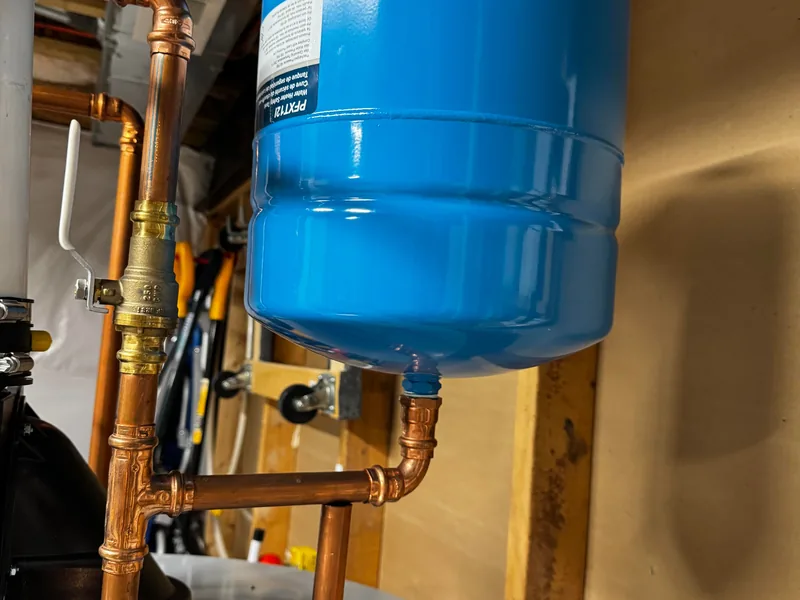
That small tank mounted above or beside your water heater is easy to overlook, but it plays an outsized role in protecting your plumbing. The expansion tank absorbs the pressure spikes that happen every time water heats and expands. Without one — or with a failed one — that extra pressure hammers your pipes, drips from your temperature-and-pressure relief valve, and shortens the life of the water heater itself. Here is what Westfield homeowners should know.
Why Expansion Tanks Exist
Water expands when heated, and in a modern plumbing system it has nowhere to go. Most Westfield homes have a pressure-reducing valve or check valve on the main line, which creates a “closed” system: water can enter, but expanded water cannot push back out into the city main. Each heating cycle then raises system pressure, sometimes dramatically. The expansion tank provides a cushion — a chamber with a rubber bladder, air on one side and water on the other — that absorbs the extra volume and keeps pressure stable. Without that cushion, pressure spikes stress every joint, valve, and appliance in the house.
How to Tell If Your Home Needs One
- TPR valve dripping: The temperature-and-pressure relief valve on your heater is designed to open at extreme pressure. If it weeps or drips regularly during heating cycles, excess pressure — often from thermal expansion — is the likely cause.
- Pressure gauge readings above 80 psi: Attach a gauge with a “lazy hand” to a hose bibb and check after a heating cycle. Readings consistently above 80 psi point to expansion problems.
- You have a PRV or check valve: If your main line has a pressure-reducing valve, backflow preventer, or check valve, your system is closed and an expansion tank is generally required by code.
- New water heater installation: Replacing a heater is the natural moment to add a tank if one is missing. Many installers include it as standard on closed systems.
- Premature plumbing failures: Repeatedly failing supply lines, faucet cartridges, or toilet fill valves can be symptoms of unchecked pressure spikes.
Signs Your Expansion Tank Has Failed
Expansion tanks do not last forever — the internal bladder typically gives out in five to ten years. A quick tap test tells the story: knock on the tank. The top should sound hollow (air side) and the bottom solid (water side). If the whole tank sounds solid, the bladder has ruptured and the tank is waterlogged — it is doing nothing. Other signs include visible rust or corrosion on the tank, water dripping from the air valve on top, and a return of the pressure symptoms the tank was installed to fix. A waterlogged tank needs replacement, not repair.
Sizing and Pressure Setting
For a typical residential 40- or 50-gallon heater, a 2-gallon expansion tank is standard; larger heaters or high incoming pressure may call for a bigger one. Just as important is the pre-charge: the air pressure in the tank must match your home's static water pressure, usually 60 to 80 psi in Westfield. A tank pre-charged to the wrong pressure cannot absorb expansion properly. Check the pre-charge with a tire gauge on the air valve — with the water pressure relieved — and adjust with a bike pump or compressor as needed.
Installation Overview
Expansion tanks mount on the cold-water inlet pipe above the heater, supported by the piping or a bracket. Installation involves shutting off water and power or gas to the heater, draining some pressure, threading the tank onto a tee fitting, setting the pre-charge to match house pressure, and restoring service. It is straightforward work for a professional but fiddly for a first-timer — wrong pre-charge or an unsupported tank hanging off copper pipe causes its own problems. Because expansion issues and TPR valve dripping go together, problems here often surface alongside TPR valve trouble in Westfield homes; addressing both at once saves a repeat visit.
If your relief valve keeps dripping, your pressure gauge tells an unhappy story, or you are not sure whether your system is closed, start with a leak and pressure inspection in Westfield to identify the real cause. Then call (833) 713-2101 and a local representative will connect you with a professional who can size, charge, and install the right expansion tank for your system.
Expansion Tanks and Water Heater Lifespan
Chronic pressure spikes do more than drip from the relief valve — they quietly shorten the life of the entire water heater. Every heating cycle that slams the system with excess pressure flexes the tank walls, stresses the glass lining, and works on pipe joints and fittings. Over years, that fatigue contributes to the pinhole leaks and seam failures that end a tank's service. A properly sized and charged expansion tank removes that daily punishment, letting the heater, the anode rod, and the plumbing all live out their full expected lifespans. It is a small component with an outsized return: one failed tank often costs less than a single emergency service call, while the damage from years of unchecked pressure can run far higher. If your heater is aging and has never had expansion protection, adding a tank now is one of the smartest longevity moves you can make.