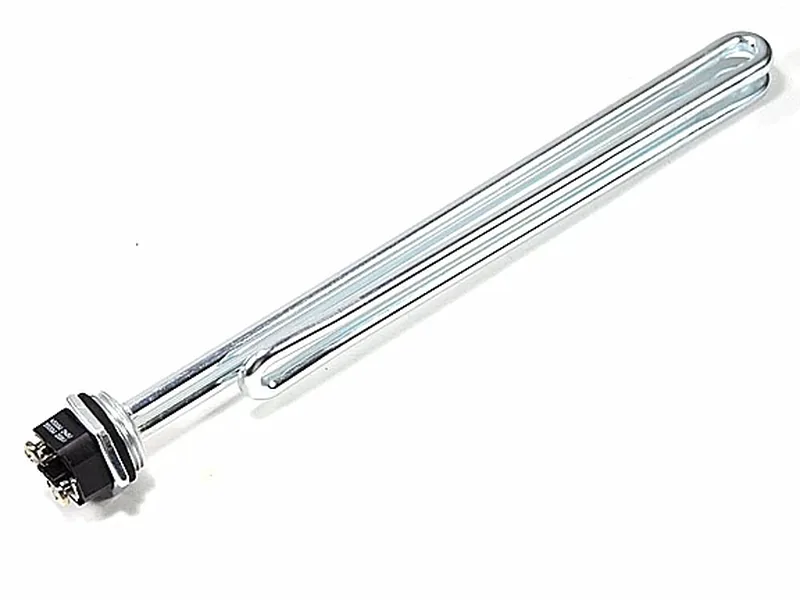
Electric water heaters have no burner and no pilot — all their heat comes from two electric elements immersed in the tank. When one fails, the symptoms can be confusing: plenty of hot water that runs out fast, or lukewarm water that never quite gets hot. Learning the warning signs of heating element failure helps Westfield homeowners diagnose the problem quickly instead of blaming the thermostat or assuming the whole heater is done.
How Heating Elements Work
Most residential electric heaters use two elements: an upper and a lower, each typically rated around 4,500 watts. They never run at the same time. The upper element heats the top third of the tank first for fast recovery of small draws; once the top is satisfied, the lower element takes over to heat the bulk of the tank. Thermostats mounted beside each element control the handoff. Because the lower element does most of the sustained heating — and sits buried in whatever sediment has settled — it fails far more often than the upper one.
Warning Signs of Element Failure
- Hot water runs out unusually fast: The classic failed-lower-element symptom. The upper element heats the top of the tank, giving a short burst of hot water, then cold arrives because the lower element never heated the rest.
- Water is lukewarm but never hot: A partially failed element or one coated in scale cannot reach full temperature.
- No hot water at all: If the upper element fails — or the breaker trips — you may get nothing. Check the breaker first; a tripped breaker can itself signal a shorted element.
- Breaker keeps tripping: An element with a cracked sheath can short to the water, tripping the breaker repeatedly. Do not keep resetting it — have the unit inspected.
- Very slow recovery: The heater takes hours to reheat after normal use because only one element is doing the work of two.
- Rust-colored hot water: A severely corroded element can shed rust into the water, and its failure often coincides with a depleted anode rod.
What Kills Heating Elements
Sediment is the number one killer. Minerals settling on the tank bottom bury the lower element, insulating it so it overheats and burns through its sheath. Dry-firing — restoring power before the tank is completely full, often after a drain valve replacement or flush — destroys an element in seconds; this is why professionals are obsessive about confirming a full tank before flipping the breaker. Hard water scale coats elements and creates hot spots. Simple age matters too: elements typically last six to ten years, and Westfield's mineral-heavy water pushes toward the shorter end. Power surges and loose wiring connections can also damage elements or their thermostats.
How a Failed Element Is Diagnosed
Diagnosis starts with the breaker and the reset button on the upper thermostat, then moves to electrical testing with the power verified off. A multimeter across the element terminals should read roughly 10 to 16 ohms for a standard 4,500-watt element; an infinite reading means a broken element, and continuity between a terminal and the tank means a shorted one. Thermostats are tested the same way. This testing involves live-panel work and must be done with the breaker off and verified — if you are not comfortable working around a breaker panel, this is squarely a job for heating element replacement service in Westfield rather than a first DIY electrical project.
Replacement: What to Expect
Replacing an element means shutting off power and water, draining the tank below the element port, unscrewing the old element, cleaning the port threads, installing the new element with its gasket, refilling completely, and only then restoring power. Many professionals replace both elements and both thermostats as a set on older heaters, since the labor overlaps and the surviving parts are usually not far behind. It is also the natural moment to flush accumulated sediment — the thing that likely killed the element in the first place — and to check the anode rod. If the tank itself shows rust, weeping seams, or is past its expected life, element replacement may be throwing good money after bad, and water heater replacement deserves an honest discussion. For diagnosis or repair in Westfield, INll (833) 713-2101 and a local representative will match you with a professional who can test the elements and give you straight answers.
Upper vs Lower Element: Telling Them Apart
Because the two elements fail differently, matching your symptom to the right element saves diagnostic time. A failed upper element usually means no hot water at all, since the upper thermostat never hands off and the lower element never gets its turn — check the breaker and the upper thermostat reset button first, because a tripped high-limit switch mimics this exactly. A failed lower element gives the classic “short shower” pattern: the top of the tank heats normally, so the first minutes feel fine, then cold water arrives far sooner than it should. If both elements test good but problems persist, suspect the thermostats, which control the handoff between elements and fail nearly as often. A professional diagnosis tests elements and thermostats together, since replacing an element when the thermostat was the real culprit — or vice versa — just means paying for the job twice.