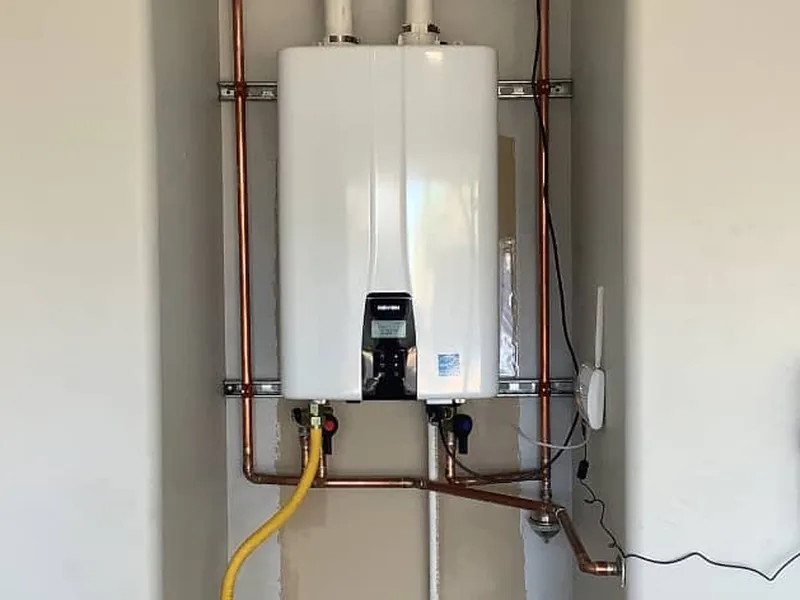
Tank and tankless water heaters both heat your water, but they fail in completely different ways — and their leaks differ just as much. A tank leak can mean dozens of gallons on your floor; a tankless leak is usually a slow seep that hides inside walls. If you are choosing between the two, or troubleshooting the one you have, understanding these differences helps you know what to watch for and how seriously to take it.
How Tank Water Heater Leaks Happen
A tank heater stores 40 to 80 gallons of hot water under pressure, so when the vessel fails, volume is the story. The most common tank leak sources are:
- Internal corrosion: Once the anode rod is spent, the steel tank rusts from inside until pinholes or split seams open — the number one cause of tank replacement.
- Sediment hot spots: Mineral buildup overheats the tank bottom until the steel weakens and weeps.
- Fittings and valves: Inlet, outlet, TPR valve, drain valve, and element gaskets all leak before the tank does, and these are repairable.
- Excess pressure: Failed expansion tanks and high system pressure stress seams and joints until something gives.
Tank leaks range from a weeping fitting to a ruptured tank emptying its full contents. That volume potential is why a failed tank can flood a basement in an hour.
How Tankless Water Heater Leaks Happen
Tankless units heat water on demand through a heat exchanger, so there is no reservoir to burst. Their leaks are smaller but sneakier:
- Heat exchanger cracks: Scale buildup creates hot spots that stress and eventually crack the exchanger — the most serious tankless leak, and an expensive part.
- Fitting and connection weeps: Water, gas, and condensate connections can loosen or corrode, leaving slow drips and mineral crust.
- Condensate line failures: High-efficiency condensing units produce acidic condensate; a clogged, cracked, or misrouted condensate line backs up and spills.
- Pressure relief discharge: Tankless units have relief valves too, and discharge usually signals a pressure or temperature control issue.
- Freeze damage: Outdoor or garage-mounted units in Indiana winters can suffer cracked components if freeze protection fails or power is cut.
Damage Comparison: Volume vs Stealth
A ruptured tank is dramatic: tens of gallons released at once, soaking everything in the vicinity. Insurance claims from tank failures are among the most common and costly water damage events in homes. Tankless leaks, by contrast, rarely flood — but what they lack in volume they make up in stealth. A slow exchanger or fitting seep can soak wall cavities, subfloor, and framing for months before anyone notices, growing mold and rot the whole time. Neither is “better”; they simply punish inattention differently. Both reward the same habit: periodic inspection of the unit and its surroundings.
Detection: What to Watch For
Tank leak detection is straightforward — look for water at the base, rust streaks, and damp floors. Tankless detection requires more detective work since there is no tank to pool water: check the wall and floor beneath the unit for staining, look for white or green mineral crust on fittings, note any musty smells in the utility area, and pay attention to error codes or drops in hot water performance, which often accompany internal leaks. Because tankless leaks hide so well, an annual professional look-over matters even more for these units.
Repair Outlook for Each Type
Here the economics diverge. Tank fitting and valve leaks are usually straightforward, affordable repairs; a corroded tank, however, cannot be patched reliably and means replacing the unit. Tankless repairs skew the other way: fittings, condensate lines, and descaling are routine, but a cracked heat exchanger is a major repair that on an older unit may approach replacement cost — a decision that weighs the unit's age, warranty status, and overall condition. For tank problems, tank water heater leak repair in Westfield covers everything from valve fixes to replacement guidance; for tankless issues, tankless leak diagnosis and repair traces those hidden seeps to their source. If your heater — tank or tankless — is showing any sign of moisture where it should not be, call (833) 713-2101 and get it identified before small becomes expensive.
Maintenance: The Real Deciding Factor
Whichever type you own, maintenance determines whether leaks stay theoretical. Tank heaters need annual sediment flushing, anode rod checks every few years, and periodic valve and fitting inspections — skip these and corrosion plus pressure will find the tank's weak points on schedule. Tankless units need annual descaling, condensate line checks, and freeze-protection verification — skip these and scale will crack the exchanger or ice will split a component. Neither type is “maintenance-free,” despite what marketing suggests. The owners who never deal with leaks are not lucky; they are the ones whose heaters get looked at every year. If yours has been running on luck, this is a good moment to change that.