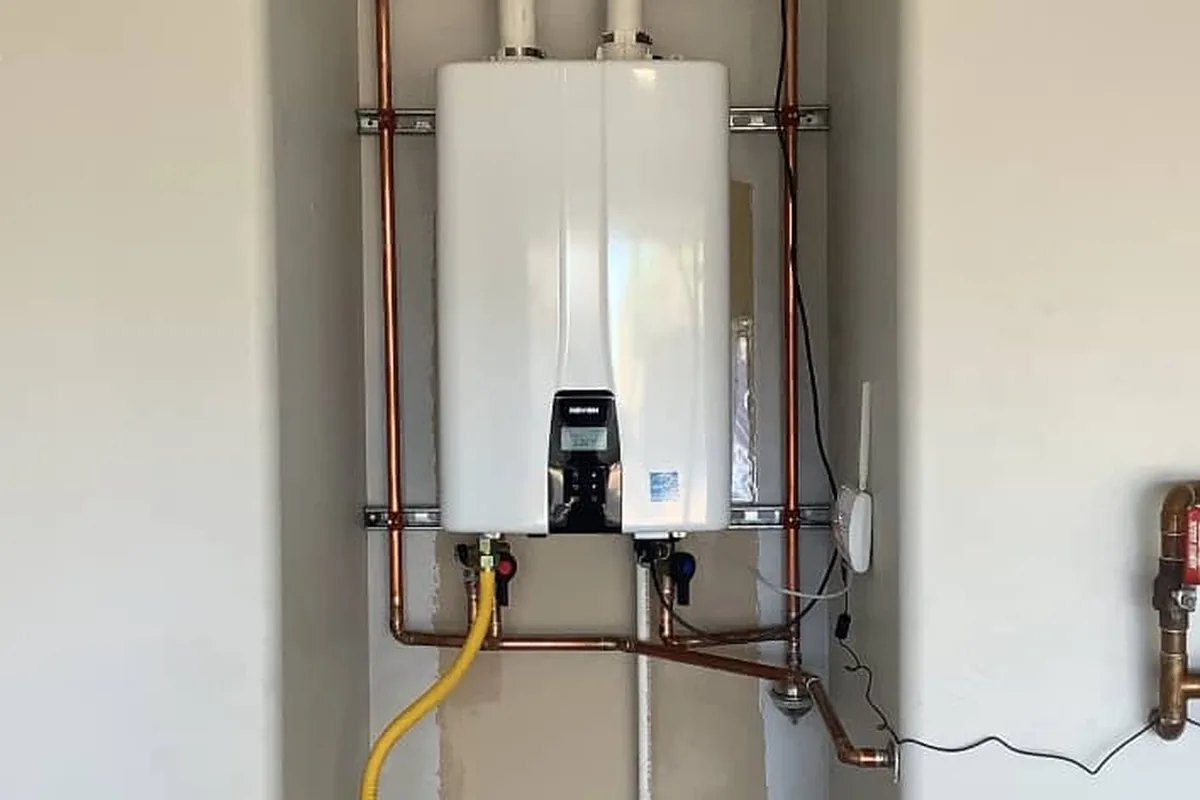
Tankless water heaters earn their reputation for reliability, but “no tank” does not mean “no leaks.” When a tankless unit starts letting water escape, the cause is rarely obvious — there is no puddle-forming reservoir to point at. Instead, water appears as stains beneath the unit, crust on fittings, or dampness inside a wall. These are the most common causes, how to recognize each, and what fixes them.
Heat Exchanger Leaks
The heat exchanger is the heart of the unit — a compact maze of copper or stainless tubing where flame meets water. It is also the most expensive part to fail. Scale from hard water coats the narrow passages, creating hot spots where metal overheats, fatigues, and eventually cracks. Freeze damage can split exchanger tubing too, a real risk for Indiana installations. Symptoms include water dripping from inside the cabinet, error codes related to overheating or flow, and declining hot water performance. A cracked exchanger on a newer unit under warranty may be worth repairing; on an older unit, the repair cost often pushes the decision toward replacement. Annual descaling is the prevention that keeps exchangers alive in Westfield's mineral-heavy water.
Fitting and Connection Leaks
A tankless unit has multiple connections — cold water in, hot water out, gas in, condensate out — and each is a potential weep point. Installation fittings can loosen with thermal cycling, threaded joints can corrode, and the isolation valves used for descaling service develop their own drips over time. These leaks announce themselves as white or green mineral crust on brass fittings, dampness on the wall behind the unit, or a slow drip from a valve body. Most connection leaks are straightforward repairs: tightening, resealing, or replacing the fitting. Catching them early matters because chronic weeping rots the mounting surface and feeds mold inside the wall cavity.
Condensate Line Problems
High-efficiency condensing tankless units extract extra heat from exhaust gases, which produces acidic condensate that must drain away through a small line. When that line clogs with debris, cracks, or was installed without proper slope, condensate backs up and spills from the unit — often mistaken for a water leak. The fix is usually simple: clear or reroute the line and confirm drainage. Because the condensate is acidic, it should run through a neutralizer before reaching drains or soil; exhausted neutralizer media lets acid attack drain piping over time. If you see water beneath a condensing unit, the condensate system is the first thing to check.
Pressure Relief Valve Discharge
Tankless units carry a pressure relief valve just like tank heaters, and discharge means the valve is doing its job against excess pressure or temperature. Occasional discharge during high-demand operation can be normal; repeated or continuous discharge is not. Causes include a failed pressure regulator, a malfunctioning temperature sensor letting the unit overheat, or system pressure issues in the home's plumbing. Do not cap or plug a discharging relief valve — find and fix the underlying cause.
Freeze Damage
This one is especially relevant in Indiana. Tankless units mounted outdoors or in unheated garages rely on built-in electric freeze protection that cycles the burner briefly to keep internal water above freezing. That protection needs electrical power — cut the power during a cold snap and the protection dies with it. It also has limits; in extreme cold with wind, even powered protection can be overwhelmed, particularly if the unit was not winterized. Freeze-cracked components leak as soon as the ice thaws, often dramatically. Prevention means keeping power on, ensuring the unit is rated for the installation location, and considering pipe insulation and wind shielding for exposed mounts.
Getting an Accurate Diagnosis
Because tankless leaks hide, diagnosis starts with detective work: tracing mineral trails, checking error code history, pressure-testing the exchanger, and inspecting with moisture meters behind the unit. Guessing wrong wastes money — replacing fittings when the exchanger is cracked, or vice versa. Tankless water heater leak repair in Westfield begins with pinpointing the exact source so the fix matches the failure. If you notice staining, crust, dampness, or error codes around your unit, do not wait for it to get worse: call (833) 713-2101 or see tankless leak service options in Westfield to arrange an inspection. Early diagnosis on a tankless unit is almost always cheaper than the repair that follows months of hidden seepage.
Error Codes: Your Unit Is Trying to Tell You Something
Modern tankless units are remarkably communicative — most display error codes that narrow down the problem before anyone opens the cabinet. Codes related to overheating, abnormal flow, or ignition failure often accompany internal leaks, since water where it should not be disrupts sensors and heat transfer. Write down the exact code and when it appears (during high demand, at startup, intermittently) before calling for service; that history lets the technician arrive with the right parts and a head start on diagnosis. Do not ignore a code that clears itself either — intermittent codes paired with any sign of moisture deserve investigation, because the underlying leak is still there whether the display is complaining today or not.