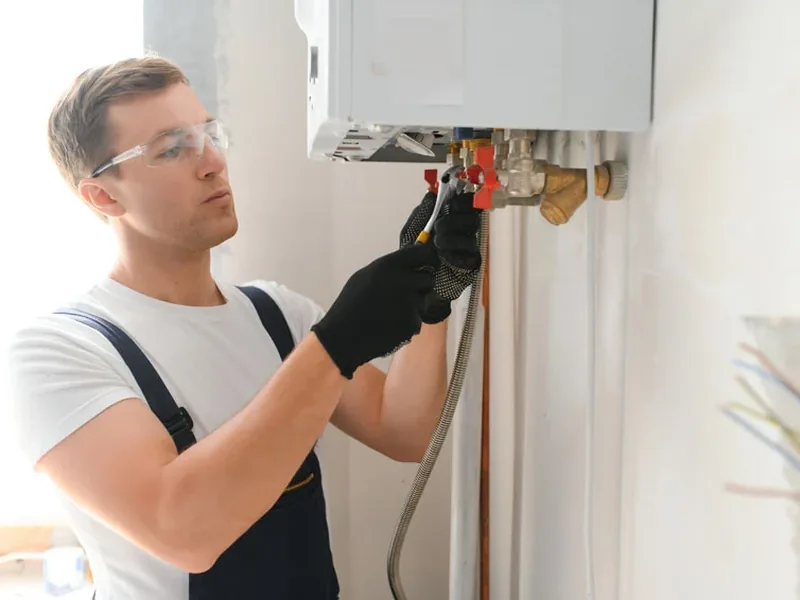
Every water heater has an expiration date — the question is whether yours is approaching and whether you will replace it on your schedule or its. Lifespan varies widely by type, water conditions, and maintenance, from under a decade for a neglected tank to two decades for a cared-for tankless unit. Here is what to expect, what moves the number up or down, and how to time replacement so a leak never makes the decision for you.
Typical Lifespans by Type
- Conventional tank (gas or electric): 8 to 12 years is the standard range. Well-maintained tanks in good water reach the upper end; neglected ones in hard water can fail in as little as 6.
- Tankless (on-demand): 15 to 20 years with proper maintenance — substantially longer than tanks, since there is no stored water corroding a vessel around the clock.
- Heat pump / hybrid: Roughly 10 to 15 years, with the heat pump components typically setting the limit rather than the tank.
- Solar thermal with tank: The collectors can last 20-plus years, but the storage tank follows conventional tank lifespans.
These are medians, not guarantees. The spread within each category is driven almost entirely by the factors below.
What Shortens a Water Heater's Life
- Hard water without maintenance: In Westfield's mineral-heavy water, unflushed sediment overheats tank bottoms and scale destroys tankless heat exchangers. This is the number one lifespan killer locally.
- Neglected anode rods: A spent rod leaves the tank defenseless against corrosion. Tanks whose rods were never checked routinely die years early.
- Excess pressure: Chronic high system pressure and failed expansion tanks stress seams, joints, and the tank structure itself.
- Oversized temperature settings: Running far above 120°F accelerates scale formation, stresses components, and wastes energy.
- Poor installation location: Units in damp, unventilated spaces corrode externally faster; outdoor units face freeze risk.
- Water chemistry extremes: Very soft water, acidic well water, or high-chlorine water each attack tanks and rods in their own way.
What Extends It
- Annual flushing: Keeps sediment from becoming the overheating, element-killing layer that ends tanks early.
- Anode rod replacement on schedule: Fresh rods keep corrosion focused on the replaceable part instead of the tank. This single habit adds the most years per dollar of any maintenance.
- Pressure control: A working expansion tank and normal system pressure remove the constant mechanical stress that ages every component.
- Water softening in hard-water homes: Dramatically slows scale and sediment — paired with more frequent anode checks, since softeners deplete rods faster.
- Moderate temperature settings: Around 120°F reduces scale formation and thermal stress while cutting energy use.
- Professional annual maintenance: Bundles all of the above plus valve testing and leak inspection into one visit.
The pattern is clear: the heaters that reach the far end of their expected range are not lucky — they are maintained. A neglected tank in Westfield water is doing well to see ten years; a maintained one can push past twelve.
Signs Yours Is Near the End
Age alone is not a death sentence, but age plus symptoms is. Watch for rusty hot water that flushing does not clear, rumbling that persists after flushing (baked-on scale), moisture around the base, frequent component failures in short succession, and steadily rising energy bills for the same usage. Any one of these on a heater past ten years is a strong signal to plan replacement rather than invest in further repairs. A professional assessment — including anode rod condition and tank integrity — gives you a straight answer about remaining life instead of guesswork.
Timing Replacement Right
The ideal replacement happens before failure: you choose the unit, the timing, and the installer on a calm schedule, with no water damage and no emergency premium. Start planning when your tank crosses the ten-year mark or shows the symptoms above — get an assessment, research your options (tank vs tankless, sizing, efficiency), and budget accordingly. Replacing a working-but-aging heater feels premature right up until the alternative happens at the worst possible moment. For an honest evaluation of your heater's remaining life and replacement planning in Westfield, call (833) 713-2101 and a local representative will connect you with a professional who will tell you plainly whether your heater has years left or is running on borrowed time.
Getting the Most from Your Current Heater
Whatever age your heater is today, the actions that extend its remaining life are the same ones that prevent leaks: flush sediment yearly, check the anode rod on schedule, keep system pressure in range, and fix small problems — weeping fittings, dripping valves — before they become big ones. If your heater is already past the ten-year mark, add planning to the list: know what type and size you would buy, understand your installation's constraints, and have a professional's assessment of remaining life on record. That preparation turns the eventual replacement from a crisis into an errand. And when the assessment says the tank is failing, believe it — nursing a dying tank along invites the one outcome nobody wants: discovering its expiration date via the utility room floor.