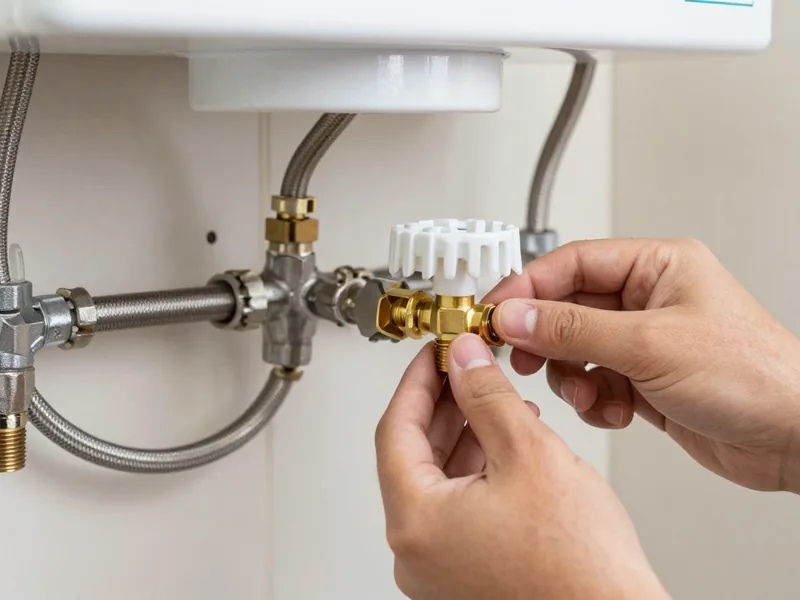
The drain valve is the small spigot at the base of a tank water heater, and it has two jobs: let the tank be flushed of sediment, and let the tank be drained for service. From the factory, that valve is almost always plastic. Plastic handles years of heat poorly, mineral sediment packs around it, and the washer inside fuses to its seat. In a town like Atlanta, where many tanks run a decade or more between flushes, the valve is often the first part of the heater to fail.
Atlanta's homes tell the story. The town has a genuine historic core with houses that have seen several water heaters come and go, plus newer infill as growth pushes north from Westfield. Municipal water serves the town, moderately hard like the rest of Hamilton County, and homes on the outskirts may run on wells. Both leave sediment in the tank. The difference is only in how fast it builds and what it is made of, calcium scale in town, sometimes iron and grit from wells outside it.
IN SHORT
Drain valve replacement in Atlanta, IN 46031 replaces a stuck, dripping, or broken factory valve with a full-port brass ball valve. Call (833) 713-2101 for same-day service.
The Seized-Valve Problem in Atlanta's Older Homes
Walk through Atlanta's older neighborhoods and you will find water heaters in basements, utility closets, and garage corners that have been quietly doing their job for ten, twelve, fifteen years. The tanks themselves are often fine. The drain valves are not. A valve that has sat untouched for a decade does not simply get stiff, its washer fuses to the seat, sediment cements around the valve body, and the plastic handle goes brittle from years of radiant heat off the tank.
The moment of truth usually comes during a flush. A homeowner decides to do the right thing and drain a few gallons of sediment, opens the valve, and brown water full of grit surges out. Then they try to close it and it will not close. Grit has lodged in the seat. Or the handle, asked to move for the first time in twelve years, snaps off in their hand. We get these calls regularly in 46031, and they are almost always preventable with a valve replacement before the flush rather than after.
There is a related scenario we see in Atlanta's historic homes: the home inspection. A buyer or inspector tries the drain valve, it weeps or will not operate, and suddenly a routine sale has a plumbing flag. Replacing the valve ahead of a listing is cheap protection. A working brass valve signals a maintained heater; a dripping plastic one invites questions about everything else.
Brass Ball Valves: Why We Install Them Exclusively
When we replace a drain valve in Atlanta, we install a full-port brass ball valve, every time, no exceptions. The reasons are practical. Brass does not become brittle with heat the way the factory plastic does. A ball valve closes with a quarter turn of a lever handle, giving a positive seal with no washer to fuse to a seat. And full-port means the bore through the valve is the full diameter of the pipe, so sediment flows out during a flush instead of bridging across a narrow restriction and choking the drain.
The difference shows up the next time the tank gets flushed. With the old plastic valve, opening it after a few years was a gamble. With a brass ball valve, you open the lever, water and sediment flow freely, you close the lever, and it seals. Homeowners who have lived through a snapped-valve incident appreciate this more than anyone. The valve goes from being the part you fear touching to a part you can actually use.
Material choice matters in another way too. The valve threads into a steel tank fitting, and dissimilar materials plus heat plus time can make removal difficult years later. Brass plays well with the tank's steel threads and with standard thread sealants, so the next replacement, a decade or more from now, comes out cleanly. We set every valve up to be serviceable, not just functional.
What to Expect During the Service Visit
Call (833) 713-2101 and the first thing we do is ask what the valve is doing and how old the tank is. A valve that drips is a different job than a valve whose handle has snapped off, and a five-year-old tank drains differently than a fourteen-year-old one full of sediment. With that information we schedule the visit, usually same-day in the Atlanta area, and arrive with the right valves and fittings.
On site, we shut the heater down and let the tank cool to a safe working temperature. Then we drain the tank in a controlled way. In Atlanta homes this means routing a hose to a floor drain, a sump pit, a utility sink, or outside, depending on where the heater sits. Older homes sometimes have the heater in a tight basement corner with no nearby drain, and we plan the hose run before opening anything so water goes exactly where we intend.
With the tank drained below the valve, the old valve comes out. Years of hardened sealant and mineral cementing mean this step takes patience, and we take it, because rushing a valve extraction risks damaging the tank's threads. The new brass ball valve goes in with fresh sealant, the tank refills, we purge air from the hot lines, bring the heater back online, and cycle the new valve under pressure. You see it open, you see it close, you see it seal. Typical visit: one to two hours.
Atlanta's Water and Housing: What It Means for Your Valve
Atlanta's municipal water is moderately hard, typical of Hamilton County groundwater sources, and hardness is the slow engine of drain valve failure. Every gallon heated leaves a trace of mineral behind, and it all settles to the bottom of the tank, right where the valve lives. In homes without softeners, which includes many of Atlanta's older houses, that sediment accumulates year after year until the valve is effectively entombed.
Homes on the town's outskirts add well-water variables. Private wells in this part of Hamilton County can produce water with iron and fine sand, and iron sediment behaves differently from calcium scale. It is grittier, it stains, and it packs into valve passages aggressively. If your water leaves orange rings in toilets or a metallic taste, your drain valve has been living in that same chemistry, and it deserves attention before you attempt a flush.
Growth is the third factor. As Westfield's expansion pushes toward Atlanta, infill construction and renovations are bringing newer tanks into a town dominated by older ones. Newer tanks have the same cheap factory plastic valves as older ones, the manufacturers have not upgraded them. So even a two-year-old heater in a new Atlanta build can have a valve worth replacing proactively, especially before its first real flush stirs up construction-era sediment.
What Happens When You Call (833) 713-2101
Describe the valve's behavior. Dripping, stuck, broken handle, or weeping at the threads, and the tank's age if you know it. We use that to plan the drain and schedule a same-day visit to Atlanta. We handle the drain and the swap. Heater shut down, tank drained in a controlled way to a safe point, old valve removed without damaging tank threads, new full-port brass ball valve installed. We prove it works. Tank refilled, air purged, heater restarted, and the new valve opened and closed under full pressure while you watch.