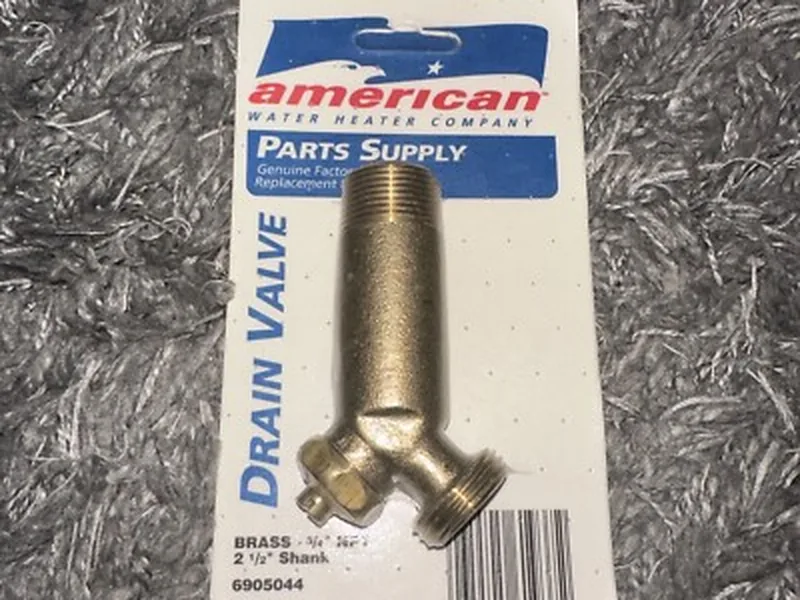
The drain valve is the unglamorous spigot at the bottom of a tank water heater, and it is the part that makes flushing and draining possible. Manufacturers install the cheapest plastic version that will survive the warranty period, and in Brownsburg's hard water, that valve spends its life sitting in heat and sediment without ever moving. When it is finally asked to work, during a flush, a repair, or a home sale inspection, it is the most likely part of the heater to fail.
Brownsburg's water comes from the town's municipal system and runs hard, as groundwater-sourced supplies in Hendricks County tend to do. The town's housing tells the rest of the story: established 1970s and 1980s ranch neighborhoods where original-owner families are common, plus newer subdivisions near the I-74 corridor. Both produce the same valve problem through different routes, extreme age and neglect in the older homes, and builder-grade valves never exercised in the newer ones.
IN SHORT
Drain valve replacement in Brownsburg, IN 46112 swaps a failed plastic factory valve for a full-port brass ball valve that you can actually operate. Call (833) 713-2101, same-day visits.
Original-Owner Homes and the Never-Touched Valve
Brownsburg has a distinctive pattern we do not see everywhere: a high share of homes where the same family has lived for decades. That is wonderful for the neighborhood and rough on drain valves. A water heater installed in 2004, never flushed, never serviced, still heating fine in 2026, will have a drain valve that is essentially a mineral sculpture. The washer has fused to the seat, sediment has packed around the valve body, and the plastic handle is brittle from twenty-plus years of heat.
The failure usually announces itself at the worst moment. The homeowner finally decides to flush the tank, or a technician needs to drain it for another repair, and the valve either will not open or will not close. In the will-not-close version, grit lodges in the seat and the valve weeps indefinitely. In the will-not-open version, the tank cannot be serviced at all. We have seen both in 46112, sometimes in the same week, and both end with a valve replacement.
The lesson for long-tenure homeowners is simple: do not test a decades-old valve yourself with pliers and hope. If the tank is old and the valve has never moved, call (833) 713-2101 first. We can assess whether the valve is salvageable or needs replacement before anyone puts torque on it, which is the difference between a planned one-hour swap and a snapped valve on a full tank.
The Replacement: What Actually Happens at the Tank
Every drain valve replacement we do in Brownsburg follows the same careful sequence, because the details are where tanks get protected. First the heater is shut down, gas valve off or breaker off, and the tank is allowed to cool to a safe temperature. Working on a fully hot, pressurized tank is how people get hurt and how threads get damaged, so we do not skip this.
Next is the controlled drain. We connect a hose to the existing valve, assuming it still passes water, and route it to the best available drain point: floor drain, sump pit, utility sink, or outside. Brownsburg basements and garages usually offer at least one good option, and we plan the route before opening the valve so water goes where intended. If the old valve is fully seized, we drain through alternate fittings rather than forcing the valve.
Then the extraction. The old valve comes out with steady, controlled leverage, never sudden force, because the tank's threaded fitting must survive the operation intact. We clean the threads, apply fresh sealant, and install the full-port brass ball valve. Refill follows, then air purging at the hot taps, then restart, then the demonstration: we open and close the new valve under full pressure while you watch. A valve you have seen seal is a valve you can trust.
Why Full-Port Brass Instead of Another Plastic Valve
It is a fair question: if the factory valve lasted fifteen years, why not just install another plastic one? Because the factory valve did not really last fifteen years, it survived fifteen years by never being used, and it failed the first time it was asked to work. A drain valve's job is to operate, and the plastic version is a single-use part in practice. The brass ball valve is a lifetime part.
Full-port is the key performance feature. The bore through the valve equals the pipe diameter, so sediment-laden water exits freely during a flush. Restricted valves, which includes every plastic factory valve we have ever removed, let sediment bridge across the opening: flow starts strong, then chokes, then stops, leaving the tank half-flushed. In Brownsburg's hard water, where sediment loads are real, that difference determines whether flushing actually maintains the tank.
Brass also handles the thermal reality. The valve lives threaded into the bottom of a tank that cycles between 120 and 140 degrees for its entire life. Plastic fatigues under that sustained heat; brass is unbothered. And the quarter-turn lever gives positive open and positive close with no packing nut to weep and no washer to fuse. It is simply the right part for the job, which is why we install nothing else.
Brownsburg Water, Housing Mix, and Valve Life
Brownsburg's municipal water is hard, consistent with the groundwater sources that supply much of Hendricks County. Hardness in the low-to-mid teens of grains per gallon is typical for the region, and every tank in 46112 accumulates sediment at a pace set by that chemistry. In the town's older ranch neighborhoods, many tanks have gone a decade or more without flushing, so the sediment load is deep and the valves are thoroughly entombed.
The newer subdivisions near I-74 present the mirror image: younger tanks, same cheap valves, same hard water, and the same neglect, because a five-year-old heater feels too new to need maintenance. But sediment does not wait for a tank to feel old. A valve on a six-year-old tank in hard water can already be gritty and unreliable, and the first flush is when homeowners discover it. Proactive replacement before that first flush is the smooth path.
Eagle Creek's proximity is a nice local amenity with no direct effect on your valve, but the town's overall growth does matter: as Brownsburg adds homes, more tanks enter the same hard-water reality every year. The valve problem is not going away. The good news is that the fix is permanent. One brass ball valve, installed correctly, outlasts the tank it serves.
What Happens When You Call (833) 713-2101
Call and describe the valve. Dripping, stuck, snapped handle, or seeping at the threads, plus tank age and heater location. We schedule a same-day visit in Brownsburg from that information. Controlled drain and clean swap. Shutdown and cool-down, hose-routed drain to a safe point, patient extraction of the old valve, and installation of a full-port brass ball valve with fresh sealant. Refill, restart, and proof. We refill the tank, purge air, bring the heater back online, and cycle the new valve under pressure while you watch it seal.