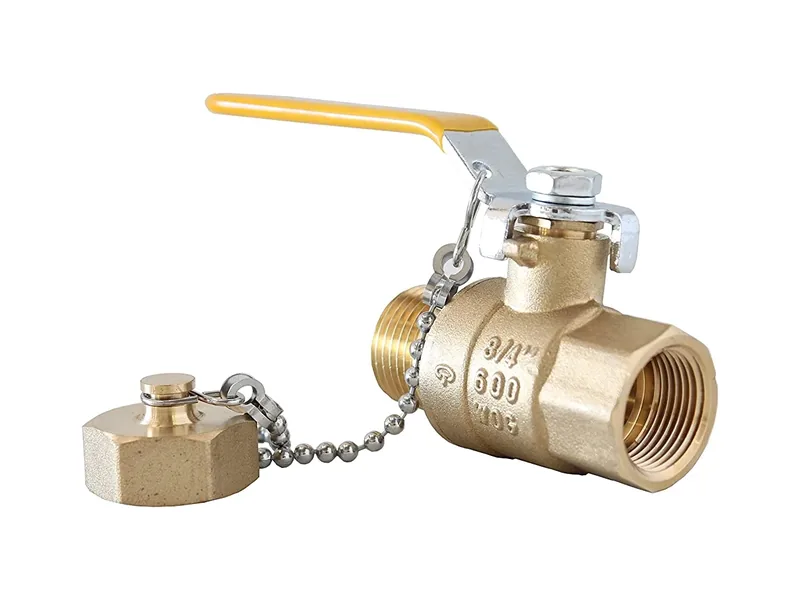
Carmel is Hamilton County's flagship suburb, famous for its roundabouts, its Arts and Design District, and its large, well-kept homes. Those homes tend to have large water heaters, 50-gallon tanks are common and 75-gallon units appear in the bigger houses, and many households are now on their second heater. What has not changed across any of those installations is the drain valve: manufacturers still ship tanks with a cheap plastic spigot at the bottom, and Carmel's very hard water is exceptionally good at destroying it.
The drain valve's job is straightforward: allow the tank to be flushed of sediment and drained for service. In 46032, with hardness around 11 to 15 grains per gallon, sediment accumulates fast and packs around the valve. The valve's washer fuses to its seat, the plastic handle embrittles from years of heat, and the first real flush attempt becomes the valve's last day. Replacement with a brass ball valve ends the cycle permanently.
IN SHORT
Drain valve replacement in Carmel, IN 46032 upgrades a seized, dripping, or snapped factory valve to a full-port brass ball valve built for hard water. Call (833) 713-2101 for same-day service.
Hard Water Meets Plastic: Carmel's Valve Failure Pattern
Carmel's municipal supply, managed through the regional water system serving the city, is documented as very hard, and local hardness figures in the 11-to-15 grains-per-gallon range are no surprise to anyone who has seen the scale on a Carmel faucet aerator. Inside a water heater, that same mineral settles to the tank bottom. The drain valve lives at the tank bottom. The arithmetic is unforgiving: year after year, sediment mounds around the valve, infiltrates its passages, and cements its washer to the seat.
The failure we see most in 46032 is the post-flush weep. A homeowner does everything right, attaches a hose, opens the valve, flushes sediment, and then the valve will not seal. A grain of grit, or a flake of scale, has lodged in the seat, and the plastic valve cannot crush past it or seal around it. The result is a steady drip from the spout that continues for days. Tightening the handle harder only risks cracking the valve body, which converts a drip into a spray.
The second most common is the snapped handle. Carmel has many homes where the heater is out of sight in a garage or basement utility area, and the valve has not been touched since the tank was installed. Plastic plus a decade of 130-degree heat equals a handle that breaks rather than turns. Either failure ends the same way: the factory valve comes out and a full-port brass ball valve goes in.
Softeners, Big Tanks, and the Realities of 46032 Homes
Whole-house softeners are common in Carmel, and they change the valve story without ending it. Softened water dramatically slows new calcium scale, which is genuinely good for the tank. But the sediment already in the tank does not vanish when the softener goes in, and softened water is slightly more aggressive toward the plastic and rubber components of a factory valve. We routinely remove valves from softened-water Carmel homes that look clean externally and are perished internally: softened washers, distorted seats, hairline body cracks.
Tank size is the other Carmel factor. Fifty-gallon tanks are the norm in the city's larger homes, and 75-gallon units are not rare. Bigger tanks hold more water, accumulate more sediment, and take longer to drain, which matters for scheduling and for valve selection. A full-port valve is even more valuable on a large tank, because restricted valves choke on heavy sediment loads exactly when you need maximum flow.
There is also a preventive pattern unique to Carmel's demographics: the conscientious homeowner with a five-year-old tank attempting its first real flush. The tank is young, the sediment load is moderate, and the valve should work, but factory valves can seize surprisingly early in hard water. If the valve feels gritty or resists on a young tank, stop and call (833) 713-2101. Replacing the valve proactively on a young tank is the cheapest version of this job and sets up a decade of trouble-free flushing.
The Service Visit, Step by Step
It starts with a phone call to (833) 713-2101. We ask what the valve is doing, dripping, stuck, broken, or seeping at the threads, how old the tank is, and where the heater is located. Carmel heaters live in garages, basements, and utility closets, and each location suggests a drain routing plan. From that conversation we schedule the visit, typically same-day.
On site, we shut the heater down and let the tank cool to a safe working temperature. Then we set up the controlled drain: hose connected to the existing valve if it still flows, routed to a floor drain, sump, utility sink, or outside. On Carmel's larger tanks with heavy sediment, draining takes patience; we allow the time rather than rushing, because a fully drained tank makes for a clean valve extraction.
Extraction is where experience matters. The old valve's sealant has hardened over years, and mineral has fused it to the steel tank fitting. We back it out with steady, controlled leverage, protecting the tank threads, then clean the fitting, install the full-port brass ball valve with fresh sealant, refill the tank, purge air from the hot lines, restart the heater, and demonstrate the new valve: open under pressure, close under pressure, watch it seal. Most visits run one to two hours.
Warning Signs Carmel Homeowners Should Not Ignore
The earliest warning is a damp spot or mineral crust beneath the valve spout. If you see white or greenish deposits around the valve, water has been weeping and evaporating there, and the valve's seal is already compromised. A second sign is handle feel: a valve handle that turns with a gritty, crunchy sensation has sediment in its mechanism and is living on borrowed time.
Behavior during flushing is the definitive test. Open the valve and the flow should be strong and steady. If it starts strong and chokes down to a trickle, sediment is bridging the valve's narrow passages. Close the valve and it should seal promptly and completely. Any continued weeping means grit in the seat or a damaged washer, and no amount of tightening will fix a plastic valve in that state.
Context matters too. If your Carmel tank is over eight years old and the valve has never been operated, treat the valve as suspect until proven otherwise. That does not mean the tank is failing; many 46032 tanks run reliably for years with untouched valves. It means that before you, or a technician, needs to drain that tank, the valve deserves a professional look. A planned replacement costs far less than an emergency extraction after a snapped valve.
What Happens When You Call (833) 713-2101
Call (833) 713-2101 and describe the valve. Its behavior, the tank's age, and the heater's location let us plan the drain and book a same-day visit in Carmel. We perform the swap. Shutdown and cool-down, controlled hose-routed drain, careful extraction of the old valve, and installation of a full-port brass ball valve with fresh sealant. We prove the seal. Refill, air purge, heater restart, then open-and-close cycling of the new valve under full pressure while you watch.