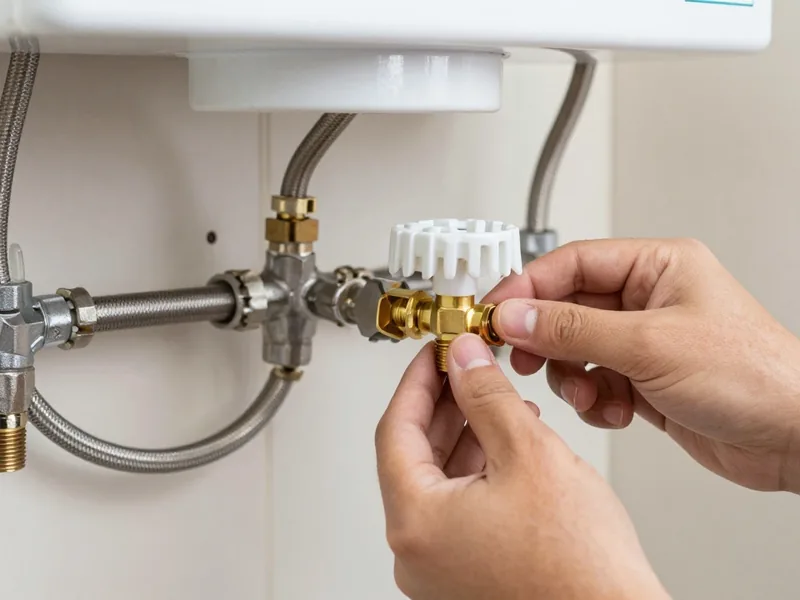
Fishers is one of Hamilton County's great suburban success stories, and its water heaters tell the growth story in steel and sediment. The subdivisions built in the 1990s and 2000s are now full of tanks on their second lifecycle: the original builder-grade heater failed years ago, a replacement went in, and life moved on. What rarely got upgraded in that swap was the drain valve. Manufacturers still ship the same plastic spigot, and installers still thread it in without a second thought.
The valve sits at the bottom of the tank, in the hottest and most sediment-laden zone, and Fishers' water is very hard, commonly in the mid-teens of grains per gallon from the municipal systems serving the city. Sediment mounds around the valve year after year. The washer fuses to the seat. The handle embrittles. Then comes the flush attempt, the repair that needs a drain, or the weep discovered during spring cleaning, and the valve's quiet decline becomes a service call.
IN SHORT
Drain valve replacement in Fishers, IN 46038 upgrades failed plastic valves to full-port brass ball valves. Same-day service. Call (833) 713-2101.
The Second-Heater Wave in Fishers
Fishers' 1990s and 2000s subdivisions are hitting a predictable milestone: the replacement heaters installed in the 2010s are now ten-plus years old, and their drain valves have never been operated. This is the second-heater wave, and it produces a specific failure signature. The tank itself is mid-life and heating fine. The valve is a time capsule from installation day, sealed by a decade of hardened sealant and mineral cementing.
We see it most often in two scenarios. The first is the maintenance-minded homeowner who decides to flush the tank and discovers the valve will not cooperate: it opens partway and chokes on sediment, or it closes but weeps, or the handle snaps. The second is the unrelated service call, a thermostat or element issue, where the technician needs to drain the tank and finds the valve seized. Both are resolved the same way, and the second scenario is why we check valves during any tank service in 46038.
The opportunity here is real. A ten-year-old tank in Fishers with a new brass valve and a proper flush has years of reliable life ahead. The valve replacement is what unlocks the maintenance; without it, the tank cannot be flushed, and unflushed tanks in very hard water age fast. If your Fishers heater is on its second tank and the valve has never moved, you are the textbook case for proactive replacement.
Geist, Softeners, and Fishers Water Chemistry
Fishers' water comes from the municipal systems serving the city, and it is very hard, commonly cited in the mid-teens of grains per gallon. The Geist Reservoir area on the city's east side shares the regional groundwater chemistry. Hardness at that level builds sediment aggressively: a tank can accumulate a meaningful sediment layer within a few years, and the drain valve, sitting in the sediment zone, feels it first.
Softeners are standard equipment in Fishers, and they create the paradox we explain on every other call. Softened water slows new scale formation, which helps the tank, but it does not remove the sediment already there, and it can accelerate degradation of the plastic and rubber in a factory valve. The valves we remove from softened Fishers homes often look deceptively clean outside while the washer has gone soft and the seat has distorted inside.
Geography adds a footnote: homes near Geist with private wells, on the fringes of the service area, can see iron and grit in addition to hardness. Iron sediment is abrasive and packs valve passages aggressively. Whether your 46038 water is municipal-hard or well-water complex, the prescription is identical: get the plastic valve out and a full-port brass ball valve in.
What the Visit Involves
Call (833) 713-2101 and describe what the valve is doing, dripping, stuck, broken, or seeping, plus the tank's age and location. Fishers heaters are typically in garages, basements, or utility closets, and the location sets our drain hose plan. We schedule from that call, usually same-day.
On arrival: shutdown, cool-down, controlled drain. We hose-route to a floor drain, sump, utility sink, or outside, connecting to the existing valve if it still flows or working around it if seized. Fishers' larger homes often have 50-gallon tanks, and a sediment-heavy tank drains slowly; we allow the time it takes rather than rushing the job.
Extraction is the craft step. The old valve, seized by years of of sealant and mineral, comes out with steady controlled leverage that protects the tank's steel threads. The new full-port brass ball valve threads in with fresh sealant. Then refill, air purge, restart, and the demonstration: open and close under full pressure while you watch. One to two hours, and the tank has a drain valve worthy of the house around it.
Why Full-Port Brass, Specifically
Three words, three reasons. Full-port: the bore matches the pipe diameter, so sediment-laden water exits freely during a flush instead of bridging across a restriction. In Fishers' hard water, where sediment loads are heavy, this is the difference between a flush that works and a flush that chokes halfway.
Brass: the valve lives threaded into a tank running 120 to 140 degrees for decades. Plastic embrittles under sustained heat; brass does not care. A brass valve installed today operates the same in ten years, which matches how often Fishers homeowners actually service their heaters.
Ball valve: a quarter-turn lever rotates a polished ball, open or sealed, with no washer to fuse and no packing to weep. Positive action, positive seal, every time. When we demonstrate it under pressure at the end of the visit, you will understand in five seconds why this is the last drain valve that tank will ever need.
What Happens When You Call (833) 713-2101
Call (833) 713-2101 with the symptoms. Valve behavior, tank age, and heater location let us plan the drain and book a same-day Fishers visit. We do the complete swap. Shutdown and cool-down, controlled drain, careful valve extraction, and installation of a full-port brass ball valve with fresh sealant. We demonstrate the result. Refill, air purge, restart, then cycling the new valve open and closed under pressure while you watch it seal.
Winter in Fishers: Garage Heaters and the Frozen-Valve Risk
A lot of Fishers homes put the water heater in the garage. It is convenient right up until January. An unheated garage in Hamilton County can sit below freezing for days during a cold snap, and a drain valve that already weeps becomes a freeze risk: water at the valve outlet ices up, expands, and cracks a brittle plastic valve body or splits the threads it screws into. Every February we see the aftermath — a valve that was fine in October now dripping steadily because ice worked the packing loose over winter.
If your heater lives in the garage, three habits protect it. First, insulate the valve outlet and any exposed piping near it; a few dollars of pipe insulation blunts the worst of a freeze. Second, never leave a garden hose attached to the drain valve in winter — a hose full of ice transmits expansion pressure straight back into the valve. Third, keep the garage door closed during deep freezes, which sounds obvious until the night everyone forgets. A full-port brass ball valve tolerates cold far better than embrittled plastic, but prevention still beats material strength. And if you spot a drip in winter, do not wait for spring: freezing temperatures turn a small weep into a split valve, and a split valve into water across the garage floor.
Making the New Valve Pay: A Fishers Flush Routine
The brass valve we install is a tool, not a trophy — its value shows up when you actually use it. In Fishers water, with hardness commonly in the mid-teens of grains per gallon, a yearly flush keeps sediment from re-mounding around the valve and quietly stealing efficiency. The routine is simple once the valve works: attach a garden hose, run it to a floor drain or outside, open the valve for five to ten minutes until the water runs clear, close it firmly, done. No shutdown needed for a quick flush on most tanks.
Homeowners with softeners sometimes ask whether they can skip flushing. The answer is no. A softener slows new scale formation, but the tank still collects fine sediment, and a valve that sits unused seizes again within a few years — softened or not. Set a phone reminder for the same weekend each fall, before heating season. Ten minutes a year protects a valve that should outlast the tank itself, and it prevents the popping and rumbling that hard-water sediment causes as it hardens on the tank bottom. The valve makes flushing possible; the calendar makes it happen.