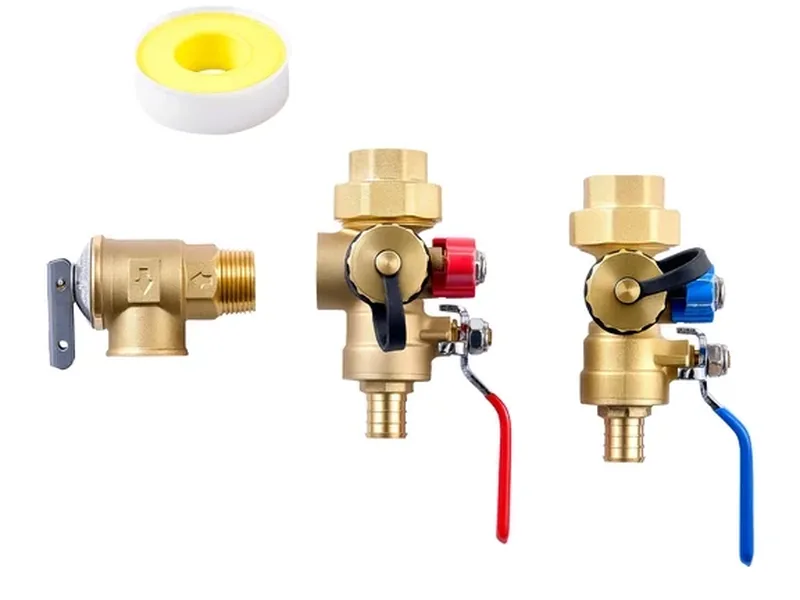
Lawrence is its own city on the northeast side of Indianapolis, anchored by the Fort Benjamin Harrison area and built out largely in the 1960s, 70s, and 80s. That build era defines its water heaters: thousands of tanks installed during construction or during the wave of replacements that followed, now fifteen to twenty-five years into service. The drain valve on those tanks, a cheap plastic spigot from the factory, has been sitting in hot, hard water the entire time, untouched.
Citizens Energy Group supplies the area with hard water typical of the region, and hardness is the author of the valve's decline. Sediment settles to the tank bottom, the washer fuses to the seat, the handle embrittles. The failure surfaces during a flush attempt, a repair requiring a drain, or as a slow weep discovered in the utility room. The permanent fix is a full-port brass ball valve, installed in a single visit.
IN SHORT
Drain valve replacement in Lawrence, IN 46226 swaps failed plastic valves for full-port brass ball valves. Same-day service. Call (833) 713-2101.
The Fort Harrison Area and Mid-Century Subdivisions
The neighborhoods around the former Fort Benjamin Harrison, now a state park and a thriving residential area, include some of Lawrence's most established housing: mid-century subdivisions with mature trees and original-owner households. Water heaters in these homes are often on their second tank, installed during 2000s updates, and those replacements are now themselves aging. Their drain valves have never been operated.
Military housing conversions and the surrounding civilian subdivisions add variety, but the valve story is consistent. A plastic valve, a decade-plus of hard water, zero maintenance. The discovery moments are the usual ones: the attempted flush that ends in a weep, the handle that snaps, the inspector's note during a sale. In a community where homes turn over steadily as families upsize or downsize, inspection-flagged valves are a recurring business, and the fix is always the same one-hour upgrade.
For Lawrence homeowners in these established neighborhoods, the message is proactive: if your tank is over ten years old and the valve has never moved, have it replaced on a planned visit, not discovered mid-flush. The cost is modest, the disruption is nil, and the tank becomes maintainable for the rest of its life.
Subdivision Tanks and the Neglect Curve
Lawrence's 1970s and 1980s subdivisions follow the neglect curve precisely. Year one through five: the tank is new, nobody thinks about the valve. Year five through ten: the tank is middle-aged, the valve is already getting gritty, still nobody touches it. Year ten plus: someone finally tries to flush, or a technician needs to drain the tank, and the valve fails on the spot. The curve is so reliable you could set a watch by it.
The physics behind the curve is sediment. Hard water deposits calcium at the tank bottom continuously, and the drain valve sits in the middle of it. Each year the sediment layer deepens around the valve body; each year the washer fuses more firmly to the seat; each year the plastic handle gets more brittle from heat. By year twelve, the valve is not a valve anymore, it is a mineral formation with a handle-shaped appendage.
Breaking the curve requires exactly one intervention: replace the plastic with brass. The full-port brass ball valve does not follow the neglect curve because it has no washer to fuse, no narrow passages to pack with sediment, and no plastic to embrittle. Install it once, operate it yearly during a flush, and the curve never applies again.
How the Service Visit Works
Your call to (833) 713-2101 starts with three questions: what is the valve doing, how old is the tank, and where is the heater. Dripping, stuck, broken, or seeping each suggest a slightly different approach. Tank age tells us the sediment load. Location, basement, garage, utility closet, sets the drain hose route. Then we schedule, usually same-day in Lawrence.
On arrival we shut the heater down and let the tank cool to a safe working temperature. The controlled drain follows: hose connected to the existing valve if it still passes water, routed to a floor drain, sump pit, utility sink, or outside. Lawrence's ranch and two-story homes usually offer a workable drain point, and we plan the route before opening anything. Sediment-heavy tanks drain slowly and run discolored; we allow the time.
Extraction is the careful step. The old valve, seized by hardened sealant and years of mineral, comes out with steady controlled leverage that protects the tank's steel threads. The new full-port brass ball valve threads in with fresh sealant. Refill, air purge at the hot taps, restart, and the demonstration: we open and close the new valve under full pressure while you watch. One to two hours total.
Lawrence Water Chemistry and Maintenance
Lawrence's water comes from the regional municipal system serving Indianapolis's northeast side, and it is hard, in the mid-teens of grains per gallon typical of the area. That hardness builds sediment at a pace that makes the drain valve a maintenance item, not an afterthought. In unsoftened homes, and many of Lawrence's older homes run without softeners, a decade is enough to fully compromise a plastic valve.
Softened homes get the alternate failure mode. The softener slows new scale, but the sediment already in the tank stays, and softened water is harder on the plastic and rubber of a factory valve. We see perished washers and distorted seats in softened Lawrence homes just as surely as cemented valves in unsoftened ones. The brass replacement is chemistry-agnostic, which is the point.
After the replacement, the program is annual flushing through the new valve. It takes minutes with a lever handle and a hose, and in Lawrence's water it is the highest-value maintenance a homeowner can perform. The valve replacement is what makes it possible; the flushing is what makes the tank last.
What Happens When You Call (833) 713-2101
Call (833) 713-2101 and describe the valve, the tank's age, and the heater's location. We plan the drain and schedule a same-day Lawrence visit. We complete the swap. Shutdown, cool-down, controlled drain, patient extraction of the old valve, and installation of a full-port brass ball valve with fresh sealant. We demonstrate the seal. Refill, air purge, restart, then open-close cycling of the new valve under pressure while you watch.
Mid-Century Basements: Drainage, Access, and Protection
Lawrence's post-war subdivisions put water heaters in basements — concrete floors, low ceilings, and usually a floor drain or sump pit within hose reach. That is good news for a valve replacement: drainage is straightforward. The challenge is what has grown up around the heater over sixty years — finished basement walls, storage shelving, the home gym. We plan every Lawrence visit around protection first: drop cloths from the stairs to the heater, a contained drain path, and a pump if the only drain is uphill.
Before we arrive, you can help by clearing a four-foot path to the heater and moving anything you do not want within splash range. The visit itself is the same careful sequence — shutdown, cool-down, controlled drain, extraction, brass valve, refill, demonstration — but in a finished basement the difference between a clean job and a mess is all in the setup, and setup is what we do first. When you call (833) 713-2101, mention the basement layout and we will arrive with the right containment plan.
When the Valve Shows Up on a Home Inspection
In Lawrence's active resale market, the drain valve has become a quiet inspection item. An inspector who finds a corroded, weeping, or seized valve flags it — not as a deal-breaker, but as deferred maintenance the buyer will ask the seller to address. We get called by both sides: sellers wanting it fixed before listing photos, and buyers wanting it handled before closing.
The good news is that it is a fast, inexpensive fix that removes the line item entirely, and we can usually schedule within the inspection-response window. If you are selling, a new brass valve reads as a recently serviced water heater — a small detail that signals a maintained home. If you are buying and the inspection flagged the valve, call (833) 713-2101 with the report in hand. We will confirm what the inspector saw and fix exactly that, usually the same week, with a dated service note for your file.