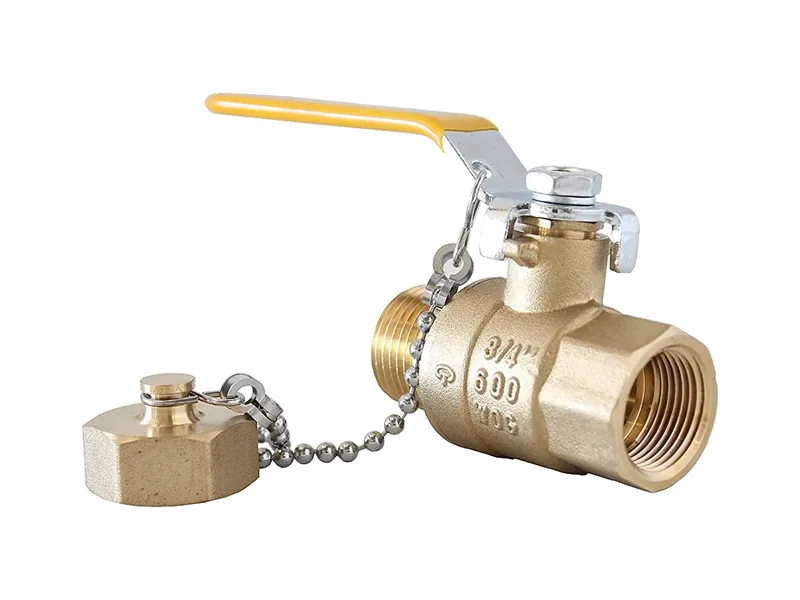
Sheridan sits where Hamilton County's suburbs give way to farm country, and its housing is small-town Indiana at its most authentic: a historic Main Street core, postwar homes, and farmhouses on the surrounding township roads. Water heaters here are often veterans, installed a decade or two ago and never serviced, with drain valves that have been sitting in hot, hard water the entire time.
In town, municipal water runs moderately hard. Outside town, private wells are common, and well water in this area frequently carries iron and fine grit. Both chemistries destroy plastic drain valves; they just do it differently. Town valves cement shut with calcium; well valves plug with iron. Either way, the first real attempt to use the valve ends the same way, and the permanent fix is a full-port brass ball valve installed in a single visit.
IN SHORT
Drain valve replacement in Sheridan, IN 46069 swaps failed plastic valves for full-port brass ball valves. Same-day service. Call (833) 713-2101.
Small-Town Tanks and Decades of Neglect
Sheridan's homes tend to keep their water heaters a long time. In a town where people stay put, a tank installed in 2005 and never flushed is not a story, it is the norm. The drain valve on such a tank has spent twenty years in 130-degree hard water without moving once. The washer has fused to the seat. Sediment has entombed the valve body. The handle is brittle enough to snap under firm hand pressure.
The failure arrives with the usual triggers: a homeowner decides to flush, a repair needs a drain, an inspector tests the valve, or a weep appears on the basement floor. In Sheridan we see a higher-than-average share of the dramatic variants, handles snapping, valve bodies cracking, because the valves here are simply older on average than in the southern suburbs. Age plus hard water plus plastic is the complete recipe.
The advice for Sheridan's long-tenure homeowners is direct: do not test a decades-old valve yourself. If the tank is old and the valve has never moved, call (833) 713-2101 first. We assess whether the valve is operable or needs replacement before anyone puts torque on it, which is the difference between a planned swap and a broken valve on a full, pressurized tank.
Well Water, Iron, and Farmhouse Valves
Outside Sheridan's town limits, farmhouses on private wells face the iron problem. Well water in northern Hamilton County commonly carries dissolved iron and fine sand, and iron sediment is uniquely hostile to drain valves: coarse, abrasive, and prone to packing valve passages solid. The farmhouse indicators are familiar, orange staining, metallic taste, and a water heater that cannot be flushed because the valve passes nothing at all.
Iron-plugged valves sometimes defeat even the drain step of the replacement, which is why well-water calls get extra planning. We drain through alternate fittings when the valve is a solid plug, and we budget the time honestly. The replacement itself is the same full-port brass ball valve, whose wide bore passes the sediment that plugs plastic valves, and whose brass body resists the corrosion that iron water accelerates.
Treatment equipment is common on these wells, iron filters, softeners, sediment filters, and each stage changes the water's behavior. Softened well water in particular can be aggressive toward plastic and rubber valve parts. Whatever the treatment chain, brass is the correct answer: it is indifferent to hardness, iron, softening, and all their combinations.
The Hands-On Homeowner Trap
Sheridan has more than its share of capable DIY homeowners, and we respect that, which is why we are direct about the trap: the drain valve is the one water heater part where DIY most often goes wrong. The failure pattern is consistent. A homeowner decides to flush the tank, the valve resists, pliers come out, the handle snaps or the valve body cracks, and a maintenance task becomes an emergency with a full tank of hot water and no working drain.
The safe DIY move is the phone call before the wrench. If the valve has not moved in years, let us evaluate it first. Often we can replace it proactively in the same visit as the flush you were planning, which means you still get your flush, just with a new brass valve making it possible instead of a broken plastic one making it a crisis.
After we install the brass valve, DIY flushing becomes genuinely safe and easy, and we will show you how. Lever open, run until clear, lever closed. That is the entire procedure, and it is the one we want Sheridan's hands-on homeowners doing annually. The valve replacement is what makes the DIY safe; the annual flush is what makes the tank last.
What the Visit Involves
Call (833) 713-2101 and describe the valve, dripping, stuck, broken, or seeping, plus the tank's age and location. Sheridan heaters sit in basements, crawlspaces, garages, and farmhouse utility rooms; the location sets our drain hose plan. Mention well water if applicable, since iron-plugged valves get a different drain approach. Same-day scheduling is standard.
On site: shutdown, cool-down, controlled drain. Hose to the existing valve if it passes water, otherwise through alternate fittings, routed to a floor drain, sump, sink, or outside. Farm properties sometimes need longer hose runs, which we plan in advance. Veteran tanks drain slowly and run brown and gritty; we allow the time for a complete drain.
Extraction takes patience: decades of sealant and mineral cementing, sometimes iron corrosion, all yield to steady controlled leverage that protects the tank's steel threads. The full-port brass ball valve threads in with fresh sealant. Refill, air purge, restart, and the demonstration, open and close under full pressure while you watch. One to two hours, and the valve is permanently solved.
What Happens When You Call (833) 713-2101
Call (833) 713-2101 and describe the valve, tank, and water source. Town or well water changes our drain plan, so mention it. We schedule a same-day Sheridan visit. We do the replacement. Shutdown, controlled drain, patient extraction of the old valve, and a full-port brass ball valve installed with fresh sealant. We prove it under pressure. Refill, purge, restart, then cycling the new valve while you watch, plus a flushing tutorial for DIY maintenance.
Country Homes: Long Driveways and Hidden Shutoffs
Sheridan's country homes add variables the suburbs do not have: a long driveway, a well pressure tank in the corner, and a main shutoff that might be in the crawlspace, the well house, or — we have seen it — buried under the previous owner's landscaping. Before we arrive, locating your main water shutoff saves real time. If you cannot find it, tell us when you call (833) 713-2101 and we will talk you through the usual hiding spots.
Well systems add a step to the visit: we coordinate with the pressure tank and check the pressure switch while we are there, since well sediment is what fills the tank in the first place. And because rural service calls cover more ground, we confirm the plan by phone before rolling — heater location, shutoff situation, well or municipal — so the visit is one trip, not two.
The Real Cost of Waiting on a Weeping Valve
A drain valve weep looks harmless — a drip every few seconds into a bucket you empty weekly. Here is the math we walk Sheridan homeowners through: that drip runs twenty-four hours a day, and valves do not heal. The washer keeps degrading, the drip becomes a stream, and the stream finds the path of least resistance — under the finished wall, into the subfloor, toward the furnace.
By the time a weep becomes a call, the valve is usually the cheapest part of the visit; the expensive part is what the water touched. A valve replacement is a one-to-two-hour scheduled visit. A valve failure is an emergency call plus flooring, drywall, and possibly mold remediation. We have done both kinds of visits in Sheridan, and the scheduled one costs a fraction of the emergency every single time. If your valve is weeping today, calling (833) 713-2101 today beats calling at midnight.