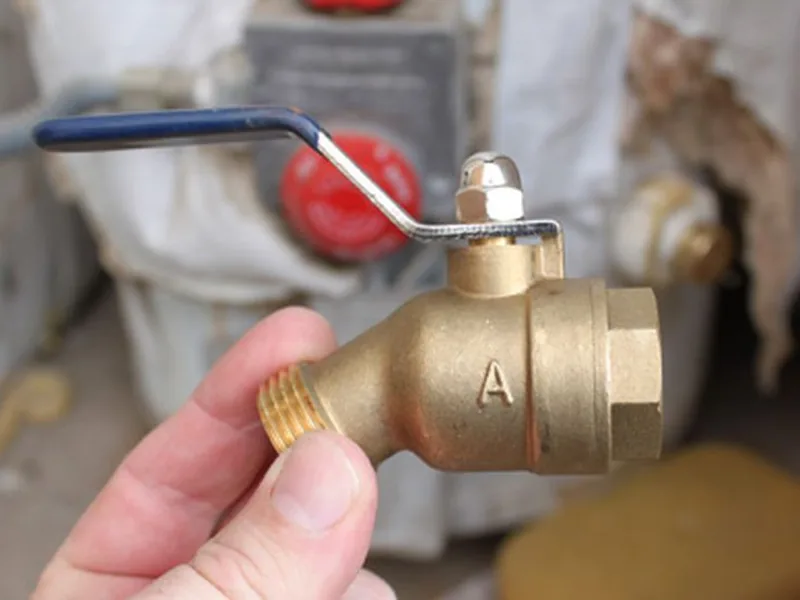
Whitestown's growth story is written in subdivisions: phases opening year after year, young families moving in, water heaters installed during construction and then forgotten. The town's tanks are among the youngest in our service area, most under fifteen years old. But youth does not protect the drain valve. The factory plastic spigot at the tank's base degrades on the water's schedule, not the tank's, and Whitestown's hard water runs a fast schedule.
Municipal water serves Whitestown's subdivisions and runs hard, typical of Boone County groundwater in the low-to-mid teens of grains per gallon. From the first year of service, sediment settles to the tank bottom where the valve lives. The washer begins fusing to the seat. The handle begins embrittling in the heat. By the time a Whitestown homeowner attempts the first real flush, often five to eight years in, the valve is frequently already compromised.
IN SHORT
Drain valve replacement in Whitestown, IN 46075 gives young tanks a full-port brass ball valve before the first flush. Same-day service. Call (833) 713-2101.
The First-Flush Failure in New Subdivisions
Whitestown's signature valve call has a specific narrative. The homeowner, often in the house five to eight years, reads that water heaters should be flushed annually. Being conscientious, they buy a hose, find the drain valve, and open it. Brown water surges out. Satisfied, they close the valve, and it keeps dripping. Or it closes but the flow never fully stops. Or the handle, turned for the first time since installation day, cracks.
The homeowner did everything right and got punished for it, which feels unfair because it is. The fault lies with the part, not the person. A plastic valve left compressed and heat-cycled for years cannot be expected to operate like new, and in hard water the sediment complicates everything. The correct sequence was valve replacement first, then flushing, and that is the sequence we recommend to every Whitestown homeowner who has not yet attempted a flush.
The good news is that this is the easiest version of the job. Young tank, moderate sediment, straightforward drain, clean extraction. Done proactively, before the first flush attempt, it is a calm one-hour visit that sets up a decade of trouble-free maintenance. Done reactively, after a failed flush, it is the same job plus water damage risk and stress. The choice is obvious.
Why New Tanks Ship With Bad Valves
Homeowners are often surprised that a nearly new water heater has a valve worth replacing. The explanation is manufacturing economics. The drain valve is a cost line on a competitive appliance, and the plastic spigot is the cheapest part that passes the factory pressure test. It is designed to survive until the warranty expires under the assumption, unstated but real, that most homeowners will never operate it.
In Whitestown's subdivisions, that assumption mostly holds, which is precisely the problem. The valve survives by never being used, and it fails the first time it is used. It is a single-use part in a component that should be operated yearly. No amount of tank youth changes this; a two-year-old tank and a twelve-year-old tank have functionally identical valves if neither has ever been operated.
The brass ball valve corrects the manufacturer's economizing permanently. Lead-free brass body, full-port bore, quarter-turn lever, no washer to fuse, no plastic to embrittle. It is the valve the tank should have shipped with, and on a young Whitestown tank it will likely outlast the heater itself.
The Visit in a Whitestown Home
Call (833) 713-2101 and tell us about the valve and tank. If the valve has never been operated and you want it replaced proactively before your first flush, say so; that is one of our favorite calls, because it is the job done right. Tank age and heater location, garage, basement, or utility closet, complete the planning. Same-day scheduling is standard.
On site: shutdown, cool-down, controlled drain. Hose to the existing valve, routed to a floor drain, sump, utility sink, or outside. Young Whitestown tanks typically drain quickly and relatively cleanly, which makes proactive replacement genuinely pleasant work. We still drain fully and carefully, because the extraction requires the tank down.
The factory valve comes out, usually without the drama of a veteran tank, though proper technique still matters: hardened sealant yields to steady leverage, tank threads protected throughout. The full-port brass ball valve threads in with fresh sealant. Refill, air purge, restart, and the demonstration, open and close under full pressure while you watch, followed by a flushing tutorial so your first real flush goes perfectly.
Whitestown Water and the Decade Ahead
Whitestown's municipal water is hard, low-to-mid teens grains per gallon, and every tank in 46075 accumulates sediment on that schedule from day one. The valve replacement does not change the water; it changes your relationship with the water. With a working full-port valve, annual flushing becomes a five-minute habit instead of an annual gamble, and flushed tanks in hard water last meaningfully longer.
Consider the decade ahead for a typical Whitestown subdivision tank. With the factory valve, the likely path is: first flush attempt fails, valve replaced reactively, or valve never attempted and tank never flushed, sediment deepens, efficiency drops, heater dies early. With the brass valve installed proactively, the path is: annual five-minute flushes, minimal sediment, full service life. Same tank, same water, different valve, different decade.
For Whitestown's young families, the framing is simple: one hour, one visit, one permanent part, and the water heater becomes the most boring appliance in the house, which is exactly what a water heater should be.
What Happens When You Call (833) 713-2101
Call (833) 713-2101 and tell us about the valve and tank. Proactive replacement before the first flush is our favorite call. Same-day scheduling in Whitestown. We perform the clean swap. Shutdown, controlled drain, careful extraction of the factory valve, and a full-port brass ball valve installed with fresh sealant. We prove it and teach. Refill, purge, restart, pressure-cycling the new valve while you watch, plus a flushing tutorial for confident DIY maintenance.
The New-Build Punch List: Do Not Skip the Valve
Whitestown's subdivisions are among Indiana's newest, and every water heater in them shipped with the same plastic drain valve. New-home punch lists cover paint touch-ups and cabinet alignment; almost nobody tests the drain valve. That is a mistake with a one-year expiration date, because builder warranties cover defective valves only inside that first year. Add this to your punch list: attach a hose, open the valve for thirty seconds, close it, and watch for a weep over the next hour.
If it fails, it is a warranty claim. If it passes, you have exercised it once — more than most valves get in a decade — and exercised valves stay working. Better yet, have us upgrade it to brass during the first year while the threads are fresh and extraction takes minutes. A brass valve installed in year one will still be operating perfectly when that tank is replaced in year twelve. In a town built this decade, the valve is the one original part worth replacing early.
New Pipes, Hard Water: Whitestown's Quiet Combination
New construction means new plumbing, and new plumbing means clean pipes — but the water filling them is the same hard central-Indiana water the rest of the region gets. The misconception we hear in Whitestown: the house is new, so the water heater does not need maintenance yet. Sediment does not care about your closing date. From the first heating cycle, minerals precipitate and settle, and the drain valve — sitting in the sediment zone from day one — starts its slow march toward seizure.
The timeline is just shifted: instead of a fifteen-year-old valve failing, it is a six-year-old valve failing on a tank that should have decades left. The fix is the same at any age, but it is cheapest now — fresh threads, no corrosion, a short extraction. Pair the brass valve with a yearly flush starting in year one, and your Whitestown heater will outlive its expected lifespan instead of limping to it. New house, same water — maintain accordingly.
Your First Flush, Step by Step
Once the brass valve is in, flushing your Whitestown tank is a fifteen-minute annual habit. Here is the whole procedure: attach a standard garden hose to the drain valve and run it to a floor drain, laundry tub, or out to the yard — somewhere the hot discharge will not scald plants or people. Open the valve fully with a quarter-turn of the lever. Let it run five to ten minutes, until the water runs clear. The first flush on a neglected tank may run cloudy longer; that is normal.
Close the valve firmly and remove the hose. That is it — no shutdown, no tools, no service call. Two cautions: never drain an electric tank below the heating elements with the power on, and never leave the valve open and walk away — a forgotten open valve can drain the tank and damage the heater. Set a yearly reminder for early fall, before heating season peaks. After two or three flushes you will notice the water runs clear faster each time. That is the sediment load dropping and your heater breathing easier. The brass valve makes this possible; the habit makes it matter.