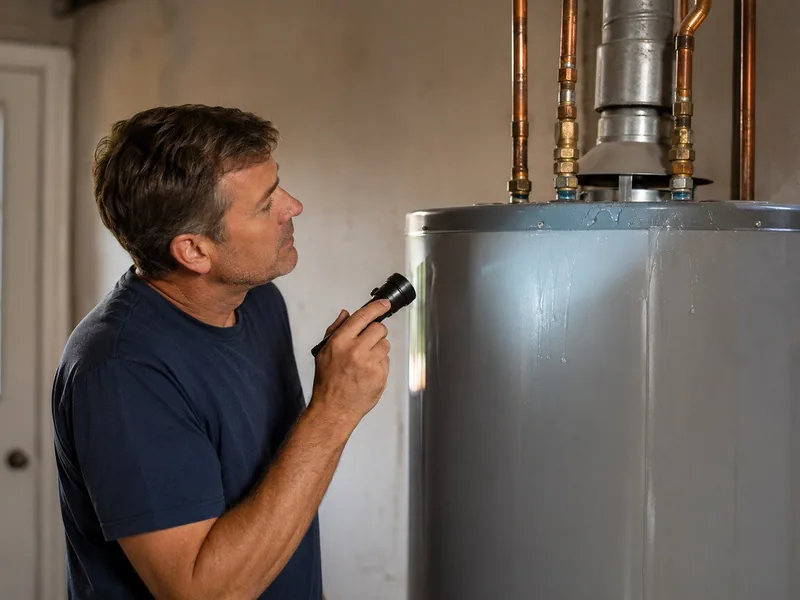
Emergency water heater leak repair in McCordsville, IN 46055 starts with a phone call and ends with the water stopped, the source found, and a clear plan. Whether it is a burst fitting at midnight or a slow seep discovered on a Saturday morning, we respond across the 46055 area days, nights, weekends, and holidays. With finished basements standard across much of McCordsville, a leaking water heater is not just a plumbing problem, it is a flooring, drywall, and furniture problem, which is why fast response matters more here than in towns where heaters sit on bare concrete.
McCordsville is a small but fast-growing town on Indianapolis's northeast edge, where cornfields have been giving way to subdivisions for two decades. Most of the housing is 2000s construction or newer. Nearly all McCordsville homes date from the 2000s through today, which means most water heaters are original to the house and are now entering the 12-to-20-year failure window together. Tract two-stories with basements dominate the subdivisions.
IN SHORT
Emergency water heater leak repair in McCordsville, IN 46055 stops active leaks fast, day or night. When you call (833) 713-2101, we first walk you through shutting off the cold-water inlet and power or gas to the heater, then dispatch a technician to find the leak source and stabilize the situation.
How Emergency Leak Repair Works in McCordsville, IN 46055
Not every water heater leak is the same emergency, and the first job is telling them apart. A drip from the drain valve, a weeping supply fitting, or a T and P valve discharging because of thermal expansion are all fixable problems on the existing tank. A leak from the tank seam or the base, rust-colored water pooling under the jacket, means the steel has failed and the tank needs replacement. In McCordsville, where nearly all mccordsville homes date from the 2000s through today, which means most water heaters are original to the house and are now entering the 12-to-20-year failure window together, we see the full spectrum, and the phone triage is designed to sort it before we roll the truck.
The triage follows the same order every time. First, stop the water: the cold-water inlet valve on top of the heater, clockwise to close. If that valve is seized, and in McCordsville's housing stock it sometimes is, the main house shutoff is the backup. Second, kill the heat source: breaker off for electric, gas control to pilot or off for gas. Third, contain: towels, a drain pan, and a hose on the drain valve directing water to a floor drain if the leak is heavy. Our dispatcher walks 46055 callers through all three steps on the initial call, because the ten minutes before we arrive are when most water damage happens.
Finished basements change our priorities on arrival. Before touching the heater, we assess what the water has reached: carpet and pad, drywall base, stored belongings. We get the leak isolated first, then help you understand the drying situation honestly. Many McCordsville homeowners are surprised to learn their heater sat directly on finished flooring with no drain pan, and after an emergency visit we usually recommend adding a pan with a drain or a water alarm, cheap insurance in a town where the next tank will also sit over finished space.
On arrival, the diagnostic sequence is methodical. We dry the area and watch where water reappears: top fittings and the T and P discharge line point to connections or pressure issues, the drain valve points to a valve failure, and water seeping from under the jacket or the base seam points to tank failure. Thermal expansion gets special attention in McCordsville, because closed plumbing systems with check valves or pressure regulators need an expansion tank, and a missing or waterlogged expansion tank will make the T and P valve weep every heating cycle, which looks exactly like a leak to a worried homeowner.
What the emergency visit includes
- Phone triage first: shutoff guidance for the inlet valve, power or gas, and well pump where applicable, before the truck rolls.
- Leak isolation on arrival: water stopped at the closest working valve, tank safed, and the area dried so the true source can be seen.
- Source diagnosis: fittings, valves, T and P and expansion issues, versus tank seam or base failure, identified by watching where water reappears.
- Stabilization: repairable leaks are repaired on the spot where possible; failed tanks are drained down and made safe, with clear next steps for replacement.
- Prevention notes for the home: shutoff locations labeled, and recommendations like drain pans or alarms where McCordsville homes typically lack them.
Local Factors That Change Emergency Response in 46055
Water chemistry drives failure timing. Municipal water serves McCordsville at the region's typical very-hard levels, roughly 12 to 16 grains per gallon. Softeners are common in these newer homes, and the combination of young tanks, hard water, and softening defines the maintenance picture here. Hard water plus age is the combination that produces sudden tank failures, and McCordsville has both in abundance. The leaks we answer here are rarely mysterious; they are the predictable end of a corrosion story the local water has been writing for a decade.
Housing layout decides the damage. Basement utility rooms are the standard placement, with some garage installs in slab sections. Access is modern and straightforward, but finished basements are increasingly common, so leak stakes are rising as the original tanks age out. Where the heater sits determines whether a leak is an inconvenience or an insurance claim, and our triage questions are tuned to figure out your layout fast.
Shutoff condition is the wild card. Nearly all McCordsville homes date from the 2000s through today, which means most water heaters are original to the house and are now entering the 12-to-20-year failure window together. In McCordsville we regularly find inlet valves that have not been turned in a decade or more. Testing yours twice a year, just closing and reopening it, is a five-minute habit that pays off enormously when a real leak starts at an inconvenient hour.
Common leak sources we find in McCordsville
- Drain valve failures: cracked plastic or sediment-fouled seats, the most common slow leak.
- Supply fittings and dielectric unions corroded by years of condensation and hard-water weeping.
- T and P valve discharge from thermal expansion where no working expansion tank is installed.
What Happens When You Call (833) 713-2101
Answer, and we go straight to triage: where is the water coming from, can you reach the cold-water inlet valve, is the heater gas or electric. We talk you through shutting the water and heat source down before anything else, then dispatch to your McCordsville address. On arrival we isolate, diagnose, and stabilize, and you get a plain-English explanation of what failed and what comes next. Day, night, weekend, or holiday.