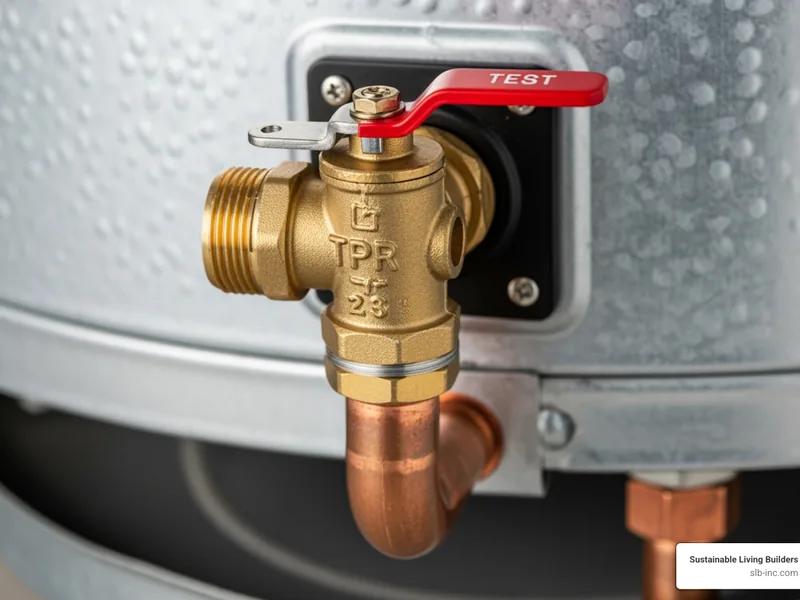
Fishers, IN 46038 — one of Indiana's fastest-growing cities, stretching from Geist Reservoir to Conner Prairie — is where we handle some of our most frequent gas control valve replacement calls. Fishers housing is overwhelmingly 1990s-to-2020s subdivisions — two-story colonials, large ranch homes, and townhome clusters — with new sections still opening near the Geist corridor. Water heaters typically sit in the garage, and two-story builds very often place the unit in the attic above the garage or a bedroom wing.
Fishers homes are served by municipal and regional water systems drawing on central Indiana aquifers, and the water is hard — commonly 13 to 19 grains per gallon. High-occupancy family homes push a lot of that hard water through the heater every day, building sediment fast. Attic platforms and garage corners are the two standard locations. Attic work means ladder access and working above finished ceilings; garage work is easy but exposes pipes and valves to winter cold snaps. This page walks through exactly how Water Heater Leak Repair Co. approaches gas control valve replacement in Fishers: the signs to watch for, our step-by-step process, and the local factors that change the job. Ready now? Call (833) 713-2101.
In Short: Gas Control Valve Replacement in Fishers, IN 46038
If your gas water heater in Fishers, IN 46038 has pilot trouble, erratic temperatures, or a burner that will not ignite, the gas control valve is the likely culprit. Water Heater Leak Repair Co. diagnoses it honestly and replaces the valve in a single visit. Call (833) 713-2101.
How Gas Control Valve Replacement Works in Fishers, IN 46038
In Fishers, Fishers housing is overwhelmingly 1990s-to-2020s subdivisions — two-story colonials, large ranch homes, and townhome clusters — with new sections still opening near the Geist corridor. Water heaters typically sit in the garage, and two-story builds very often place the unit in the attic above the garage or a bedroom wing. That matters for gas valve work because valve replacement means draining the tank below the valve port, pulling the burner assembly, and working with gas connections — all of which go smoother with the right access plan, which we set before we arrive.
Hard water is the quiet killer of gas control valves. Fishers homes are served by municipal and regional water systems drawing on central Indiana aquifers, and the water is hard — commonly 13 to 19 grains per gallon. High-occupancy family homes push a lot of that hard water through the heater every day, building sediment fast. Sediment blankets the tank bottom, the burner runs longer and hotter to push heat through, and that chronic overheating cooks the valve's thermostat and seals. When we replace a valve here, we always address the sediment that killed the last one.
Attic platforms and garage corners are the two standard locations. Attic work means ladder access and working above finished ceilings; garage work is easy but exposes pipes and valves to winter cold snaps. For a gas valve job that means we plan the drain-down, the burner removal, and the gas leak check around the real-world constraints of your utility space — not an idealized workshop.
Signs Your Fishers Home Needs Gas Control Valve Replacement
Gas control valves rarely fail without warning. In Fishers homes, these are the symptoms that point to the valve rather than the tank:
- The pilot will not stay lit: A healthy thermocouple holds the pilot open, but a failing gas valve drops it anyway. If you have relit the pilot more than once and it keeps dying, the valve — not your relighting technique — is the prime suspect.
- No hot water despite a running burner: When the valve's thermostat probe misreads tank temperature, the burner may fire at the wrong times or shut off early. Lukewarm water from a heater that sounds like it is working is a classic valve-thermostat failure.
- Water far too hot or wildly inconsistent: A valve stuck open overheats the tank, which is dangerous as well as uncomfortable. Scalding-hot water or big temperature swings mean the valve has lost control and needs immediate attention.
- Burner will not ignite at all: If the pilot lights but the main burner never catches, or nothing ignites despite gas being available, the valve's internal gas metering has usually failed.
- Clicking or delayed ignition: Worn valve internals can cause delayed or rough ignition — the small ‘whoomph’ when the burner finally catches. That stresses the combustion chamber and should not be ignored.
- Water pooling near the valve body: A valve body can weep at its seals or at the threaded tank port. Any moisture around the gas control valve deserves a prompt look, since water and gas controls are a bad combination.
Our Gas Control Valve Replacement Process in Fishers, IN 46038
Here is exactly what happens when we replace a gas control valve in a Fishers home:
Step 1: Gas shutoff and safety check
We close the gas supply valve at the heater and verify zero gas flow, then check the area with a combustible-gas detector. If we ever smell gas beyond a faint pilot odor, we stop and treat it as a gas emergency first — the valve job waits until the area is safe.
Step 2: Diagnose before replacing
We test the thermocouple, thermopile, and pilot assembly independently, because a ten-dollar thermocouple can mimic a failed valve. Only when testing points to the valve itself do we recommend replacement — we do not sell valves to fix thermocouple problems.
Step 3: Controlled drain-down
We shut off the cold-water supply and drain the tank below the valve port. While it drains, we note sediment volume — heavy sediment here usually explains why the valve failed, and we flush it so the new valve starts clean.
Step 4: Valve removal and replacement
We disconnect the pilot tube, thermocouple, and burner supply line, unthread the old valve, and install the new valve with proper thread sealant rated for gas service. The thermostat probe length is matched to the tank so temperature readings stay accurate.
Step 5: Reassembly and leak testing
We reconnect the pilot, thermocouple, and burner lines, restore the gas supply, and test every joint with a gas detector and leak-detection solution. No bubbles, no detector alarms — that is the only acceptable result before we relight.
Step 6: Relight, calibrate, and verify
We relight the pilot, bring the burner up, and verify the thermostat cycles the burner off at the set temperature. We run hot water at a tap to confirm steady delivery, then recheck all gas joints one final time before leaving.
Fishers Factors That Change Gas Control Valve Replacement in 46038
Gas Control Valve Replacement is never one-size-fits-all in Fishers. These local conditions shape how we diagnose and perform the work:
- Attic units over bedrooms: A large share of Fishers two-story homes carry the heater in the attic. We check drain pans, pan drains, and shutoff accessibility on every attic call, because a slow fitting leak upstairs becomes a ceiling collapse downstairs.
- Garage freeze exposure: Garage heaters and their exposed piping are vulnerable during polar-vortex events. We insulate vulnerable runs and check drain valves for freeze cracks on winter service calls.
- High-occupancy demand: Fishers family homes run constant laundry, dishwashers, and showers. Heavy cycling wears elements and gas valves faster, so we verify replacement parts suit the household's actual load.
- New-build PEX and builder parts: Newer Fishers builds use PEX supply lines — easy to work with — but builder-grade valves and elements that fail early under hard water. We upgrade the failed part rather than repeating the builder's minimum spec.
- Finished garages and storage: Many Fishers garages are finished and packed with storage around the heater. We ask for a clear work zone and protect floors and stored items while we work.
Safety Notes for Gas Control Valve Replacement in Fishers
Gas water heaters demand respect. If you smell gas — the rotten-egg odor — do not light anything, do not flip switches, leave the house, and call your gas utility's emergency line first, then us at (833) 713-2101. Never force a stiff gas valve with tools; a cracked valve body leaks gas into the room. And never cap or plug the temperature-and-pressure relief valve to ‘fix’ overheating — that valve is the tank's last defense, and disabling it can turn a bad valve into a dangerous one.