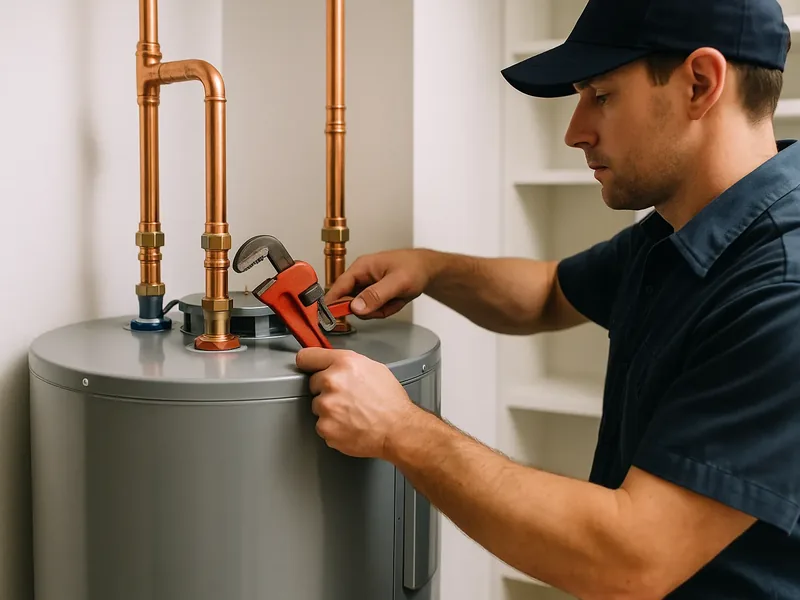
Danville, IN 46122 — the historic Hendricks County seat, built around its courthouse square — is where we handle some of our most frequent tank water heater leak repair calls. Danville's core holds Victorian and early-1900s homes near the square, ringed by mid-century neighborhoods and newer subdivisions to the edges. The historic homes often keep the water heater in a stone or block basement with low headroom and narrow stairs.
The town water system delivers hard water typical of the region — generally 12 to 18 grains per gallon. Older homes with original-era plumbing add rust and scale to the mix, which settles into tanks and works against elements and valves. Historic basements mean tight stairs, low ceilings, and heaters tucked behind furnaces or under stairwells. We plan for difficult carries and bring compact tools; some jobs need the old unit's parts removed in pieces simply to get them up the stairs. This page walks through exactly how Water Heater Leak Repair Co. approaches tank water heater leak repair in Danville: the signs to watch for, our step-by-step process, and the local factors that change the job. Ready now? Call (833) 713-2101.
In Short: Tank Water Heater Leak Repair in Danville, IN 46122
If your tank water heater in Danville, IN 46122 is pooling water, dripping from the relief valve, or showing rust streaks, Water Heater Leak Repair Co. traces the leak to its true source and repairs what is repairable. Call (833) 713-2101.
How Tank Water Heater Leak Repair Works in Danville, IN 46122
In Danville, Danville's core holds Victorian and early-1900s homes near the square, ringed by mid-century neighborhoods and newer subdivisions to the edges. The historic homes often keep the water heater in a stone or block basement with low headroom and narrow stairs. Where the heater sits determines how fast a leak gets noticed and how much damage it does before it does — a basement puddle is obvious, while a slow weep in a crawl space or behind a finished wall can run for weeks.
Hard water drives most tank leaks from the inside out. The town water system delivers hard water typical of the region — generally 12 to 18 grains per gallon. Older homes with original-era plumbing add rust and scale to the mix, which settles into tanks and works against elements and valves. Sediment stresses the tank bottom, depleted anodes let corrosion start, and mineral-laden water weeps through weakened fittings. Finding the leak is step one; understanding the water chemistry behind it keeps the repair from being temporary.
Historic basements mean tight stairs, low ceilings, and heaters tucked behind furnaces or under stairwells. We plan for difficult carries and bring compact tools; some jobs need the old unit's parts removed in pieces simply to get them up the stairs. Leak tracing means following water to its highest point, which takes good lighting, dry test areas, and patience — we bring all three and plan the inspection around your home's real layout.
Signs Your Danville Home Needs Tank Water Heater Leak Repair
Tank leaks hide well. In Danville homes, watch for these signs that water is escaping where it should not be:
- Water pooling at the tank base: The most obvious sign — but the puddle's location rarely marks the leak's source. We trace upward from the puddle to find whether it is a fitting, a valve, or the tank body itself.
- Dripping from the T&P discharge pipe: The temperature-and-pressure relief valve's discharge pipe should be dry. Steady dripping means the valve is weeping from age, debris, or excessive pressure — each with a different fix.
- Rusty streaks down the tank jacket: Rust trails running down from a fitting, the anode port, or a seam mark where water has been escaping and evaporating. Fresh rust means an active leak; old staining means one worth investigating.
- Hissing or sizzling near the tank: On gas heaters, water dripping onto the hot burner or flue sizzles audibly. That sound means water is reaching places it must not, and the source needs finding promptly.
- Damp drywall or musty smells nearby: A slow leak wicks into drywall, baseboards, and flooring long before it forms a visible puddle. Musty odors around the utility area are an early warning worth heeding.
- Water meter moving with everything off: If the meter's leak indicator spins with all fixtures closed, water is going somewhere — and a weeping heater connection is a common somewhere. We isolate the heater to confirm.
Our Tank Water Heater Leak Repair Process in Danville, IN 46122
Our leak repair process in Danville follows the water to its source before we touch a wrench:
Step 1: Trace the leak to its origin
We dry the area and watch where water reappears, check the tank top, fittings, T&P discharge, drain valve, and seams in order. Water runs downhill and along pipes, so we trace upward until we find the highest wet point — that is the source.
Step 2: Shut down safely
We close the cold-water supply and shut off power at the breaker or gas at the supply valve. For active leaks we also attach a hose to the drain valve so we control where the water goes instead of letting it spread.
Step 3: Repair the serviceable points
Leaking fittings get resealed or replaced; a weeping T&P valve is replaced and the system pressure checked; a failed drain valve is swapped; corroded supply nipples and connectors are renewed. Each repair matches the cause we found — not a guess.
Step 4: Honest verdict on the tank body
If the leak comes from the tank body itself — a seam, the welded base, or pinholes through corrosion — no fitting repair will hold it. We show you exactly what we found and explain why replacement is the sound recommendation in that specific case.
Step 5: Address the underlying cause
We check system pressure, test the thermal expansion setup, note sediment volume, and check the anode's condition. A repair that ignores 90-psi pressure or a depleted anode is a repair that fails again — we fix the cause alongside the symptom.
Step 6: Refill, pressurize, and verify dry
We refill the tank, restore power or gas, bring the system to full pressure and temperature, and verify every repaired joint stays bone dry. We leave only when the utility area is dry and the leak is demonstrably gone.
Danville Factors That Change Tank Water Heater Leak Repair in 46122
Tank Water Heater Leak Repair is never one-size-fits-all in Danville. These local conditions shape how we diagnose and perform the work:
- Historic homes with tight access: Victorian-era basements were not designed around modern 50-gallon tanks. We map the carry path before starting and confirm replacement parts can physically reach the heater location.
- Original-era plumbing remnants: Some Danville homes still have sections of galvanized or even older piping feeding the heater. We inspect supply nipples and shutoffs because corroded connections are a common secondary leak source.
- Upgraded-over-decades electrical: A 1910 home with a 2020 panel still has old wire runs in the walls. On electric heater calls we verify the circuit from breaker to heater, not just at the panel.
- Stone foundations and damp basements: Older foundations wick moisture, and a damp basement corrodes tank jackets and fittings from the outside. We check for external corrosion that can mimic or mask a leak.
- New subdivisions, builder-grade parts: Danville's newer edges have the same builder-grade components as any growth suburb — adequate, but early failures under hard water are common. We replace with better-grade parts matched to the water.
Safety Notes for Tank Water Heater Leak Repair in Danville
A leaking water heater mixes scalding water with electricity or gas, so treat it with caution. Shut off the cold-water supply valve above the heater to slow the leak, and for electric heaters switch off the dedicated breaker if water is near any wiring — never stand in water to reach a panel. On gas heaters, if water has reached the burner area, shut the gas supply valve and do not relight anything yourself. Never plug or cap a dripping T&P discharge pipe; that valve is protecting the tank from dangerous pressure. Then call Water Heater Leak Repair Co. at (833) 713-2101 and keep people and pets away from standing water near the heater.