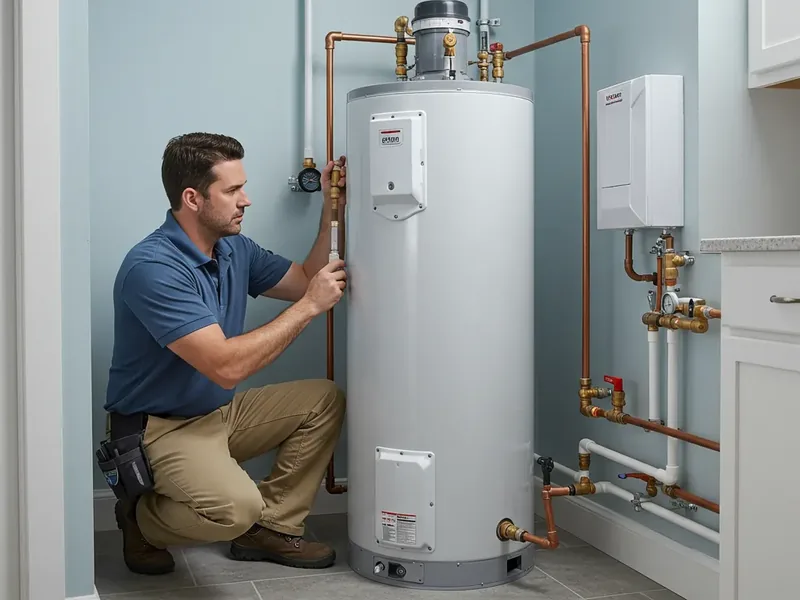
McCordsville, IN 46055 — a fast-growing bedroom community just east of Geist Reservoir — is where we handle some of our most frequent tank water heater leak repair calls. McCordsville is overwhelmingly 2000s-to-2020s subdivisions — two-story colonials, large ranch homes, and townhome villages — built for commuters to Indianapolis and Fishers. Water heaters almost always sit in the garage or a first-floor utility room, with attic placement in some two-story designs.
Municipal and regional systems serve McCordsville with hard water drawn from central Indiana aquifers — typically 13 to 19 grains per gallon. New neighborhoods mean new pipes, but the hardness starts building sediment from the first year. Garage and utility-room installs offer easy, well-lit access — the simplest working conditions in the county. Attic units in two-story homes need ladder access and careful water containment above finished ceilings. This page walks through exactly how Water Heater Leak Repair Co. approaches tank water heater leak repair in McCordsville: the signs to watch for, our step-by-step process, and the local factors that change the job. Ready now? Call (833) 713-2101.
In Short: Tank Water Heater Leak Repair in McCordsville, IN 46055
If your tank water heater in McCordsville, IN 46055 is pooling water, dripping from the relief valve, or showing rust streaks, Water Heater Leak Repair Co. traces the leak to its true source and repairs what is repairable. Call (833) 713-2101.
How Tank Water Heater Leak Repair Works in McCordsville, IN 46055
In McCordsville, McCordsville is overwhelmingly 2000s-to-2020s subdivisions — two-story colonials, large ranch homes, and townhome villages — built for commuters to Indianapolis and Fishers. Water heaters almost always sit in the garage or a first-floor utility room, with attic placement in some two-story designs. Where the heater sits determines how fast a leak gets noticed and how much damage it does before it does — a basement puddle is obvious, while a slow weep in a crawl space or behind a finished wall can run for weeks.
Hard water drives most tank leaks from the inside out. Municipal and regional systems serve McCordsville with hard water drawn from central Indiana aquifers — typically 13 to 19 grains per gallon. New neighborhoods mean new pipes, but the hardness starts building sediment from the first year. Sediment stresses the tank bottom, depleted anodes let corrosion start, and mineral-laden water weeps through weakened fittings. Finding the leak is step one; understanding the water chemistry behind it keeps the repair from being temporary.
Garage and utility-room installs offer easy, well-lit access — the simplest working conditions in the county. Attic units in two-story homes need ladder access and careful water containment above finished ceilings. Leak tracing means following water to its highest point, which takes good lighting, dry test areas, and patience — we bring all three and plan the inspection around your home's real layout.
Signs Your McCordsville Home Needs Tank Water Heater Leak Repair
Tank leaks hide well. In McCordsville homes, watch for these signs that water is escaping where it should not be:
- Water pooling at the tank base: The most obvious sign — but the puddle's location rarely marks the leak's source. We trace upward from the puddle to find whether it is a fitting, a valve, or the tank body itself.
- Dripping from the T&P discharge pipe: The temperature-and-pressure relief valve's discharge pipe should be dry. Steady dripping means the valve is weeping from age, debris, or excessive pressure — each with a different fix.
- Rusty streaks down the tank jacket: Rust trails running down from a fitting, the anode port, or a seam mark where water has been escaping and evaporating. Fresh rust means an active leak; old staining means one worth investigating.
- Hissing or sizzling near the tank: On gas heaters, water dripping onto the hot burner or flue sizzles audibly. That sound means water is reaching places it must not, and the source needs finding promptly.
- Damp drywall or musty smells nearby: A slow leak wicks into drywall, baseboards, and flooring long before it forms a visible puddle. Musty odors around the utility area are an early warning worth heeding.
- Water meter moving with everything off: If the meter's leak indicator spins with all fixtures closed, water is going somewhere — and a weeping heater connection is a common somewhere. We isolate the heater to confirm.
Our Tank Water Heater Leak Repair Process in McCordsville, IN 46055
Our leak repair process in McCordsville follows the water to its source before we touch a wrench:
Step 1: Trace the leak to its origin
We dry the area and watch where water reappears, check the tank top, fittings, T&P discharge, drain valve, and seams in order. Water runs downhill and along pipes, so we trace upward until we find the highest wet point — that is the source.
Step 2: Shut down safely
We close the cold-water supply and shut off power at the breaker or gas at the supply valve. For active leaks we also attach a hose to the drain valve so we control where the water goes instead of letting it spread.
Step 3: Repair the serviceable points
Leaking fittings get resealed or replaced; a weeping T&P valve is replaced and the system pressure checked; a failed drain valve is swapped; corroded supply nipples and connectors are renewed. Each repair matches the cause we found — not a guess.
Step 4: Honest verdict on the tank body
If the leak comes from the tank body itself — a seam, the welded base, or pinholes through corrosion — no fitting repair will hold it. We show you exactly what we found and explain why replacement is the sound recommendation in that specific case.
Step 5: Address the underlying cause
We check system pressure, test the thermal expansion setup, note sediment volume, and check the anode's condition. A repair that ignores 90-psi pressure or a depleted anode is a repair that fails again — we fix the cause alongside the symptom.
Step 6: Refill, pressurize, and verify dry
We refill the tank, restore power or gas, bring the system to full pressure and temperature, and verify every repaired joint stays bone dry. We leave only when the utility area is dry and the leak is demonstrably gone.
McCordsville Factors That Change Tank Water Heater Leak Repair in 46055
Tank Water Heater Leak Repair is never one-size-fits-all in McCordsville. These local conditions shape how we diagnose and perform the work:
- New-build heater stock: Most McCordsville heaters are under 15 years old, which means failures are component-level: elements, gas valves, thermocouples, and T&P valves — not dead tanks. We repair rather than replace whenever the tank is sound.
- Builder-grade original parts: Tract-built subdivisions use builder-grade components that meet minimum spec and fail early under hard water. We see original elements and valves giving up at year six or seven regularly.
- Garage freeze exposure: Garage installs are convenient but cold. Winter cold snaps crack drain valves and split exposed piping, so cold-weather calls always include a freeze check.
- Attic units in two-story homes: Some two-story designs put the heater in the attic, where a leak rains through insulation and drywall. We verify drain pans and pan drains on every attic visit.
- HOA communities and scheduling: McCordsville's HOA neighborhoods have rules about work vehicles, hours, and noise. We schedule within community guidelines and keep driveways and work areas clean.
Safety Notes for Tank Water Heater Leak Repair in McCordsville
A leaking water heater mixes scalding water with electricity or gas, so treat it with caution. Shut off the cold-water supply valve above the heater to slow the leak, and for electric heaters switch off the dedicated breaker if water is near any wiring — never stand in water to reach a panel. On gas heaters, if water has reached the burner area, shut the gas supply valve and do not relight anything yourself. Never plug or cap a dripping T&P discharge pipe; that valve is protecting the tank from dangerous pressure. Then call Water Heater Leak Repair Co. at (833) 713-2101 and keep people and pets away from standing water near the heater.