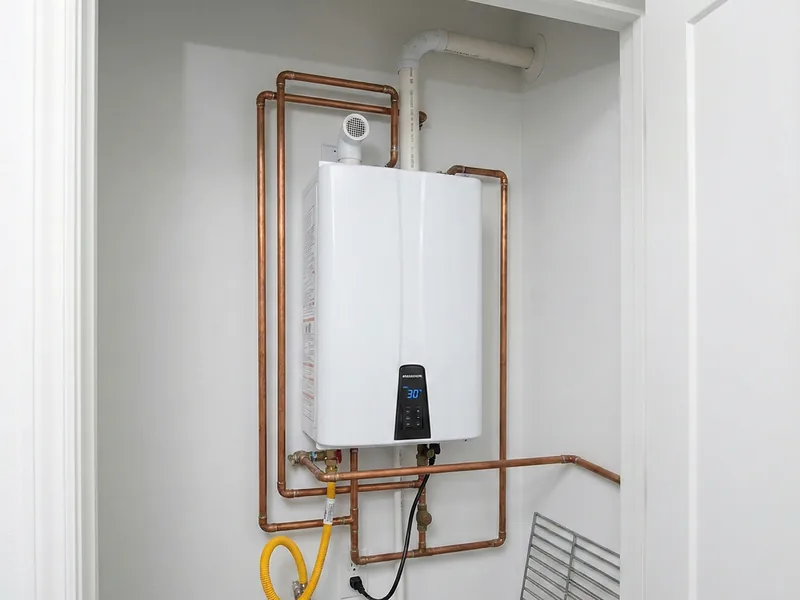
Tankless water heaters are still relatively uncommon in Arcadia, IN 46030 — most homes run traditional tanks — but the units that are here tend to be in newer infill builds, renovated farmhouses, and homes whose owners chose endless hot water deliberately. When a tankless unit leaks in Arcadia, the causes differ fundamentally from tank leaks: there is no 40-gallon reservoir to rust through, but there are heat exchangers that develop pinhole leaks from scale, condensate systems that clog and overflow, service valves that weep, and venting that drips condensation back into the cabinet.
Water Heater Leak Repair Co. provides tankless water heater leak repair in Arcadia, IN 46030 for gas condensing and non-condensing units. We diagnose the leak's origin — heat exchanger, condensate, plumbing connections, or venting — then repair with descaling, component replacement, and corrected drainage as needed. Call (833) 713-2101 and describe where the water is appearing.
In Short: Tankless leaks in Arcadia, IN 46030 most often come from scale-damaged heat exchangers, clogged condensate drains on condensing units, weeping service valves, or venting condensation. We pinpoint the source, descale the heat exchanger, repair or replace failed components, and verify leak-free operation under full fire — usually in a single visit.
How Tankless Water Heater Leak Repair Works in Arcadia, IN 46030
A tankless unit heats water on demand as it flows through a copper or stainless heat exchanger — no stored volume, but intense thermal stress concentrated in a small component. Our Arcadia diagnostic starts with the leak's location and timing, because each origin tells a different story.
Water dripping from inside the cabinet during or after firing points to the heat exchanger: pinhole leaks from scale-induced hot spots, or gasket and O-ring failures at the exchanger's water connections. Arcadia's hard water — especially on well-fed properties — is brutal on heat exchangers. Without regular descaling, calcium plates the exchanger's waterways, creating insulated hot spots where the metal overheats, weakens, and eventually pinholes. We confirm with a visual inspection inside the cabinet (with the unit cool and isolated) and, when scale is implicated, perform a full descaling flush: circulating food-grade descaling solution through the isolated exchanger via the service valves until flow and heat transfer normalize.
Water pooling beneath a condensing unit usually means the condensate system. Condensing tankless heaters extract extra efficiency by cooling exhaust below the dew point, producing acidic condensate that must drain freely — typically through a neutralizer then to a drain. In Arcadia we find condensate traps clogged with sediment, neutralizer media exhausted and cemented, and drain lines frozen or kinked — any of which backs condensate up into the cabinet, where it overflows and corrodes. We clear the trap, replace spent neutralizer media, and verify free drainage; where freeze is the culprit, we reroute or insulate the line.
Weeping at the service valves — the hot and cold isolation valves with hose bibs used for flushing — is Arcadia's most common minor tankless leak. Valve packing dries, hose-bib caps weep, and the threaded connections work loose from thermal cycling. We repack or replace service valves and verify them under full operating pressure.
Venting condensation affects non-condensing units vented with long horizontal runs: exhaust cools in the vent, condensation forms, and improper slope sends it back into the unit instead of out. We inspect vent slope and termination during leak diagnosis — a venting issue masquerades as a unit leak convincingly.
After repair, we run the unit through full-fire operation — maximum flow, maximum temperature rise — and verify every repaired point stays dry. We also check the pressure relief valve (tankless units have one, usually on the hot outlet) and confirm it is not the actual leak source. During a tankless water heater leak repair in Arcadia, IN 46030, the verification run is the proof.
Arcadia's Descaling Deficit
The single most preventable cause of tankless leaks in Arcadia is skipped descaling. Manufacturers recommend annual descaling in hard water; most Arcadia units we service have never been descaled once. The progression is predictable: scale narrows waterways, the unit works harder for the same temperature rise, hot spots form, efficiency drops, error codes appear — and eventually the exchanger pinholes or a gasket fails from thermal stress. A descaling service costs far less than a heat exchanger, and we recommend annual descaling for every tankless unit in Arcadia's hard water, without exception.
Local Factors That Matter for Tankless Leaks in Arcadia, IN 46030
Hard water — municipal and especially well — is Arcadia's defining tankless factor: rapid scaling, hot-spot pinholes, and failed gaskets. Annual descaling is the non-negotiable maintenance.
Well-fed properties add sediment and iron that clog inlet filters and condensate traps; we check the inlet filter screen during every leak service — a clogged screen starves flow and stresses the exchanger.
Rural installations in outbuildings and unheated spaces face freeze risk: a tankless unit's small water volume freezes fast in a power outage. We verify freeze-protection function and advise on outage precautions for exposed installations.
Low tankless density means fewer local technicians truly understand these units; our diagnostic is tankless-specific — combustion, condensate, venting, and descaling — not tank-heater habits applied to the wrong equipment.
When the Heat Exchanger Itself Leaks
A pinholing heat exchanger is the serious tankless leak. Minor weeps at gaskets and fittings are repairable; a perforated exchanger waterway usually means exchanger replacement — a major repair we quote honestly against the unit's age and condition. On units past 12–15 years with a failed exchanger, we will discuss whether replacement of the unit is the wiser investment rather than selling a repair with a short horizon. You get the evidence and the math, not a sales pitch.
Arcadia's Annual Tankless Service Checklist
Every tankless unit in Arcadia should get a professional service once a year — and knowing what that service includes helps you hold it accountable. The checklist: descaling circulation through the isolated heat exchanger until flow normalizes; inlet filter screen removal and cleaning (on well-fed properties, expect significant sediment); condensate trap cleaning and neutralizer media check on condensing units; service valve exercise and packing inspection; vent termination inspection for blockages or corrosion; and a full-fire operational test confirming temperature rise and leak-free joints.
Between professional visits, owners handle two tasks: monthly visual checks for any moisture inside or beneath the cabinet, and noting any change in hot-water performance — longer waits for hot water, temperature fluctuation, or new error codes all precede leaks. In Arcadia's hard water, the descaling is the load-bearing item on the list; everything else is inspection. A unit that gets this annual service will run its full design life. One that does not will be back on the leak-repair schedule — and the second visit always costs more than the maintenance would have.
What Happens When You Call (833) 713-2101
Tell us where the water appears — inside the cabinet, beneath the unit, at the valves — and when (during firing, after, constantly), plus the unit's brand, age, and fuel. We will give a preliminary read on the likely source.
On site: leak-source diagnosis, descaling flush when scale is implicated, component repair or replacement, condensate and venting verification, and a full-fire leak check — usually one visit. Findings and options explained plainly, including the honest exchanger-vs-unit math when it applies.
For tankless water heater leak repair in Arcadia, IN 46030, Water Heater Leak Repair Co. finds the source and fixes it right. Call (833) 713-2101 today.