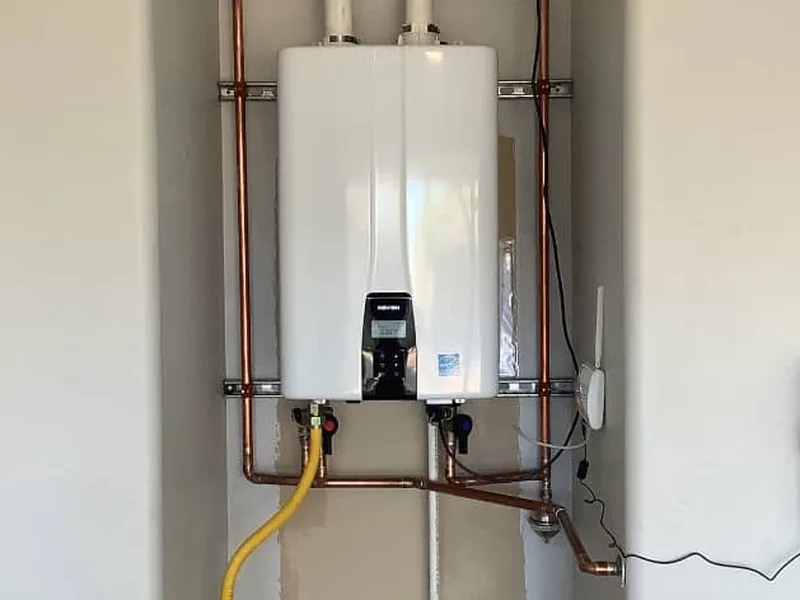
Atlanta, IN 46031 is tank country — but a growing handful of farmhouses, renovated older homes, and new builds run tankless units, and those units leak in ways tanks never do. In Atlanta's very hard well water, tankless heat exchangers scale aggressively: calcium plates the waterways, hot spots form, gaskets fail, and pinholes develop. Add condensate drainage issues on condensing units, weeping service valves, and inlet filters choked with sediment and iron, and Atlanta's small tankless population generates a steady stream of leak calls.
Water Heater Leak Repair Co. provides tankless water heater leak repair in Atlanta, IN 46031 for gas condensing and non-condensing units. We diagnose the leak's origin — heat exchanger, condensate system, service valves, venting, or inlet plumbing — descale when scale is the driver, and repair or replace failed components. Call (833) 713-2101 and tell us where the water is showing up.
In Short: In Atlanta, IN 46031, tankless leaks are dominated by hard-well-water scale damage to heat exchangers, clogged condensate systems, weeping service valves, and sediment-choked inlet filters. We pinpoint the source, perform descaling flushes, repair failed components, and verify leak-free full-fire operation — usually in one visit.
How Tankless Water Heater Leak Repair Works in Atlanta, IN 46031
A tankless heater passes water through a compact heat exchanger at high thermal intensity — efficient, but unforgiving of scale. Our Atlanta diagnostic maps the leak to its origin before any repair begins.
Cabinet-interior dripping during or after firing indicates heat exchanger trouble: pinhole leaks from scale hot spots, or failed gaskets and O-rings at the exchanger's water connections. Atlanta's well water scales exchangers faster than anywhere else in our service area; units that have never been descaled — the Atlanta norm — develop narrowed waterways, overheating zones, and eventual perforation. We inspect the exchanger visually (unit cool and isolated), and when scale is the driver, we run a full descaling circulation: food-grade solution pumped through the isolated exchanger via the service valves until flow normalizes and temperature-rise performance recovers.
Pooling beneath a condensing unit points to the condensate path: traps clogged with sediment and neutralizer fines, exhausted media cemented solid, drain lines kinked or frozen. Condensate is acidic — a backed-up trap overflows inside the cabinet and corrodes everything it touches. We clear traps, replace spent neutralizer media, verify free drainage to the termination, and address freeze exposure on the drain line.
Weeping service valves — the isolation valves with flush ports — are Atlanta's most frequent minor tankless leak: packing dries, caps weep, thermal cycling loosens threads. We repack or replace valves and prove them under full operating pressure.
Inlet filter screens choked with sediment and iron do not leak themselves, but they cause the low-flow overheating that damages exchangers — we clean the screen during every Atlanta tankless service, because in this water it is always due.
Venting condensation on non-condensing units with long horizontal runs can drain back into the cabinet when slope is wrong; we inspect vent pitch and termination as part of leak diagnosis.
Post-repair, we fire the unit at maximum — full flow, full temperature rise — and verify every repaired point dry. The pressure relief valve on the hot outlet gets checked as a possible source. During a tankless water heater leak repair in Atlanta, IN 46031, the full-fire verification is the proof of the fix.
Atlanta's Water: The Whole Story
It is impossible to discuss tankless leaks in Atlanta without centering the water. Heavy hardness plus iron plus silt is the harshest combination a heat exchanger faces: scale narrows waterways, iron fouls sensors and filters, silt abrades. Descaling intervals that suffice elsewhere are inadequate here — we recommend twice-yearly descaling for Atlanta well-water tankless units, and we mean it. The units we service that follow this schedule run cleanly for 15-plus years; the ones that do not pinhole before year ten. The water decides; maintenance answers.
Local Factors That Matter for Tankless Leaks in Atlanta, IN 46031
Extreme well-water hardness is Atlanta's defining tankless factor — the fastest scaling in our service area, driving pinholes, gasket failures, and the twice-yearly descaling recommendation.
Iron and silt clog inlet filters and condensate traps; filter cleaning is part of every service, not an add-on.
Rural installations — barns, shops, unheated spaces — face freeze risk for the unit's small water volume and the condensate line; we verify freeze protection and advise on outage precautions.
Low tankless density means tank-heater habits misapplied to tankless units by others; our diagnostic is tankless-native: combustion, condensate, venting, descaling, filtration.
Exchanger Pinholes: The Honest Math
Gasket and fitting weeps are repairable; perforated exchanger waterways generally mean exchanger replacement — a major repair. We quote it against the unit's age and condition: on a young unit with a scale-pinholed exchanger, replacement plus a descaling schedule makes sense; past 12–15 years, unit replacement is usually wiser. You get the evidence, the options, and the math.
Atlanta Well Owners' Tankless Survival Plan
Running a tankless water heater on Atlanta's well water without a plan is asking for early exchanger failure — with a plan, these units thrive. The survival plan has five standing elements. First, descaling twice yearly, scheduled like clockwork — spring and fall — because Atlanta's hardness, iron, and silt defeat annual intervals. Second, inlet filter cleaning quarterly: pull the screen, rinse the sediment and iron deposits, inspect for damage. On the siltiest wells, consider a pre-filter ahead of the unit.
Third, condensate trap service with each descaling — sediment and neutralizer fines clog traps fast in this water, and acidic backup corrodes everything it touches. Fourth, sensor awareness: iron fouls flame and flow sensors, producing the ignition and flow codes that accompany Atlanta's leaks. Note any code the moment it appears; it is diagnostic evidence, not a nuisance. Fifth, the honest water conversation: on the harshest Atlanta wells, we discuss whether the water should be treated before it reaches the heater — because the best tankless maintenance plan in the world cannot fully compensate for water that scales visibly in months. This five-part plan is the difference between Atlanta tankless owners who replace exchangers and those who never think about theirs.
Reading Atlanta Tankless Error Codes
Atlanta's hard-water tankless units speak in error codes before they leak, and learning the vocabulary buys early intervention. Overheating codes (varies by brand — often in the 120s range) mean scaled waterways restricting flow: the exchanger is overheating because water cannot carry the heat away. Do not just reset; the scale is still there, and each overheat event stresses gaskets toward the weep that becomes the leak call. Flow codes indicate the inlet filter or flow sensor is choked with sediment and iron — clean the filter immediately, because starved flow overheats the exchanger within days.
Ignition and flame codes on Atlanta well-water units usually mean iron-fouled flame sensors: the burner lights, the sensor cannot prove flame through the deposits, and the unit locks out. Power-cycling clears the code but not the fouling; the unit will fail again, often at the worst moment. Photograph every code the moment it appears — the exact code plus the conditions (during a shower? first thing in the morning?) — and report both when you call (833) 713-2101. Codes are the unit's diagnostic log; a technician who arrives knowing the code history diagnoses in minutes what takes an hour to discover cold.
What Happens When You Call (833) 713-2101
Describe the leak's location and timing, plus unit brand, age, fuel, and water source. We will give a preliminary read on the likely origin.
On site: source diagnosis, descaling circulation when scale drives it, component repair or replacement, condensate/vent/filter verification, full-fire leak check — usually one visit. Findings explained plainly, with honest exchanger-vs-unit counsel when applicable.
For tankless water heater leak repair in Atlanta, IN 46031, Water Heater Leak Repair Co. handles the water as well as the unit. Call (833) 713-2101 today.