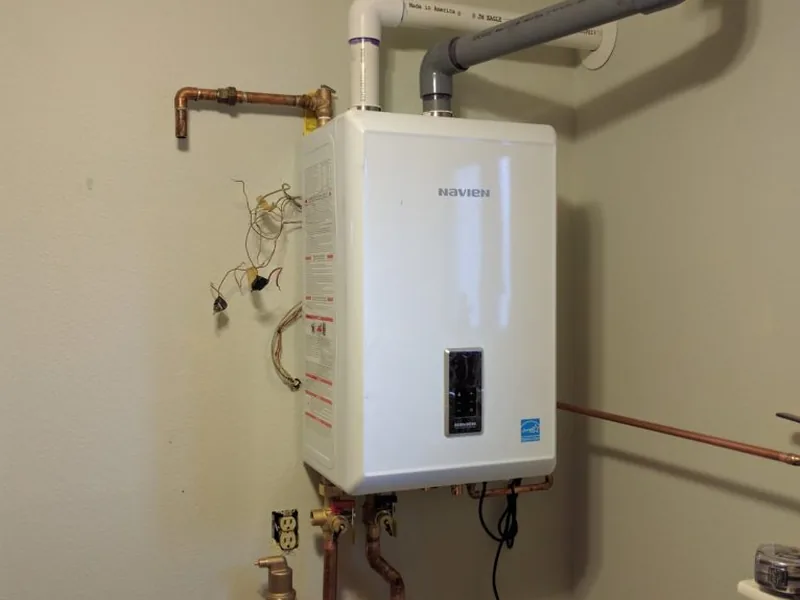
Fishers, IN 46038 has adopted tankless water heaters enthusiastically — they are common in the subdivisions built over the last fifteen years, standard in many new constructions, and popular in renovations chasing endless hot water. That installed base, now aging into the 8-to-15-year window, generates the full tankless leak catalog: heat exchangers weeping from descaling debt, condensate systems failing, service valves dripping, and recirculation loops leaking. Fishers homeowners get system-level diagnosis from our tankless leak service — the unit, the water, and the installation, together.
Water Heater Leak Repair Co. provides tankless water heater leak repair in Fishers, IN 46038 for gas condensing and non-condensing units, including recirculation-equipped systems. We pinpoint the leak's origin, descale when scale drives it, and repair or replace failed components with full-fire verification. Call (833) 713-2101 and describe where the water appears.
In Short: In Fishers, IN 46038, tankless leaks typically come from scale-damaged heat exchangers (descaling debt on 8-to-15-year-old units), condensate drainage failures, weeping service valves, or recirculation loop faults. We map the leak by location and timing, descale the exchanger, repair components, and verify leak-free full-fire operation — usually in one visit.
How Tankless Water Heater Leak Repair Works in Fishers, IN 46038
Fishers' tankless installed base is heavily 2000s–2010s — the exact cohort where skipped descaling matures into leaks. Our diagnostic maps each leak: location plus timing equals origin.
Cabinet-interior dripping tied to firing signals heat exchanger distress: pinholes from scale hot spots, failed gaskets and O-rings. Fishers' hard water scales exchangers steadily; the never-descaled 12-year-old unit weeping at its gaskets with declining efficiency is the town's characteristic tankless patient. We inspect with the unit cool and isolated, then circulate food-grade descaling solution through the isolated exchanger via service valves until flow and temperature-rise recover — treating the cause while staging gasket weeps versus actual perforation.
Pooling beneath condensing units means condensate failure: clogged traps, exhausted neutralizer media, kinked or frozen drain lines. Acidic backup corrodes quickly. We clear traps, replace media, verify drainage, and address freeze exposure on garage-run lines.
Service valve weeping — packing, caps, joints — is the most common minor leak; repack or replace and prove under full pressure.
Recirculation systems in Fishers' larger homes add pump seals, check valves, and return-line joints; a failing pump seal mimics a unit leak, so we isolate the recirc loop during diagnosis.
Venting condensation on non-condensing units with long horizontal runs drains back when slope is wrong; vent pitch verified during diagnosis.
Inlet filter screens get cleaned during every Fishers service — sediment starves flow and overheats exchangers.
Post-repair full-fire verification — maximum flow, maximum rise — confirms every point dry; the hot-outlet relief valve is checked as a possible source. During a tankless water heater leak repair in Fishers, IN 46038, that run proves the fix.
Fishers' Descaling-Debt Cohort
The defining feature of Fishers' tankless leak work is the descaling-debt cohort: thousands of units installed in the 2000s–2010s, the overwhelming majority never descaled once, now simultaneously reaching the age where scale consequences surface. The progression is uniform — efficiency decline, intermittent error codes, gasket weeps, and in the worst cases pinholes — and the remedy is uniform too: descaling circulation plus gasket/component service, with honest perforation assessment. We tell Fishers homeowners plainly: the descaling your unit never got is now due with interest, and the repair visit is the time to start the annual habit that prevents the next one.
Local Factors That Matter for Tankless Leaks in Fishers, IN 46038
The descaling-debt cohort is Fishers' defining factor: 8-to-15-year-old never-descaled units weeping at gaskets across the subdivisions simultaneously.
Hard water makes annual descaling the non-negotiable baseline; high-use family households deposit scale faster and benefit from more frequent service.
Recirculation-equipped larger homes add loop leak points; we isolate the loop before condemning the unit.
Finished basements elevate leak consequences; rigorous verification plus water alarms at unit bases.
Error Codes Tell the Story
Fishers' debt-cohort units almost always display error codes with their leaks — overheating codes from scaled waterways, flow codes from choked filters, ignition codes from condensate-fouled flame sensors. Note the code before calling; it corroborates the origin and focuses the diagnostic. We read code history during service as standard.
Fishers' Neighborhood Descaling Reminder System
Fishers' descaling-debt cohort — thousands of 2000s–2010s units never serviced — suggests a neighborhood-scale solution: the reminder system. The idea is simple: because entire subdivisions installed tankless units in the same construction window, entire streets hit descaling debt simultaneously. A shared reminder — HOA newsletter note, neighborhood social media post, or simply neighbors comparing notes — timed each spring ("descaling season") moves whole streets onto the annual habit together.
The practical mechanics: schedule descaling in spring, before summer's high-demand season; pair it with the inlet filter cleaning and condensate service so one visit covers the unit; and keep the service record (date, what was done, temperature-rise reading) with the home's documents — it transfers to the buyer at sale and demonstrates maintained equipment. For Fishers homeowners who discover their unit is deep in debt, the two-visit recovery (descaling now, follow-up descaling in six months) clears the backlog before joining the annual rhythm. The neighborhood angle matters because social proof works: when three houses on the street get descaled the same week, the fourth calls. Fishers' cohort problem has a cohort solution — and the streets that adopt it stop generating leak calls.
Fishers' Inlet Filter Cleaning Routine
The inlet filter screen is the most owner-serviceable part of a Fishers tankless unit, and cleaning it quarterly prevents a cascade of problems. The procedure (unit-specific — check your manual): close the cold-water service valve, relieve pressure via a hot tap, unscrew the filter housing (usually at the cold inlet), remove the screen, rinse it clean of sediment, inspect for tears or distortion, reseat it, and reopen the valve slowly while checking for drips. Ten minutes, no special tools.
What the filter tells you matters as much as the cleaning: a screen lightly dusted with fine sediment is normal Fishers hard water; a screen packed with coarse grit suggests supply-line disturbance or well issues worth investigating; iron staining on a municipal supply suggests the softener needs attention. A screen that clogs within weeks of cleaning signals abnormal sediment load — call us, because the unit is telling you something changed upstream. The critical warning: never run the unit with the filter removed "to improve flow" — the screen protects the flow sensor and exchanger from debris that damages both. Quarterly cleaning keeps flow normal, sensors accurate, and the exchanger fed — the three things a starved unit cannot survive.
What Happens When You Call (833) 713-2101
Describe the leak's location and timing, any error codes, and the unit's brand, age, fuel, and recirc status. We will give a preliminary read.
On site: origin diagnosis, descaling circulation when scale drives it, component repair or replacement, condensate/vent/recirc/filter verification, full-fire leak check — usually one visit. Findings explained plainly, with honest exchanger assessment and the annual-descaling counsel that prevents recurrence.
For tankless water heater leak repair in Fishers, IN 46038, Water Heater Leak Repair Co. treats the debt and starts the habit. Call (833) 713-2101 today.