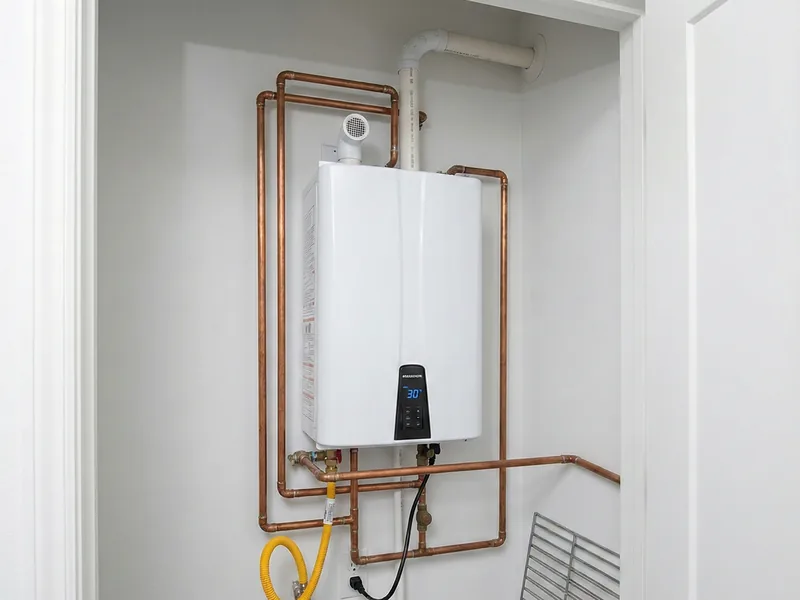
The 46260 ZIP covers north Indianapolis — mid-century ranches, split-levels, and brick traditionals where tankless units are mostly retrofits, installed when a tank failed and the homeowner chose endless hot water. These retrofit tankless heaters leak in the full catalog of ways: heat exchangers scaled by hard water, condensate drains run as afterthoughts through crawlspaces, service valves weeping, and venting adapted from the old tank's chimney. Our 46260 tankless service diagnoses the installation as well as the unit — because in retrofit territory, the installation is often the story.
Water Heater Leak Repair Co. provides tankless water heater leak repair in Indianapolis, IN 46260 for gas condensing and non-condensing units. We pinpoint the origin — exchanger, condensate, valves, venting — descale when scale drives it, verify gas supply and venting adequacy, and repair or replace failed components with full-fire verification. Call (833) 713-2101 and describe where the water appears.
In Short: In Indianapolis, IN 46260, tankless leaks come from scale-damaged heat exchangers, condensate failures, weeping service valves, and venting issues — with the area's retrofit-heavy installed base adding undersized gas lines and adapted chimney venting as root causes. We verify the installation during diagnosis, descale the exchanger, and repair components with full-fire verification in one visit.
How Tankless Water Heater Leak Repair Works in Indianapolis, IN 46260
46260's tankless units are overwhelmingly retrofits into mid-century homes — and retrofits carry installation variables that new construction does not. Our diagnostic maps the leak (location plus timing) and verifies the installation in parallel.
Cabinet-interior dripping tied to firing signals heat exchanger distress: pinholes from scale hot spots, failed gaskets and O-rings. North-side hard water scales exchangers steadily; never-descaled retrofit units narrow waterways, lose efficiency, throw codes, and weep. We inspect with the unit cool and isolated, then circulate food-grade descaling solution through the isolated exchanger via service valves until flow and temperature-rise recover — staging gasket weeps versus perforation.
Pooling beneath condensing units means condensate failure: traps clogged, neutralizer media exhausted, drain lines — often run through crawlspaces as retrofit afterthoughts — kinked or frozen. Acidic backup corrodes quickly. We clear traps, replace media, verify drainage, and reroute vulnerable lines out of freeze paths.
Service valve weeping — packing, caps, joints — is the most common minor leak; repack or replace and prove under full pressure.
Venting gets forensic attention in 46260: many retrofits vent through the old tank heater's chimney — oversized, wrong slope — condensing gallons of acidic water back toward the unit, mimicking an exchanger leak while destroying the vent. We verify vent sizing and slope during every leak diagnosis; correcting a chimney-vent defect solves leaks that parts never would.
Gas supply adequacy is checked on retrofits: original mid-century gas lines sized for a 40,000-BTU tank cannot always feed a 199,000-BTU tankless at full fire. Starved burners soot, foul sensors, and produce excess condensation — shortening exchanger life and contributing to leaks. We verify supply during diagnosis.
Inlet filter screens get cleaned during every 46260 service; sediment starves flow and overheats exchangers.
Post-repair full-fire verification — maximum flow, maximum rise — confirms every point dry; the hot-outlet relief valve checked as a possible source. During a tankless water heater leak repair in Indianapolis, IN 46260, that run proves the fix.
46260's Retrofit Reality
The defining truth of 46260 tankless work: the unit is rarely the whole story. A retrofit into a 1962 ranch brings a 1962 gas line, a 1962 chimney, and a crawlspace condensate drain — and any of the three can be the leak's root cause. Our diagnostic treats the installation as a suspect, not a given: gas-line sizing checked against the unit's input rating, vent sizing and slope measured, condensate routing traced to termination. Homeowners are often surprised that the "tankless leak" was a venting defect — but the surprise fades when the corrected installation runs leak-free for years.
Local Factors That Matter for Tankless Leaks in Indianapolis, IN 46260
Retrofit dominance is 46260's defining factor: mid-century gas lines, adapted chimneys, afterthought condensate drains — installation verification as a core diagnostic step.
Hard water demands annual descaling; never-descaled retrofit units are the norm in our leak calls.
Crawlspace and basement installations expose condensate lines to freeze and dampness; we reroute, insulate, and inspect.
Aging electrical and gas infrastructure can starve or destabilize units; supply verification separates installation faults from unit faults.
When the Chimney Is the Culprit
If your 46260 retrofit tankless vents through the old chimney and leaks, suspect the venting first: oversized flues condense exhaust moisture that drains back into the unit, mimicking exchanger failure while corroding the vent from inside. Mention the chimney when you call — venting verification leads our retrofit diagnostic, and a proper venting correction (correctly sized, correctly sloped) ends a class of leaks permanently.
46260's Retrofit Correction Roadmap
When our diagnostic finds installation defects behind a 46260 tankless leak, the correction follows a roadmap prioritized by safety and impact. First priority — venting: a chimney-adapted vent condensing acidic water back into the unit is both a leak source and a corrosion hazard; correcting vent sizing and slope comes first, always. Second — gas supply: an undersized line starving the burner produces incomplete combustion, sooting, and sensor fouling; upsizing the gas line (by a qualified professional) restores clean full-fire operation and stops the cascade of secondary problems.
Third — condensate routing: crawlspace lines get rerouted with proper fall and freeze protection, traps get proper geometry, neutralizers get installed where missing. Fourth — electrical: dedicated circuit verification, grounding check, voltage under load. Fifth — water: pressure verification, inlet filtration, and the descaling baseline. Each correction is quoted and scheduled in priority order — venting and gas first because they affect safety and combustion, condensate and electrical next, water last because descaling can proceed once the unit burns correctly. Homeowners sometimes balk at correcting "the installation" when they called about "a leak" — until the roadmap shows that the leak was the installation's symptom. Corrected retrofits in 46260 run for decades; uncorrected ones generate repeat visits.
46260's Combustion-Air Requirements
Tankless units in 46260's tight retrofit spaces sometimes starve for combustion air — and starved combustion produces the sooting, sensor fouling, and excess condensation behind many "mystery" leaks. The requirement: the unit needs a specified volume of fresh air per BTU of input, delivered through dedicated openings or ducting per the manufacturer's instructions. Retrofit installations that sealed the old tank heater's closet without adding combustion air for the higher-input tankless unit are the classic violation.
The symptoms of air starvation are distinctive: yellow, lazy burner flames instead of crisp blue; soot accumulating on the burner and around the cabinet; frequent ignition or flame-failure codes; and a sour, incomplete-combustion odor. The excess condensation from incomplete combustion is acidic and aggressive — it accelerates exactly the gasket and exchanger damage that becomes the leak call. Our diagnostic includes combustion-air verification on every 46260 retrofit: we check opening sizes, confirm they are unblocked (storage creep seals more air supplies than any other cause), and verify the unit is not competing with a furnace or dryer for the same closet air. Correcting air supply is straightforward — added openings or ducting — and it stops the sooting-fouling-condensation cascade at its source.
What Happens When You Call (833) 713-2101
Describe the leak's location and timing, any error codes, the unit's brand, age, and fuel — plus retrofit details: how it vents, and any chronic issues (soot, ignition codes, poor temperature control). We will give a preliminary read.
On site: origin diagnosis with gas, venting, and condensate verification, descaling when indicated, component repair or replacement, filter service, full-fire leak check — usually one visit. Findings explained plainly, with honest exchanger assessment when applicable.
For tankless water heater leak repair in Indianapolis, IN 46260, Water Heater Leak Repair Co. investigates the installation too. Call (833) 713-2101 today.