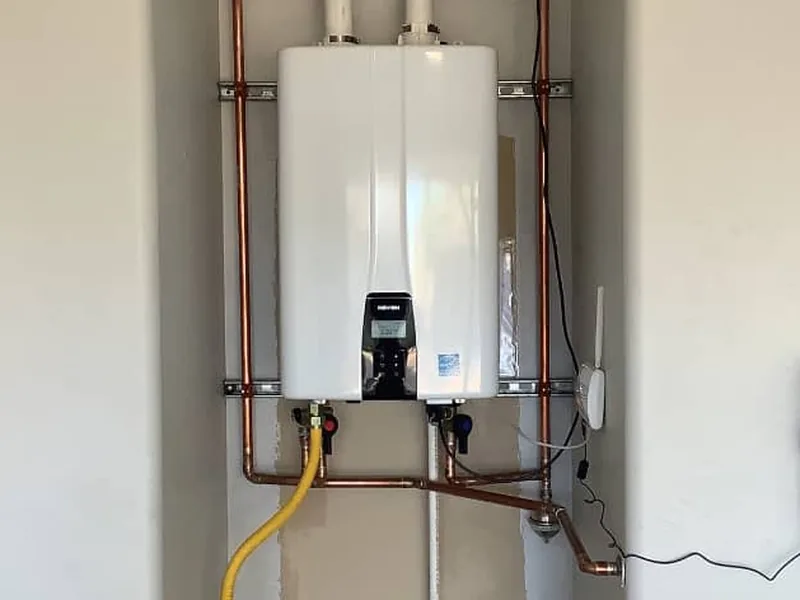
Lawrence, IN 46226 — northeast Indianapolis's post-war suburbs — has tankless units mostly as retrofits, installed when an aging tank failed and the homeowner chose endless hot water. These retrofit units leak in the established tankless patterns plus the installation variables of older homes: heat exchangers scaled by hard water, condensate drains routed through crawlspaces, service valves weeping, and venting adapted from the old tank's flue. Our Lawrence tankless service diagnoses the installation alongside the unit.
Water Heater Leak Repair Co. provides tankless water heater leak repair in Lawrence, IN 46226 for gas condensing and non-condensing units. We pinpoint the origin — exchanger, condensate, valves, venting — descale when scale drives it, verify gas and venting adequacy on retrofits, and repair or replace failed components with full-fire verification. Call (833) 713-2101 and describe where the water appears.
In Short: In Lawrence, IN 46226, tankless leaks come from scale-damaged heat exchangers, condensate failures, weeping service valves, and venting issues — with the suburb's retrofit-heavy base adding gas-supply and venting defects. We verify the installation during diagnosis, descale the exchanger, and repair components with full-fire verification in one visit.
How Tankless Water Heater Leak Repair Works in Lawrence, IN 46226
Lawrence's tankless units are predominantly retrofits into post-war homes, so our diagnostic treats the installation as a suspect from the start. Leak mapping — location plus timing — runs alongside installation verification.
Cabinet-interior dripping tied to firing signals heat exchanger distress: pinholes from scale hot spots, failed gaskets and O-rings. Lawrence's hard water scales exchangers steadily; never-descaled retrofit units narrow waterways, lose efficiency, throw codes, and weep. We inspect with the unit cool and isolated, then circulate food-grade descaling solution through the isolated exchanger via service valves until flow and temperature-rise recover — staging gasket weeps versus perforation.
Pooling beneath condensing units means condensate failure: clogged traps, exhausted neutralizer media, drain lines run through crawlspaces kinked or frozen. Acidic backup corrodes quickly. We clear traps, replace media, verify drainage, and reroute vulnerable lines out of freeze paths.
Service valve weeping — packing, caps, joints — is the most common minor leak; repack or replace and prove under full pressure.
Venting verification is essential on Lawrence retrofits: chimney-adapted venting with wrong slope condenses acidic water back into the unit, mimicking exchanger leaks while destroying the vent. We measure vent sizing and slope during diagnosis; correcting it ends that leak class permanently.
Gas supply gets checked: post-war gas lines sized for tanks may starve high-input tankless burners, causing sooting, sensor fouling, and excess condensation. We verify supply adequacy during diagnosis.
Inlet filter screens get cleaned during every Lawrence service; sediment starves flow and overheats exchangers.
Post-repair full-fire verification — maximum flow, maximum rise — confirms every point dry; the hot-outlet relief valve checked as a possible source. During a tankless water heater leak repair in Lawrence, IN 46226, that run proves the fix.
Lawrence's Post-War Infrastructure Factor
The through-line of Lawrence tankless work is infrastructure age: gas lines, chimneys, electrical panels, and crawlspaces from the 1950s–70s hosting 2010s tankless technology. Each interface is a potential failure point — the gas line that cannot feed full fire, the chimney that condenses exhaust back down, the crawlspace drain that freezes every January, the panel that nuisance-trips. Our diagnostic systematically checks each interface, because a tankless unit is only as reliable as the 60-year-old infrastructure feeding it. Homeowners are often relieved to learn the "bad unit" was actually a correctable installation defect.
Local Factors That Matter for Tankless Leaks in Lawrence, IN 46226
Post-war infrastructure hosting modern tankless units is Lawrence's defining factor: gas, venting, condensate, and electrical interfaces all verified during diagnosis.
Hard water demands annual descaling; never-descaled retrofit units dominate our leak calls.
Crawlspace condensate drains face winter freeze; we reroute or insulate vulnerable runs.
Basement and utility-room installations in finished surroundings elevate leak consequences; rigorous verification plus water alarms.
The Freeze-Thaw Condensate Cycle
Lawrence's crawlspace condensate drains produce a seasonal failure rhythm: the line freezes in January, condensate backs up and overflows the trap, the spring thaw clears the blockage — and the homeowner assumes the leak "fixed itself." It did not; the trap, neutralizer, and cabinet components absorbed acidic overflow all winter. If your Lawrence tankless leaked last winter and stopped in spring, the condensate path needs professional service before next freeze — not congratulations.
Lawrence's Infrastructure-First Tankless Plan
In Lawrence, the tankless maintenance plan starts with infrastructure, not the unit — because the 1950s–70s infrastructure determines the unit's fate. The plan's first year: infrastructure audit and correction — gas line sizing verified and upsized if needed, venting corrected from chimney adaptations to proper dedicated venting, condensate drains rerouted out of freeze-prone crawlspaces with proper fall, electrical circuit verified and dedicated. Only on corrected infrastructure does the unit's own maintenance begin: descaling, filter service, combustion verification.
The ongoing rhythm: annual professional service (descaling, filter, condensate, combustion, vent inspection), seasonal condensate freeze-watch in winter (monthly line checks during deep freezes), and the infrastructure re-check every five years — gas pressure, vent condition, condensate routing — because infrastructure ages too. The plan's logic is sequential: no amount of descaling compensates for a starved burner or a condensing chimney, so infrastructure comes first and unit maintenance follows. Lawrence homeowners who adopt the infrastructure-first plan stop the cycle of mysterious recurring issues — the ignition codes, the condensation leaks, the premature gasket failures — that uncorrected infrastructure produces. The unit was never the problem; the plan treats the actual problem.
Lawrence's Electrical Circuit Checks for Tankless
Gas tankless units still need electricity — for controls, ignition, freeze protection, and condensate pumps — and Lawrence's aging electrical infrastructure deserves verification as part of tankless service. The checks: dedicated circuit confirmation (the unit should not share a breaker with other loads — shared circuits brown out the controls during concurrent demand); grounding verification (poor grounding causes the erratic control behavior and nuisance codes that get misdiagnosed as board failures); and voltage stability under load.
Two Lawrence-specific issues recur. First, panels with weakened breakers that nuisance-trip during the unit's ignition sequence — the homeowner experiences it as random no-hot-water episodes that "fix themselves," which is the breaker resetting, not the unit healing. Second, freeze-protection dependence: the unit's built-in freeze protection only works with power — during a winter outage, an unheated-space unit with no power is unprotected, and owners need to know their outage plan (drain the unit if extended outage threatens). We verify the electrical supply during tankless service and explain the outage implications plainly: the finest freeze protection in the world is a paperweight without electricity, and Lawrence's winter outages make the backup plan part of the installation.
What Happens When You Call (833) 713-2101
Describe the leak's location and timing, any error codes, the unit's brand, age, and fuel — plus retrofit details and any seasonal pattern. We will give a preliminary read.
On site: origin diagnosis with installation verification, descaling when indicated, component repair or replacement, condensate/vent/filter service, full-fire leak check — usually one visit. Findings explained plainly, with honest exchanger assessment when applicable.
For tankless water heater leak repair in Lawrence, IN 46226, Water Heater Leak Repair Co. investigates the infrastructure too. Call (833) 713-2101 today.