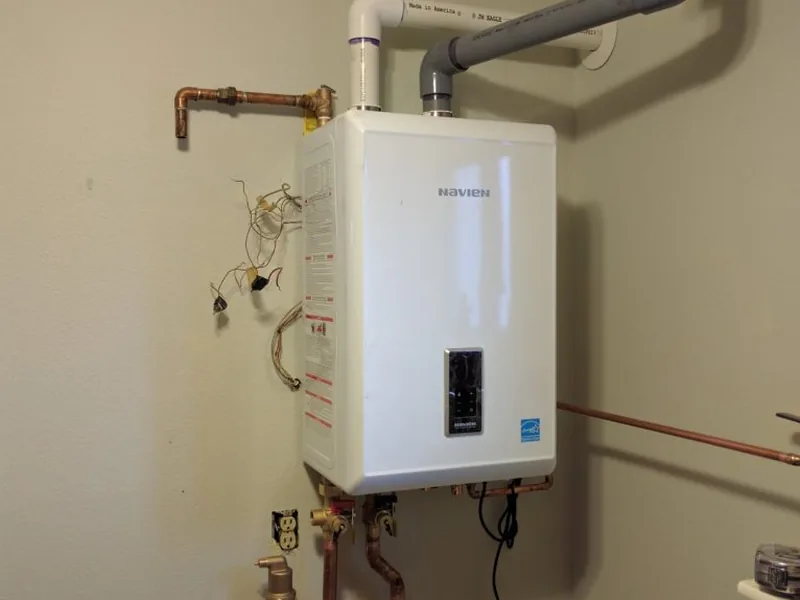
Lebanon, IN 46052 — Boone County's seat — has tankless units in its newer corridor subdivisions, in renovated downtown homes, and on rural properties where well water meets endless-hot-water demand. Each setting leaks in its own way: the subdivision unit with descaling debt weeping at gaskets, the downtown retrofit with chimney-adapted venting dripping condensation, the rural well-fed unit with iron-fouled sensors and a silt-choked inlet filter. Our Lebanon tankless service diagnoses the setting, the water, and the installation — not just the unit.
Water Heater Leak Repair Co. provides tankless water heater leak repair in Lebanon, IN 46052 for gas condensing and non-condensing units. We pinpoint the origin — exchanger, condensate, valves, venting — descale when scale drives it, verify retrofit installations, and repair or replace failed components with full-fire verification. Call (833) 713-2101 and describe where the water appears.
In Short: In Lebanon, IN 46052, tankless leaks come from scale-damaged heat exchangers, condensate failures, weeping service valves, and venting issues — with rural well water adding iron/silt complications and retrofits adding installation defects. We diagnose the water and installation alongside the unit, descale the exchanger, and repair components with full-fire verification in one visit.
How Tankless Water Heater Leak Repair Works in Lebanon, IN 46052
Lebanon's town-to-country split shapes its tankless leak work: municipal hard water in town, mineral-heavy well water outside it, retrofits downtown, new installs in the corridor. Our diagnostic adapts to the setting while mapping every leak by location and timing.
Cabinet-interior dripping tied to firing signals heat exchanger distress: pinholes from scale hot spots, failed gaskets and O-rings. In-town units scale from municipal hardness; rural well-fed units scale faster and harder, with iron plating compounding the damage. Never-descaled units — the Lebanon norm — narrow waterways, lose efficiency, throw codes, and weep. We inspect with the unit cool and isolated, then circulate food-grade descaling solution through the isolated exchanger via service valves until flow and temperature-rise recover, staging gasket weeps versus perforation.
Pooling beneath condensing units means condensate failure: clogged traps, exhausted neutralizer media, kinked or frozen drains. Acidic backup corrodes quickly. We clear traps, replace media, verify drainage, and address freeze exposure — including rerouting rural lines run through unheated spaces.
Service valve weeping — packing, caps, joints — is the most common minor leak; repack or replace and prove under full pressure.
Venting verification matters for Lebanon's downtown retrofits: chimney-adapted venting with wrong slope condenses acidic water back into the unit. We measure vent sizing and slope during diagnosis.
Inlet filter screens on well-fed rural units choke with silt and iron fast — starving flow, overheating exchangers, fouling flow sensors. We clean the screen during every Lebanon service and assess whether a pre-filter is warranted for the worst well water.
Post-repair full-fire verification — maximum flow, maximum rise — confirms every point dry; the hot-outlet relief valve checked as a possible source. During a tankless water heater leak repair in Lebanon, IN 46052, that run proves the fix.
Lebanon's Well-Water Tankless Challenge
Rural Lebanon's well water is among the harshest tankless water we service: hardness that scales exchangers rapidly, iron that fouls flame and flow sensors (producing ignition and flow codes alongside leaks), and silt that chokes inlet screens and abrades components. Well-fed tankless units need a stricter regimen: inlet filter checks twice as often, descaling on schedule without fail, and honest assessment of whether a sediment pre-filter should protect the unit. When a rural Lebanon tankless leaks, the water is always part of the diagnosis — and the repair plan addresses the water, not just the leak.
Local Factors That Matter for Tankless Leaks in Lebanon, IN 46052
The town-country water split defines Lebanon's tankless work: municipal hardness in town, extreme well water outside it — with rural diagnostics weighted toward filtration and sensor fouling.
Downtown retrofits bring chimney-adapted venting and legacy gas lines; installation verification is part of leak diagnosis.
Corridor subdivisions bring descaling-debt units in the 8-to-15-year window weeping at gaskets.
Rural outbuilding installations face freeze risk; freeze-protection verification and winterization guidance included.
Pre-Filters for the Worst Well Water
On Lebanon's harshest wells, we sometimes recommend a sediment pre-filter ahead of the tankless unit — a simple spin-down or cartridge filter that catches silt and coarse sediment before it reaches the inlet screen and exchanger. It does not replace descaling, but it extends filter-cleaning intervals and reduces abrasive wear. We assess the well's sediment load during service and recommend pre-filtration only where the evidence supports it — another instance of the water shaping the repair plan.
Lebanon's Town-and-Country Tankless Schedules
Lebanon's town-country split calls for two maintenance schedules. In-town schedule (municipal hard water): annual descaling, annual inlet filter cleaning, annual condensate service, combustion verification every two years, vent inspection annually. This is the standard hard-water regimen, and it keeps in-town units at full 20-year life.
Country schedule (private wells): descaling twice yearly — well water's mineral load defeats annual intervals; inlet filter cleaning quarterly, with pre-filter assessment at the first service (spin-down plus cartridge on the siltiest wells); condensate service with each descaling; sensor cleaning annually (iron fouls flame and flow sensors, producing the codes that accompany country leaks); pressure-tank air charge check annually, since waterlogged tanks hammer the unit's connections. The country schedule is roughly double the in-town effort — which surprises rural owners until they see what their water does to an exchanger in a single year. Both schedules share the same principle: maintenance intensity matched to water aggressiveness. Lebanon's water varies more across ten miles than most towns' does across the county, and the schedules honor that variation instead of averaging it away.
Lebanon's Pre-Filter Selection Guide
When a Lebanon well warrants pre-filtration ahead of the tankless unit, selecting correctly matters — the wrong filter is either useless or a flow restriction. The selection starts with the water test: sediment particle size and loading determine the filter type. For coarse sand and grit, a spin-down separator with a flush valve — self-cleaning, no cartridges to replace — handles the bulk load. For fine silt that passes the spin-down, a cartridge filter (typically 20-micron pleated) polishes the remainder.
Sizing is by flow rate: the filter assembly must pass the household's peak demand without significant pressure drop — an undersized filter starves the unit exactly like the clogged screen it was meant to prevent. Placement is before the unit's service valves but after the main shutoff, with isolation valves and a bypass so cartridges can be changed without draining the system. Maintenance is the commitment: spin-downs get flushed monthly (thirty seconds), cartridges get replaced on pressure-drop indication, not on a calendar — a gauge across the filter tells the truth. We size and specify pre-filtration during Lebanon service visits based on the actual sediment evidence from your inlet screen, not on guesswork — the screen's contents are the water test that matters.
What Happens When You Call (833) 713-2101
Describe the leak's location and timing, any error codes, the unit's brand, age, fuel — and your water source (town or well) plus retrofit details. We will give a preliminary read.
On site: setting-aware diagnosis with water and installation verification, descaling when indicated, component repair or replacement, condensate/vent/filter service, full-fire leak check — usually one visit. Findings explained plainly, with honest exchanger assessment when applicable.
For tankless water heater leak repair in Lebanon, IN 46052, Water Heater Leak Repair Co. treats the water as well as the unit. Call (833) 713-2101 today.