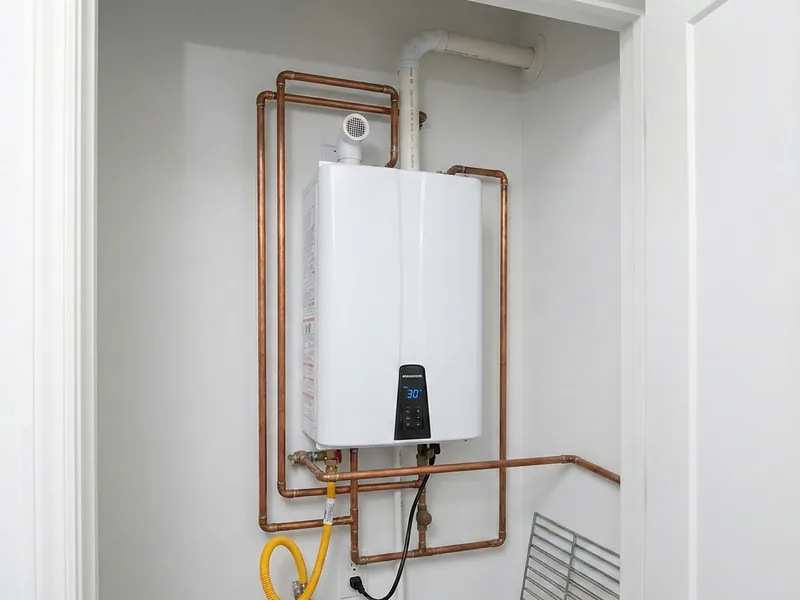
Plainfield, IN 46168 stretches from its historic downtown to the subdivisions and workforce housing of the logistics corridor, and its tankless water heaters reflect the spread: retrofits in older homes, builder units in subdivisions, and high-demand installations serving large households. Tankless leaks in Plainfield follow the setting — the retrofit with adapted venting, the subdivision unit with descaling debt, the high-occupancy installation with accelerated wear. Our Plainfield service diagnoses the setting, the demand, and the unit together.
Water Heater Leak Repair Co. provides tankless water heater leak repair in Plainfield, IN 46168 for gas condensing and non-condensing units. We pinpoint the origin — exchanger, condensate, valves, venting — descale when scale drives it, verify retrofit installations, and repair or replace failed components with full-fire verification. Call (833) 713-2101 and describe where the water appears.
In Short: In Plainfield, IN 46168, tankless leaks come from scale-damaged heat exchangers, condensate failures, weeping service valves, and venting issues — with high household demand accelerating wear and retrofits adding installation defects. We diagnose demand level and installation quality alongside the unit, descale the exchanger, and repair components with full-fire verification in one visit.
How Tankless Water Heater Leak Repair Works in Plainfield, IN 46168
Plainfield's tankless installed base spans retrofits to new builds to high-demand workforce housing — and our diagnostic accounts for demand intensity, because a unit serving eight people ages differently than one serving three. Leak mapping (location plus timing) runs alongside demand and installation assessment.
Cabinet-interior dripping tied to firing signals heat exchanger distress: pinholes from scale hot spots, failed gaskets and O-rings. Plainfield's hard water scales exchangers steadily; high-demand households deposit scale faster (more throughput) and cycle gaskets harder (more thermal cycles) — the fastest-aging combination a tankless unit faces. We inspect with the unit cool and isolated, then circulate food-grade descaling solution through the isolated exchanger via service valves until flow and temperature-rise recover, staging gasket weeps versus perforation.
Pooling beneath condensing units means condensate failure: clogged traps, exhausted media, kinked or frozen drains. Acidic backup corrodes quickly. We clear traps, replace media, verify drainage, and address freeze exposure.
Service valve weeping — packing, caps, joints — is the most common minor leak; repack or replace and prove under full pressure.
Venting verification matters for Plainfield's downtown retrofits: chimney-adapted venting with wrong slope condenses acidic water back into the unit. We measure vent sizing and slope during diagnosis.
Gas supply adequacy gets checked where demand is high: a unit serving a large household at full fire needs full gas delivery; starved burners soot and stress exchangers. We verify during diagnosis.
Inlet filter screens clogged with sediment starve flow and overheat exchangers — cleaned during every Plainfield service, more often on high-demand units.
Post-repair full-fire verification — maximum flow, maximum rise — confirms every point dry; the hot-outlet relief valve checked as a possible source. During a tankless water heater leak repair in Plainfield, IN 46168, that run proves the fix.
Plainfield's Demand Factor
High-occupancy households near the logistics corridor put exceptional demand on tankless units — back-to-back showers, constant laundry, simultaneous draws. Demand accelerates everything: scale deposition (more water through the exchanger), gasket thermal cycling (more firing cycles), and filter loading (more sediment). A Plainfield tankless serving eight people needs descaling more often than the annual baseline — we recommend twice-yearly for the hardest-used units — and its gaskets age on cycle count, not calendar. When a high-demand unit leaks, the repair plan includes the demand-adjusted maintenance schedule, because the demand is not changing.
Local Factors That Matter for Tankless Leaks in Plainfield, IN 46168
Household demand intensity is Plainfield's defining factor: high-occupancy installations age by throughput and cycles — with demand-adjusted descaling schedules as part of the repair plan.
Hard water demands annual descaling minimum; high-demand units need twice-yearly.
Downtown retrofits bring chimney-adapted venting and legacy gas lines; installation verification during diagnosis.
Damp basements near the creek corrode external fittings; external inspection during service.
Rental-Property Tankless Units
Plainfield's rental stock includes tankless units that get zero maintenance between tenancies — no descaling, no filter cleaning, no condensate service. Landlords: a tankless unit turned over between tenants without descaling accumulates the debt that becomes the next tenant's leak call. We document findings clearly for property owners and recommend between-tenancy descaling as the cheapest reliability investment in the rental.
Plainfield's Demand-Matched Tankless Care
Plainfield's high-demand households need tankless care matched to throughput, not the calendar — and the matching starts with an honest demand assessment. Count the household's daily hot-water events: showers, laundry loads, dishwasher cycles. A household running the equivalent of six or more full showers daily is high-demand; its tankless unit deposits scale faster (more water through the exchanger), cycles gaskets harder (more firings), and loads the inlet filter quicker (more sediment).
The demand-matched schedule: high-demand households descale twice yearly, clean the inlet filter quarterly, and service the condensate system with each descaling; standard households follow the annual rhythm. Both get annual combustion verification and vent inspection. The demand assessment also governs expectations: a high-demand unit's gaskets age on cycle count, so earlier gasket service is normal, not defective — and when capacity no longer meets demand even with a healthy unit, the answer is a second unit or higher capacity, not hotter settings. Plainfield's rental properties deserve special mention: tenant turnover without between-tenancy descaling accumulates debt invisibly, so landlords should schedule descaling with each turnover — the cheapest reliability investment in the rental, and far cheaper than the emergency leak call with a tenant's belongings at stake.
Plainfield's Landlord Tankless Playbook
Plainfield landlords running tankless units in rentals need a playbook, because tenant turnover plus zero maintenance is the fastest route to emergency leak calls. The playbook: descaling scheduled with every tenant turnover — non-negotiable, since the unit absorbed the entire tenancy's water usage unserviced. Inlet filter check at turnover (two minutes, reveals the tenancy's sediment story). Condensate trap service at turnover. Error-code history reviewed at turnover — tenants ignore codes, and the history reveals what the unit endured.
Between tenancies, document everything with dates: temperature-rise reading, filter condition, service performed. This log is both a maintenance record and a diligence demonstration. For high-turnover properties, consider the economics openly: turnover descaling costs less than a single emergency weekend leak call, and far less than water damage to a tenant's belongings — the liability that keeps landlords awake. Educate tenants minimally but effectively: a one-page sheet explaining "call immediately for error codes, leaks, or no hot water — do not reset repeatedly" prevents the tenant behaviors (ignored codes, reset cycling) that turn small issues into big ones. The playbook's thesis: scheduled turnover service is the cheapest reliability money a landlord spends.
What Happens When You Call (833) 713-2101
Describe the leak's location and timing, any error codes, the unit's brand, age, and fuel — plus household size and retrofit details. We will give a preliminary read.
On site: demand-aware diagnosis with installation verification, descaling when indicated, component repair or replacement, condensate/vent/filter/gas service, full-fire leak check — usually one visit, with a demand-adjusted maintenance schedule established. Findings explained plainly, with honest exchanger assessment when applicable.
For tankless water heater leak repair in Plainfield, IN 46168, Water Heater Leak Repair Co. accounts for the demand as well as the unit. Call (833) 713-2101 today.