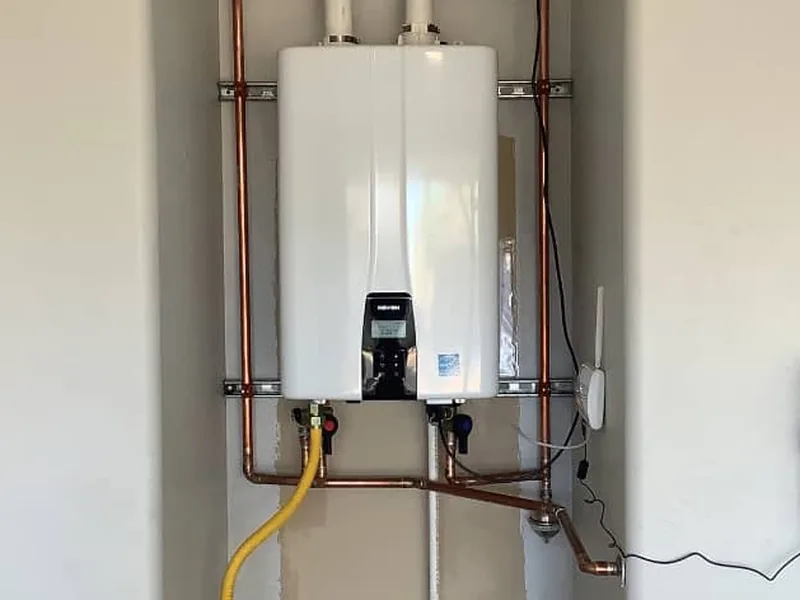
Zionsville, IN 46077 pairs upscale homes with the hardest water in central Indiana — limestone geology producing water that attacks tankless heat exchangers faster than anywhere else we serve. Tankless units in Zionsville's village homes, subdivisions, and rural estates leak on the hardness timeline: exchangers scaling visibly within a couple of years, gaskets weeping early, pinholes developing ahead of schedule — all accelerated by water that can exceed 20 grains per gallon. Our Zionsville tankless service centers the water in every diagnosis.
Water Heater Leak Repair Co. provides tankless water heater leak repair in Zionsville, IN 46077 for gas condensing and non-condensing units, including recirculation-equipped systems. We pinpoint the origin — exchanger, condensate, valves, venting, recirc — descale aggressively when hardness drives it, assess softener effectiveness, and repair or replace failed components with full-fire verification. Call (833) 713-2101 and describe where the water appears.
In Short: In Zionsville, IN 46077, very hard limestone water accelerates every tankless leak mode — rapid exchanger scaling, early gasket weeps, premature pinholes — plus condensate failures, service valve weeps, and recirc faults. We center water hardness in the diagnosis, descale the exchanger, assess softener protection, and repair components with full-fire verification in one visit.
How Tankless Water Heater Leak Repair Works in Zionsville, IN 46077
Zionsville's hardness multiplier reshapes the tankless leak diagnostic: scale forms faster, damage arrives earlier, and softener status predicts everything. Our leak mapping (location plus timing) runs alongside hardness assessment.
Cabinet-interior dripping tied to firing signals heat exchanger distress: pinholes from scale hot spots, failed gaskets and O-rings. In unsoftened Zionsville homes, exchangers scale visibly within two years; gaskets weep years ahead of normal schedules; pinholes appear on timelines that shock owners of softened units. We inspect with the unit cool and isolated, then circulate food-grade descaling solution — sometimes requiring extended circulation for heavy Zionsville scale — through the isolated exchanger via service valves until flow and temperature-rise recover, staging gasket weeps versus perforation.
Pooling beneath condensing units means condensate failure: clogged traps, exhausted media, kinked or frozen drains. Hardness compounds it — scale particles join sediment in clogging traps. We clear traps, replace media, verify drainage, address freeze exposure.
Service valve weeping — packing, caps, joints — arrives early in unsoftened Zionsville homes as mineral deposits attack seals; repack or replace and prove under full pressure.
Recirculation systems in Zionsville's larger homes add pump seals, check valves, and return-line joints — with recirc's continuous warmth accelerating gasket aging in hard water. We isolate the recirc loop during diagnosis.
Venting condensation verified via slope checks on applicable units.
Inlet filter screens choke fast in unsoftened Zionsville water; cleaned during every service — and on the hardest supplies, we discuss pre-filtration.
Post-repair full-fire verification — maximum flow, maximum rise — confirms every point dry; the hot-outlet relief valve checked as a possible source. During a tankless water heater leak repair in Zionsville, IN 46077, that run proves the fix.
Zionsville's Softener Divide
No factor splits Zionsville tankless outcomes like softener status. Maintained softeners transform the picture: descaling intervals hold at annual, gaskets age normally, exchangers reach full life. Unsoftened — or softeners run dry on salt, bypassed during renovations, sized wrong for 20-grain water — and the hardness timeline applies: descaling needed twice yearly, gaskets weeping early, exchangers pinholing ahead of schedule. During diagnosis we read the old components for the truth about softener effectiveness: scaled exchangers and mineral-attacked seals on a "softened" home mean the softener has not been protecting, and we say so — because the repaired unit deserves genuinely softened water going forward, not assumed softening.
Local Factors That Matter for Tankless Leaks in Zionsville, IN 46077
Limestone hardness is Zionsville's defining tankless factor — the fastest scaling in our service area, compressing every failure timeline and making softener status the key diagnostic variable.
The softener divide determines descaling frequency (annual softened, twice-yearly unsoftened), gasket life, and exchanger longevity; we verify effectiveness through component evidence.
Rural well-fed estates compound hardness with maximum mineral loads; well diagnostics weight filtration heavily.
Recirculation in larger homes adds loop leak points with hardness-accelerated gasket aging; loop isolation standard.
Descaling Frequency in Zionsville
The question every Zionsville tankless owner asks: how often? Softened with a maintained unit: annually. Unsoftened: twice yearly — and we mean it, because annual descaling in 20-grain water leaves six months of unchecked accumulation between services, enough to start the hot-spot cycle. High-use unsoftened households may need even more frequent attention. We set the schedule from the evidence — hardness effects on your exchanger, your softener's real status, your household demand — not from a generic card.
Zionsville's Hardness-Based Descaling Schedule
Zionsville's descaling schedule should be set by hardness reality, not by generic guidance — and the reality divides by softener status. Softened homes with verified-maintained softeners: annual descaling, with the softener's salt and settings checked at the same visit (a softener run dry for two months deposits the scale that the descaling then removes — the schedule only works when both halves hold). Unsoftened homes: twice yearly, spring and fall, without exception — in 20-grain water, a single annual descaling leaves six months of unchecked accumulation, enough to begin the hot-spot cycle that ends in pinholes.
High-demand unsoftened households: consider three times yearly — throughput multiplies deposition, and the cost of the extra visit is trivial against an exchanger. The schedule-setting visit measures what matters: we test hardness at the tap, assess the exchanger's current scale loading during the descaling circulation, and verify softener effectiveness through the evidence on the components — not the owner's assumption. From those three data points comes your schedule, written down and calendared. Zionsville owners sometimes negotiate the schedule downward for convenience; the hardness does not negotiate. The schedule that matches the water keeps the exchanger alive; the convenient one does not.
Zionsville's Softener Verification for Tankless
A Zionsville tankless owner's most important maintenance act might not involve the heater at all — it is verifying the softener actually softens. The verification methods, in order of reliability: first, test the water — hardness test strips or a titration kit at the tap nearest the heater, compared against the raw water hardness. Treated water should read near zero grains; readings climbing toward raw mean the softener is failing. Second, read the heater's components at service — scaled exchanger waterways and mineral-attacked seals on a "softened" home convict the softener more reliably than any strip.
Third, audit the softener itself: salt level (bridging — a salt crust with empty space beneath — fools owners into thinking salt is present), settings matched to actual tested hardness (not the installer's guess from years ago), and regeneration frequency appropriate to household usage. The common Zionsville failure is the softener bypassed during a renovation and never restored — months of 20-grain water through a "protected" unit. We include softener verification in Zionsville tankless service because the descaling schedule depends on it: verified softening earns the annual interval; unverified softening gets the twice-yearly schedule regardless of what the owner believes. Trust, but verify — the exchanger cannot tell the difference between a broken softener and no softener.
What Happens When You Call (833) 713-2101
Describe the leak's location and timing, any error codes, the unit's brand, age, and fuel — plus softener status and water source. We will give a preliminary read with hardness in mind.
On site: hardness-centered diagnosis, descaling circulation (extended when needed), softener-effectiveness assessment, component repair or replacement, condensate/vent/recirc/filter service, full-fire leak check — usually one visit, with the hardness-appropriate maintenance schedule established. Findings explained plainly, with honest exchanger assessment when applicable.
For tankless water heater leak repair in Zionsville, IN 46077, Water Heater Leak Repair Co. treats the water first. Call (833) 713-2101 today.