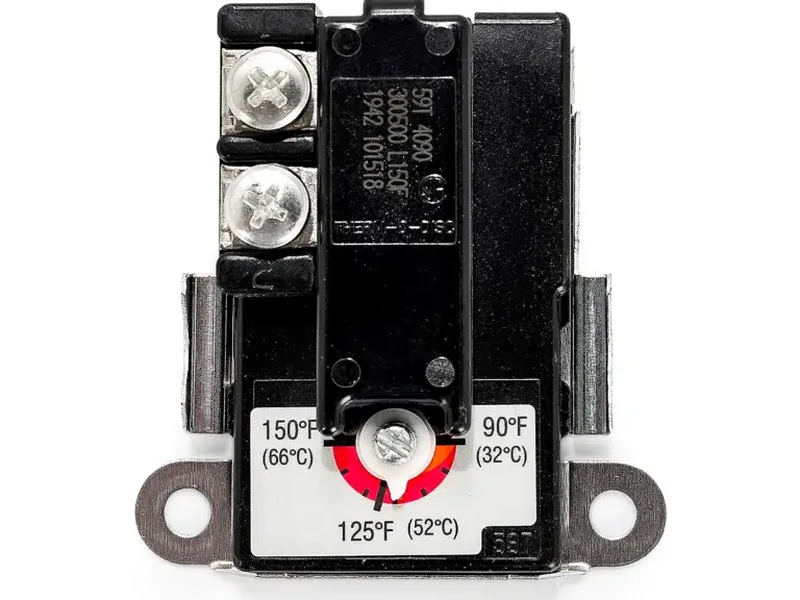
When the showers in Arcadia, IN 46030 turn lukewarm halfway through, or the hot water runs out twice as fast as it used to, the thermostat is one of the first suspects — and one of the most commonly misdiagnosed components on an electric water heater. Arcadia's older ranch homes, farmhouses on the rural edges, and newer infill builds all run electric tank heaters whose upper and lower thermostats orchestrate every heating cycle. When a thermostat sticks, drifts, or dies, the symptoms range from annoying to genuinely hazardous.
Water Heater Leak Repair Co. provides thermostat replacement in Arcadia, IN 46030 for electric tank water heaters. We diagnose before we replace — testing thermostats and elements with a multimeter, checking for the sediment and wiring issues that mimic thermostat failure — then install correctly rated thermostats and verify operation through a full heating cycle. Call (833) 713-2101 and describe your hot-water symptoms.
In Short: Thermostat failure in Arcadia, IN 46030 shows up as lukewarm water, hot water that runs out fast, scalding water, or no hot water with a tripped reset button. We test both thermostats and both elements electrically before replacing anything — because elements, sediment, and wiring cause identical symptoms. Replacement restores proper temperature control, usually within a single visit.
How Thermostat Replacement Works in Arcadia, IN 46030
Most electric tank water heaters in Arcadia use two thermostats and two elements working as a team. The upper thermostat is the boss: it senses the top of the tank, powers the upper element first, and once the top is satisfied, flips power down to the lower thermostat and lower element to heat the bulk of the tank. The upper thermostat also carries the ECO — the energy cut-off reset button — which trips if the tank overheats. Understanding this choreography is what separates a real diagnosis from parts-swapping, and it is the foundation of our Arcadia service.
We start with the breaker off — verified, not assumed — and remove the access panels and insulation to expose both thermostats. The diagnostic is electrical: with a multimeter, we check each thermostat's continuity and switching behavior, and we test each element's resistance. A healthy 4500-watt, 240-volt element reads roughly 12 to 13 ohms; an open reading means a burned-out element, while a thermostat that shows continuity when it should be open (or vice versa) has failed. This testing matters enormously in Arcadia, because the area's hard water and sediment produce thermostat-lookalike failures constantly: a lower element buried in sediment overheats and burns out, and the symptom — hot water that runs out fast — looks exactly like a bad lower thermostat. Replace the thermostat without testing the element and the problem persists.
Symptom patterns guide the testing order. No hot water at all with a tripped ECO reset button suggests the upper thermostat allowed overheating — we investigate why before resetting, because a reset button that trips repeatedly is reporting a control failure. Lukewarm water that never gets properly hot points to the upper thermostat or upper element. Plenty of hot water that runs out quickly points to the lower thermostat or lower element. Scalding water points to a thermostat stuck closed — the most urgent pattern, since it can also drive the TPR valve to discharge.
Replacement itself is careful work. We photograph and label every wire — thermostat wiring must be restored exactly, as miswired thermostats create simultaneous-element operation that overheats wiring and trips breakers. The new thermostats must match the heater's voltage and be rated for the element wattage; we verify against the data plate. Thermostats mount flush against the tank wall under a spring-steel bracket — the sensing disc must sit flat against clean tank steel, because a thermostat sensing air instead of tank temperature will misread wildly. We clean the mounting surface, seat the new thermostat squarely, and confirm the bracket holds it tight.
Temperature setting is part of the job. We set both thermostats to the same temperature — 120°F is the standard recommendation, balancing scald safety against usable hot water — and we explain the setting to you. Mismatched thermostat settings (upper at 140, lower at 110, as we sometimes find) produce strange hot-water behavior that mimics failure.
Finally, we restore power and verify through a full cycle: the upper element heats first, the upper thermostat clicks over, the lower element takes over, and both thermostats cut out at the set point. We check delivered water temperature at a tap and confirm the ECO is armed. During a thermostat replacement in Arcadia, IN 46030, you see the verification — not just a parts swap.
Thermostat vs. Element vs. Sediment: Arcadia's Diagnostic Triangle
These three causes produce overlapping symptoms, and Arcadia's water makes all three common. Sediment is the great imitator: calcium baked onto the tank bottom insulates the lower element, which then overheats, burns out, or heats inefficiently — producing the classic "runs out fast" complaint that looks like a lower thermostat failure. A thermostat can also be perfectly good while its sensing is corrupted by sediment piled against the tank wall at its level. Our diagnostic separates these with the meter and with a sediment assessment: we check the drain valve's flow and, when sediment is clearly implicated, recommend a flush alongside the thermostat work. Replacing a thermostat onto a tank with six inches of sediment is a short-lived repair.
Wiring is the fourth corner of the triangle. Loose wire nuts, corroded terminals, and — in Arcadia's older homes — aluminum branch wiring or decades-old splices can drop voltage to elements or overheat at the thermostat terminals. We inspect every connection we touch, because a thermostat replaced onto a burned terminal will fail again.
Local Factors That Matter for Thermostats in Arcadia, IN 46030
Hard water and sediment dominate Arcadia's thermostat work. The area's mineral-heavy water — especially on the well-fed properties outside town — builds sediment fast in tanks that are never flushed. Sediment buries lower elements, corrupts lower thermostat sensing, and shortens the life of every control in the tank. When we replace thermostats in Arcadia, we assess sediment load as a matter of course and recommend flushing when it is driving the failure.
Older electrical systems add complexity. Arcadia's mid-century homes may have original panels, aging breakers, and wiring that has been spliced through multiple renovations. A breaker that trips intermittently, or voltage that sags under load, produces symptoms that look like thermostat failure. We check supply voltage under load during diagnosis — a step skipped by parts-swappers.
Well systems with pressure tanks introduce a subtle factor: pressure fluctuations do not affect thermostats directly, but the mineral load of well water accelerates every sediment-related failure mode. Well-fed Arcadia homes see thermostat and element issues earlier and more often than municipal-fed ones.
Garage and crawlspace installations — common in Arcadia's ranches — expose thermostats to wider temperature swings and, in damp crawlspaces, to terminal corrosion. We inspect terminals for green corrosion during service and clean or replace compromised connections.
What a Stuck Thermostat Can Do If Ignored
A thermostat stuck closed does not just make scalding water — it keeps heating past the set point until the ECO trips or the TPR valve discharges. Repeated ECO trips weaken the reset mechanism; repeated TPR discharges score the valve seat. Either way, the ignored thermostat damages the safety devices around it. If your Arcadia water is scalding hot, or the reset button keeps tripping, that is not a nuisance — it is a control failure with a safety dimension, and it deserves prompt attention.
What Happens When You Call (833) 713-2101
Describe your symptoms: no hot water, lukewarm, runs out fast, scalding, tripped reset button. We will tell you what the pattern suggests and whether to check anything before we arrive — for scalding water, we will advise lowering use until service.
On site: breaker-verified electrical diagnosis of both thermostats and both elements, sediment and wiring assessment, replacement with correctly rated thermostats, matched temperature settings, and full-cycle verification — usually in one visit. You get the failed parts, the meter readings, and a plain explanation.
For thermostat replacement in Arcadia, IN 46030, Water Heater Leak Repair Co. diagnoses electrically and fixes completely. Call (833) 713-2101 today.