In Atlanta, IN 46031, water heaters are often the oldest appliance in the house — farmhouse and older frame-home tanks that have been heating water since before some of their owners were born. When hot water behavior changes in these veterans — lukewarm showers, a tank that runs out in ten minutes, water hot enough to scald, or a reset button that keeps tripping — the thermostats are prime suspects. But in Atlanta's hard well water, thermostats share the blame with elements and sediment so evenly that only electrical testing tells the true story.
Water Heater Leak Repair Co. provides thermostat replacement in Atlanta, IN 46031 for electric tank water heaters. Our service is diagnostic-first: we test both thermostats and both elements with a multimeter, assess sediment and wiring, and replace only what has actually failed — with correctly rated parts, matched settings, and full-cycle verification. Call (833) 713-2101 and describe your symptoms.
In Short: In Atlanta, IN 46031, thermostat symptoms — lukewarm water, fast-depleting hot water, scalding, tripped reset — overlap heavily with element burnout and sediment damage from hard well water. We diagnose electrically before replacing, install correctly rated thermostats with matched 120°F settings, and verify operation through a complete heating cycle in a single visit.
How Thermostat Replacement Works in Atlanta, IN 46031
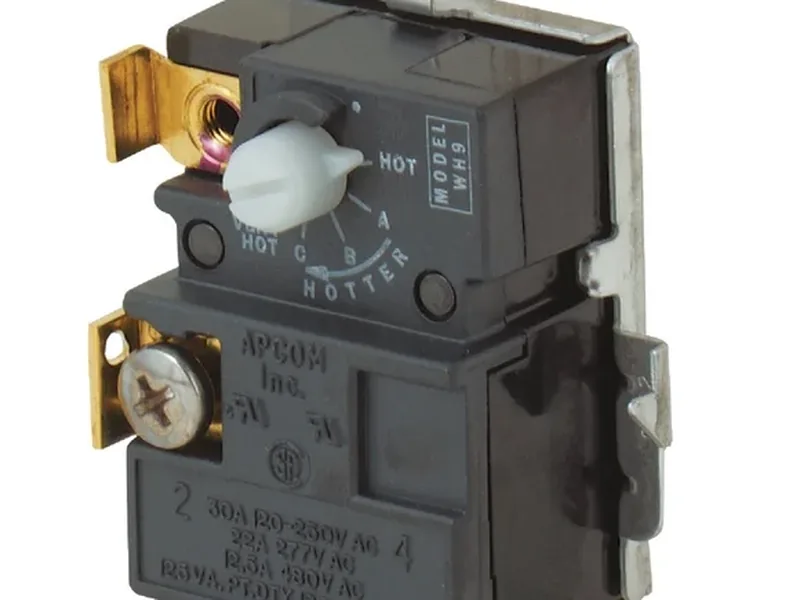
Atlanta's electric tanks overwhelmingly use the dual-thermostat, dual-element design: the upper thermostat commands the upper element first, then hands off to the lower thermostat and element for the bulk heating, with the ECO reset button on the upper thermostat as the overheat guard. Our replacement service in Atlanta is built on electrical proof, because this town's water produces every thermostat mimic in the book.
With the breaker off and verified, we open both access panels and test. Each thermostat gets continuity and switching checks; each element gets a resistance reading against its rated value. In Atlanta's well-water homes, the most common actual finding is not a failed thermostat at all — it is a lower element burned out from sediment burial, reading open on the meter while the thermostat tests fine. The homeowner's symptom (hot water runs out fast) pointed at the thermostat; the meter points at the element. We replace what the meter condemns, which is why our Atlanta thermostat calls so often become thermostat-plus-element calls — diagnosed honestly, fixed completely.
When a thermostat has genuinely failed, the patterns are distinct. An upper thermostat stuck open produces lukewarm water that never satisfies; stuck closed, it overheats the top of the tank and trips the ECO. A lower thermostat stuck open leaves you with a small effective tank — hot for ten minutes, then cold. A lower thermostat stuck closed overheats the bottom, accelerates sediment baking, and can trip the ECO from below. We identify the failed unit by switching behavior under the meter, not by symptom alone.
Installation demands precision. We label every wire before disconnecting — dual-element wiring must be restored exactly, since miswiring can energize both elements simultaneously, overloading the circuit. New thermostats must match voltage and element wattage ratings; we confirm against the data plate. The thermostat's sensing disc must sit flat against clean tank steel under firm bracket pressure — in Atlanta's older tanks, we often find the mounting surface crusted with scale or the bracket spring weakened, both of which we correct so the new thermostat reads tank temperature accurately rather than air.
We set both thermostats to 120°F — matched, never mismatched — and explain why: consistent control, scald safety, slower scale formation. Then we restore power and watch a full cycle: upper element first, changeover click, lower element heating, both cutting out at set point. We verify delivered temperature at a tap and confirm the ECO is armed. That verification is the difference between a repair and a guess.
Atlanta's Well-Water Complications
Well water changes the thermostat equation in three ways. First, mineral load: Atlanta-area wells produce heavy sediment that buries lower elements and insulates tank bottoms, creating the overheating that kills elements and corrupts thermostat sensing. Second, the sediment itself can pile against the tank wall at the lower thermostat's level, so the thermostat reads sediment temperature rather than water temperature — it cuts out early, and the homeowner gets lukewarm water from a "working" thermostat. Third, iron and manganese in some wells corrode terminals and connections, adding wiring faults to the mimic list. Our Atlanta diagnostic accounts for all three: sediment assessment, sensing-surface inspection, and terminal condition checks alongside the electrical tests.
Local Factors That Matter for Thermostats in Atlanta, IN 46031
Heater age is Atlanta's headline factor. Tanks of 15 to 20 years are common, and original thermostats at that age have endured hundreds of thousands of switching cycles — contact wear is real. But age also means sediment: two decades of never-flushed hard water leaves inches of mineral in the tank bottom. We weigh every thermostat replacement against the tank's overall condition and give an honest read when the tank itself is the better investment.
Rural electrical systems add variables: older panels, long wire runs to outbuildings with voltage drop, and well-pump circuits sharing panels with the heater. Voltage sag under load mimics thermostat problems; we check supply voltage during diagnosis.
Secondary heaters in barns, shops, and garage apartments — common on Atlanta properties — suffer the worst maintenance neglect and the widest temperature swings. Their thermostats fail earlier; mention the outbuilding heater when you call and we will assess both.
Finally, the DIY legacy: we find mismatched thermostat settings, incorrect wattage elements, and miswired changeovers from previous owner repairs. We correct all of it during service — the wiring must be right for the new thermostats to work safely.
When the Reset Button Keeps Tripping
Atlanta homeowners often call about the ECO reset button tripping repeatedly — and often they have been resetting it for months. A tripping ECO means the tank overheated, period. Causes include a stuck thermostat, a grounded element heating continuously, or sediment-driven overheating. Resetting without diagnosing is like silencing a smoke alarm: the condition persists. We find the overheat source electrically before the new thermostat goes in, because a new thermostat on an undiagnosed overheat will trip again — or worse, fail to protect.
What Happens When You Call (833) 713-2101
Tell us the symptoms in plain terms — what the water does, when it changed, whether the reset button trips. We will give you a preliminary read and advise on scalding-water caution if applicable.
On site: breaker-verified multimeter diagnosis of thermostats and elements, sediment and wiring assessment, replacement of failed parts with correctly rated components, matched 120°F settings, and full-cycle verification — usually one visit. You keep the failed parts and get the readings explained.
For thermostat replacement in Atlanta, IN 46031, Water Heater Leak Repair Co. proves the failure before replacing the part. Call (833) 713-2101 today.