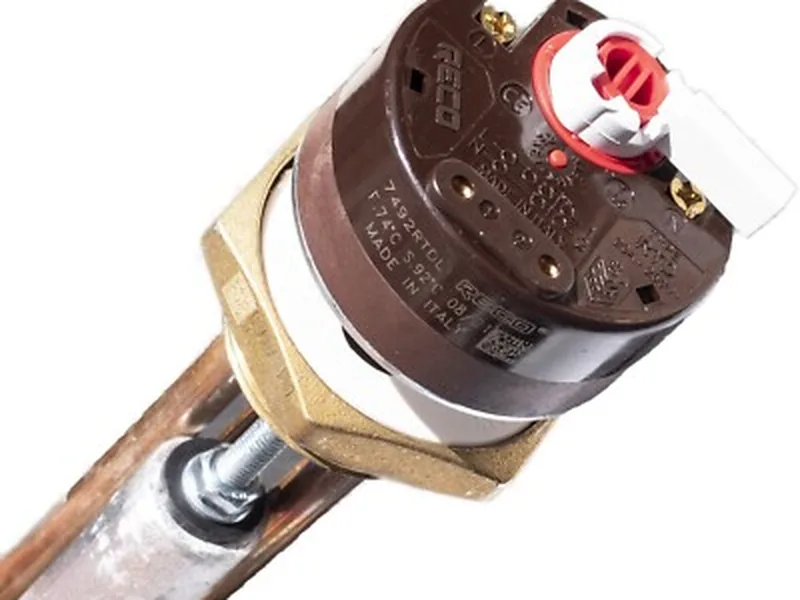
Avon's subdivisions are full of electric water heaters in the 10-to-20-year range — the exact age when thermostats start failing. In Avon, IN 46123, the complaints follow familiar lines: the master shower goes lukewarm, the tank that once handled back-to-back showers now quits after one, or the water comes out hot enough to scald. Thermostats are the usual suspects, but in Avon's hard water they are far from the only ones — elements, sediment, and even dip-tube failures mimic thermostat symptoms closely.
Water Heater Leak Repair Co. provides thermostat replacement in Avon, IN 46123 for electric tank water heaters. We diagnose electrically — both thermostats and both elements under the multimeter, plus sediment and wiring assessment — then replace failed components with correctly rated parts, matched temperature settings, and verified full-cycle operation. Call (833) 713-2101 and describe your hot-water trouble.
In Short: In Avon, IN 46123, thermostat failure shows as lukewarm water, rapidly depleting hot water, scalding, or a tripped ECO reset. We prove the failure with multimeter testing of thermostats and elements before replacing anything — Avon's hard water makes element and sediment mimics common. Correctly rated thermostats, matched 120°F settings, and full-cycle verification in one visit.
How Thermostat Replacement Works in Avon, IN 46123
Avon's electric heaters predominantly use dual thermostats with dual elements in the classic changeover arrangement: upper thermostat and element heat the top first, then control passes to the lower pair for the tank's bulk. The ECO reset on the upper thermostat guards against overheat. Our Avon service treats this system as an electrical circuit to be tested, not a parts list to be swapped.
Breaker off and verified, panels open, insulation folded back — then the meter comes out. We check each thermostat's switching: it should show continuity when calling for heat and open when satisfied, changing state crisply at its set point. A thermostat that stays closed regardless of temperature is stuck and dangerous; one that never closes starves its element. Each element gets a resistance check against its rating — a 4500W/240V element should read about 12–13 ohms; infinite resistance means a burned-out element, and a reading to ground means a shorted element that can heat uncontrollably. In Avon, the meter frequently acquits the thermostat and condemns the element: sediment-buried lower elements burn out on schedule in hard water, and the "runs out fast" symptom sends homeowners thermostat-shopping for an element problem.
Sediment assessment runs parallel to electrical testing. We check drain-valve flow — a valve that trickles or clogs signals heavy bottom sediment — because sediment is Avon's great thermostat imitator. Piled against the lower tank wall, sediment insulates the thermostat's sensing area; the thermostat reads hot while the water is lukewarm and cuts out early. Baked onto the tank bottom, sediment overheats the lower element until it fails. When sediment is driving the failure, we recommend flushing with the thermostat service; a new thermostat sensing through six inches of mineral is a compromised repair.
Replacement is meticulous. Every wire is labeled before disconnection — the changeover wiring must be restored exactly, as miswiring can run both elements at once, overloading the 30-amp circuit. New thermostats match the heater's voltage and element wattage, confirmed against the data plate. The sensing disc seats flat against clean tank steel under firm spring-bracket pressure; we clean scale from the mounting surface so the new thermostat reads water temperature, not an air gap.
Both thermostats go to 120°F — matched, verified with a thermometer at the tap. Then the full-cycle proof: upper element heats, changeover clicks, lower element takes over, both cut out at set point, ECO armed. During a thermostat replacement in Avon, IN 46123, we demonstrate the cycle rather than just declaring it done.
The Dip-Tube Wildcard
One Avon-specific mimic deserves mention: the dip tube. In 1990s–2000s heaters — Avon's core subdivision vintage — dip tubes are reaching the age where they crack or disintegrate, dumping cold inlet water at the tank top instead of the bottom. The symptom is unmistakable once you know it: hot water that starts fine and turns cold shockingly fast, with the tank itself still hot. It looks like a lower thermostat failure but is a no-cost diagnosis away with the right test. We check for dip-tube failure when the electrical tests pass but the symptom persists — because replacing thermostats onto a broken dip tube fixes nothing.
Local Factors That Matter for Thermostats in Avon, IN 46123
Subdivision-vintage heaters define Avon's thermostat work. The 1990s–2000s tanks now hitting 15–25 years combine worn thermostat contacts, heavy sediment, and aging dip tubes — often all three at once. Our diagnostic is built for this vintage: electrical tests, sediment check, dip-tube assessment, and an honest read on whether the tank deserves the investment.
Hard municipal water accelerates every failure mode: sediment burial of elements, sensing corruption, terminal corrosion. Annual flushing is the single highest-value maintenance for Avon electric heaters, and we recommend it plainly during every thermostat visit.
Finished basements with heaters in utility closets mean symptoms get noticed late — the lukewarm shower is the first sign, months after the failure began. We encourage Avon homeowners to note hot-water changes early; a thermostat caught when it starts drifting is a simple repair, while months of overheating damage surrounding components.
Higher-demand households — Avon's larger families in larger homes — cycle heaters harder, wearing thermostats faster. If your heater runs multiple recovery cycles daily, expect control life at the shorter end of the range.
Scalding Water: The Urgent Pattern
Among thermostat failures, one demands immediate attention: the stuck-closed thermostat producing scalding water. Beyond the burn risk at every tap, it drives the tank toward ECO trip and TPR discharge, stressing safety devices. If your Avon water is suddenly much hotter than usual, treat every tap with caution and call (833) 713-2101 promptly — this is the thermostat failure with a safety dimension, and same-week service matters.
When to Call Early in Avon
The cheapest thermostat repair in Avon is the early one. Call at the first sustained change — the shower that is noticeably cooler than last month, the tank that handles two showers instead of three — rather than after months of decline. Early drift is usually a single thermostat; late failure is often a thermostat plus a sediment-killed element plus a tank that has been overheating for months. The diagnostic is the same either way, but the parts list — and the stress on the tank — grows with delay. Avon homeowners with subdivision-vintage heaters should treat any capacity change as a signal, not background noise.
What Happens When You Call (833) 713-2101
Describe the symptoms — lukewarm, runs out fast, scalding, reset tripping, breaker tripping. We will give you a preliminary read on the likely cause and any immediate precautions.
On site: verified-safe electrical diagnosis of both thermostats and elements, sediment and dip-tube assessment, wiring inspection, replacement of failed parts with correctly rated components, matched 120°F settings, and full-cycle verification — usually a single visit. Failed parts and meter readings are shown and explained.
For thermostat replacement in Avon, IN 46123, Water Heater Leak Repair Co. tests first and fixes completely. Call (833) 713-2101 today.