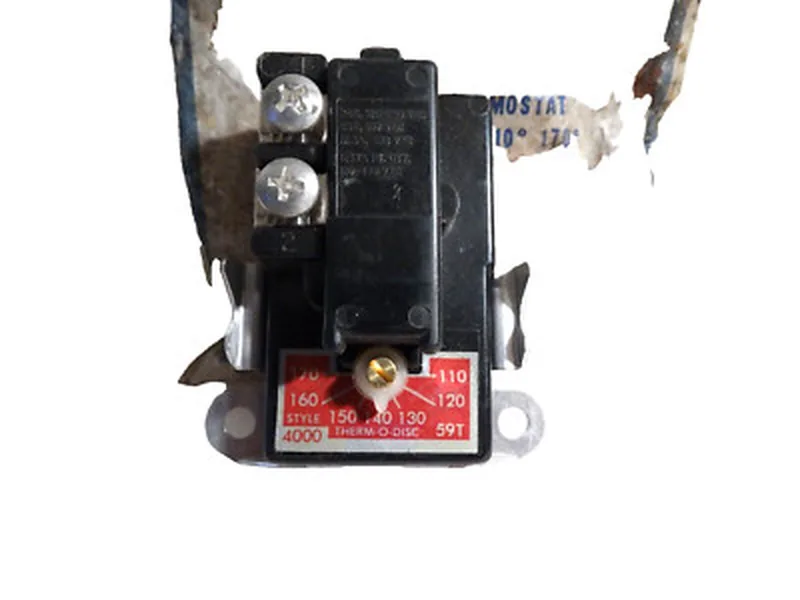
Danville, IN 46122 blends a historic town square with surrounding subdivisions, and its electric water heaters span the full age range — from tanks installed during the Reagan administration to units put in last year. Thermostat failure looks different at each end: worn contacts and heavy sediment in the veterans, early drift or misconfiguration in the young ones. The symptoms that bring Danville homeowners to call are consistent though — lukewarm water, hot water that runs out too fast, scalding delivery, or the ECO reset button tripping repeatedly.
Water Heater Leak Repair Co. provides thermostat replacement in Danville, IN 46122 for electric tank water heaters. We diagnose electrically first — both thermostats and both elements under the multimeter, sediment and wiring assessed — then replace failed parts with correctly rated components, matched 120°F settings, and full-cycle verification. Call (833) 713-2101 and describe your hot-water symptoms.
In Short: In Danville, IN 46122, thermostat failure shows as lukewarm water, rapid depletion, scalding, or repeated ECO trips — but elements, sediment, and wiring cause identical symptoms in Danville's hard water. We prove the failure electrically before replacing anything, install correctly rated thermostats with matched settings, and verify through a complete heating cycle in one visit.
How Thermostat Replacement Works in Danville, IN 46122
Danville's electric tanks use the dual-thermostat changeover design almost universally: the upper thermostat heats the top via the upper element, then switches power to the lower thermostat and element for the bulk, with the ECO reset as the overheat guard on the upper unit. Our Danville service is built on electrical proof, because this town's mix of old tanks and hard water produces every thermostat mimic.
Breaker off and verified, panels open, insulation back — then systematic testing. Each thermostat's switching behavior under the meter: continuity when calling for heat, open when satisfied, crisp transitions. Each element's resistance against its nameplate rating. In Danville's oldest tanks, we regularly find the double failure: a lower element burned out from decades of sediment burial plus a lower thermostat with worn contacts — both condemned by the meter, both replaced in the same visit. In younger Danville heaters, the finding is often simpler: a single drifting thermostat, caught early, replaced alone.
Sediment assessment is inseparable from the electrical work in Danville. We check drain-valve flow and evaluate bottom buildup, because sediment here does triple duty as a mimic: it buries lower elements until they burn out, piles against sensing surfaces so good thermostats misread, and bakes onto tank bottoms driving the overheating that trips ECOs. When sediment is implicated, we recommend flushing alongside the thermostat service — a new thermostat reading through inches of mineral is a compromised repair, and we say so.
Failure signatures guide precise replacement: upper stuck-open gives lukewarm water; upper stuck-closed overheats and trips the ECO; lower stuck-open shrinks capacity; lower stuck-closed overheats the bottom. We match the electrical signature to the failed unit — one thermostat, both, plus elements as the meter dictates.
Installation is exacting: every wire labeled before disconnection, changeover wiring restored precisely (miswiring can parallel both elements and overload the circuit), replacements matched to voltage and element wattage per the data plate, sensing discs seated flat against clean tank steel under firm brackets. In Danville's oldest tanks we often clean scale from mounting surfaces and re-tension weakened bracket springs so the new thermostat reads accurately.
Both thermostats to 120°F — matched, verified at the tap — then the full-cycle demonstration: upper heats, changeover clicks, lower heats, both cut out at set point, ECO armed. During a thermostat replacement in Danville, IN 46122, the proof is shown, not claimed.
Danville's Oldest Tanks: Repair or Replace?
This question comes up constantly in Danville, where 20-year-old tanks are still in service. Our rule is straightforward: if the tank shows no leak, the glass lining is intact (no rusty water, no rumbling from hardened sediment), and the failure is confined to controls, thermostat and element replacement is sound economics. But if the tank rumbles like a cement mixer, delivers rusty water, or shows moisture at the base, controls are not the real problem — the tank is failing, and we will tell you so honestly rather than sell a repair with months of life in it. That honest read is part of every Danville thermostat visit on an aging tank.
Local Factors That Matter for Thermostats in Danville, IN 46122
Heater age diversity is Danville's defining factor — the diagnostic flexes from contact wear and sediment on veterans to drift and configuration on young units, with the repair-or-replace assessment built in for the oldest.
Hard water accelerates everything: sediment burial, sensing corruption, terminal corrosion. Annual flushing is the highest-value maintenance for Danville electric heaters, recommended plainly at every visit.
Older electrical systems in Danville's historic homes — aging panels, long-lived breakers, legacy splices — can sag voltage or trip under load, mimicking control failure. We check supply voltage under load during diagnosis.
Rural well-fed properties around Danville add mineral load and pressure-tank electrical neighbors; well water's sediment burden makes element and thermostat issues earlier and more frequent than in town.
The ECO Trip: Stop Resetting, Start Diagnosing
A tripping ECO means the tank overheated — stuck thermostat, grounded element, or sediment overheating. Danville homeowners sometimes reset it for months; each reset without diagnosis risks scalding delivery or TPR discharge and degrades the safety device. We find the overheat source electrically before the new thermostat goes in.
What a Flush Does for Your Thermostats in Danville
Danville homeowners sometimes question why we recommend flushing alongside thermostat replacement — the connection deserves a plain explanation. Sediment harms thermostats in three distinct ways. First, it buries the lower element, which then overheats and burns out; the dead element produces the "runs out fast" symptom that sends people thermostat shopping. Second, sediment piled against the tank wall at the lower thermostat's level insulates the sensing disc from the water — the thermostat reads the hot sediment, cuts out early, and the household gets lukewarm water from a perfectly good control. Third, sediment baked onto the tank bottom forces longer, hotter burn cycles that drive the overheating behind ECO trips.
A proper flush addresses all three: it removes the burial from the element, clears the sensing surface so the thermostat reads water temperature again, and restores normal cycle lengths. On Danville tanks with years of accumulation, the flush can take a full hour — stubborn sediment does not surrender quickly — but the result is a tank where the new thermostats can actually do their job. Skipping the flush to save time is the false economy we warn against: new controls on a sediment-choked tank inherit every problem the sediment caused.
What Happens When You Call (833) 713-2101
Describe the symptoms — what the water does, when it changed, reset behavior. We will give a preliminary read and scalding-water precautions if needed.
On site: breaker-verified multimeter diagnosis, sediment and wiring assessment, correctly rated replacements, matched 120°F settings, full-cycle verification — usually one visit, with an honest tank-condition read on older units. Failed parts and readings shown and explained.
For thermostat replacement in Danville, IN 46122, Water Heater Leak Repair Co. proves the failure first. Call (833) 713-2101 today.