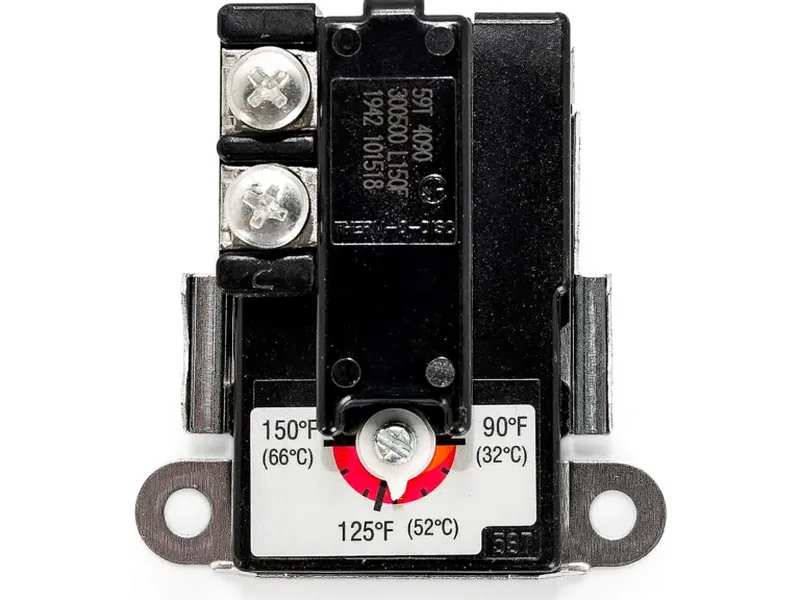
Fishers, IN 46038 is full of electric water heaters in the 10-to-20-year sweet spot for thermostat trouble — subdivision tanks installed in the 2000s and 2010s whose controls are now drifting, sticking, or failing outright. Fishers homeowners notice it as shrinking capacity: the heater that handled the family's morning routine now quits halfway through, or the water never quite reaches the temperature it used to. Thermostats are the leading suspects, but Fishers' hard water keeps elements and sediment in the running — only electrical testing separates them.
Water Heater Leak Repair Co. provides thermostat replacement in Fishers, IN 46038 for electric tank water heaters. We diagnose electrically — both thermostats and both elements tested with a multimeter, sediment and wiring assessed — then replace failed parts with correctly rated components, matched 120°F settings, and full-cycle verification. Call (833) 713-2101 and describe your symptoms.
In Short: In Fishers, IN 46038, thermostat failure typically shows as shrinking hot-water capacity, lukewarm delivery, scalding, or ECO trips. We prove the failure with multimeter testing of thermostats and elements before replacing — Fishers' hard water makes sediment-buried elements a common mimic. Correctly rated thermostats, matched settings, and demonstrated full-cycle operation in one visit.
How Thermostat Replacement Works in Fishers, IN 46038
Fishers' electric heaters overwhelmingly use the dual-thermostat changeover design: upper thermostat and element heat the top first, then power switches to the lower pair for the bulk, with the ECO reset as overheat guard. Our Fishers service treats this as an electrical system to be proven — because the town's subdivision-vintage tanks produce thermostat mimics on schedule.
Breaker off and verified, panels open — then the meter. Thermostat switching tests: continuity calling for heat, open when satisfied, crisp changeover. Element resistance checks against nameplate values. The recurring Fishers finding is the sediment-buried lower element reading open while both thermostats test good — the "runs out fast" complaint explained by the element, not the control. We replace what the meter condemns: thermostat, element, or both, in the same visit.
Genuine thermostat failures show clear signatures: upper stuck-open gives lukewarm water; upper stuck-closed overheats and trips the ECO; lower stuck-open shrinks capacity; lower stuck-closed overheats the bottom and bakes sediment. We match the electrical signature to the failed unit and replace precisely — no symptom-only guessing.
Sediment assessment runs with the electrical work. Drain-valve flow checks reveal bottom buildup; in Fishers' unflushed subdivision tanks, sediment is the engine behind most element failures and much thermostat mis-sensing. When sediment drives the failure, we recommend flushing with the service — a new thermostat sensing through mineral buildup is a compromised repair.
Installation is exacting: wires labeled and restored exactly (miswiring can parallel elements and overload the 30-amp circuit), replacements matched to voltage and wattage per the data plate, sensing discs flat against clean tank steel under firm brackets. Both thermostats to 120°F, matched, verified at the tap. Then the full-cycle proof: upper heats, changeover clicks, lower heats, both cut out at set point, ECO armed — demonstrated during your thermostat replacement in Fishers, IN 46038.
Fishers' Capacity Complaints, Decoded
The most common Fishers call is not "no hot water" but "less hot water" — the slow shrink over months that families adapt to until someone gets a cold shower. Three causes dominate: lower thermostat drift (cuts out early, heats less of the tank), lower element degradation (heats the bottom weakly), and sediment displacement (mineral occupying gallons of tank volume). Our diagnostic separates these: the meter tests the first two, the drain-valve flow and flush assessment reveal the third. Often it is a combination — a drifting thermostat plus five gallons of sediment — and the complete fix addresses both.
Local Factors That Matter for Thermostats in Fishers, IN 46038
Subdivision-vintage tanks define Fishers' thermostat work: 2000s–2010s heaters hitting control-failure age simultaneously across neighborhoods, with sediment from unflushed hard water as the accelerant. Our diagnostic is tuned to this vintage.
High household demand — Fishers' larger families — means more daily recovery cycles and faster contact wear. Thermostat life tracks cycles, so heavy-use homes see earlier failures.
Water softeners are common and help, but only when maintained; dry-on-salt months still deposit scale. We ask about softener status because it predicts sediment load.
Finished basements hide heaters where drift develops unnoticed for months. Noting capacity changes early — the first short shower, not the tenth — keeps the repair to a thermostat instead of a thermostat plus element plus flush.
When Capacity Shrinks: Act Early
The slow shrink is the expensive pattern to ignore. A drifting lower thermostat that cuts out early forces longer, harder cycles; a degrading element overheats; sediment keeps accumulating. Months of marginal operation stress every component. In Fishers, where the symptom is usually noticed late, we encourage calling at the first capacity change — early thermostat replacement is a simple visit; late is a multi-part repair.
Fishers' Newer-Heater Drift: Catching It Early
Fishers' subdivision-vintage heaters are young enough that owners do not suspect the thermostats — which is exactly why drift goes unnoticed for months. Thermostat drift is gradual calibration loss: the control cuts out a few degrees early, then a few more, each month heating slightly less of the tank. No error, no trip, no drama — just the slow shrink that families adapt to, turning up the shower mix, shortening showers, until someone finally says the heater "isn't what it used to be."
The early-detection method is simple: once a season, run hot water at the tap nearest the heater and note how long full-hot lasts compared to your memory of the heater's prime. A shrinking full-hot duration with no other change is drift until proven otherwise. The second check is the delivered temperature itself — a cooking thermometer under the hot tap should read near the thermostat setting (120°F); readings consistently 10–15 degrees low indicate a thermostat cutting out early. Catching drift at this stage means replacing one thermostat before the prolonged underheating stresses the elements with longer cycles. In Fishers, where the symptom is usually reported late, these two simple checks are the difference between a single-thermostat visit and a multi-part repair.
Fishers' Thermometer Check Method
The cooking thermometer is the most underused diagnostic tool in Fishers homes — and the simplest early-warning system for thermostat drift. The method: once a season, run hot water at the tap nearest the heater for a full minute (clearing the cooled water standing in the pipes), then hold a cooking thermometer in the stream. Compare the reading to the thermostat setting — typically 120°F. A reading within a few degrees means controls are healthy; a reading consistently 10–15 degrees low indicates a thermostat cutting out early (drift); a reading significantly high indicates a thermostat not cutting out (stuck — the safety-relevant failure).
Run the check at the same tap each season and write down the number with the date — the trend matters more than any single reading. A slow decline across seasons is drift; a sudden change is failure. This two-minute check catches what showers reveal months later: by the time the family notices lukewarm water, the thermostat has been drifting for a season. The thermometer gives Fishers homeowners the same early warning our multimeter gives us — earlier, cheaper, and without a service call. When the number moves, call before the drift becomes the failure.
What Happens When You Call (833) 713-2101
Describe the symptoms — capacity change, temperatures, reset behavior — and household size if relevant. We will give a preliminary read and any precautions.
On site: verified-safe electrical diagnosis, sediment and wiring assessment, correctly rated replacements, matched 120°F settings, full-cycle verification — usually one visit. Failed parts and readings shown and explained.
For thermostat replacement in Fishers, IN 46038, Water Heater Leak Repair Co. proves the failure first. Call (833) 713-2101 today.