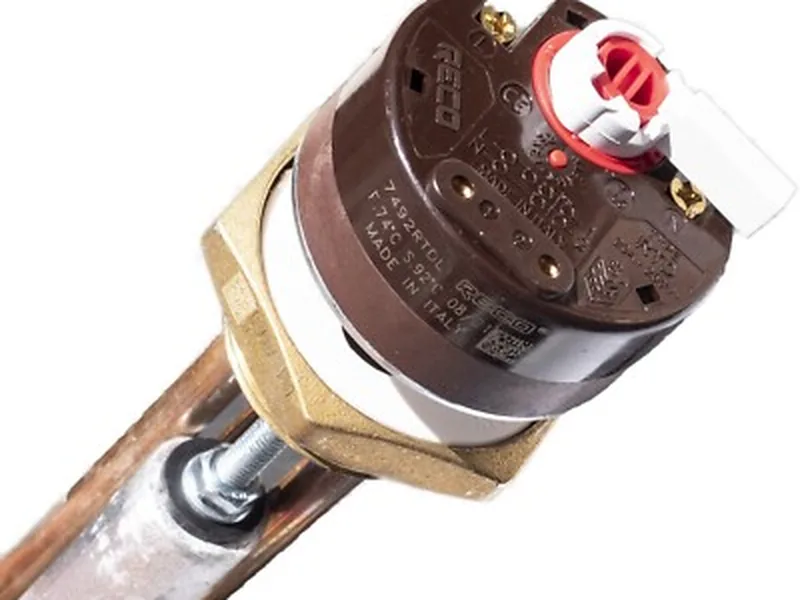
Greenfield, IN 46140 spans Victorian-era homes near downtown to new subdivisions on the edges, and its electric water heaters fail accordingly — worn contacts and deep sediment in the veterans, early drift in the young ones. Greenfield homeowners call about the familiar quartet: lukewarm water, hot water that runs out too fast, scalding delivery, or the ECO reset button tripping over and over. Thermostats are suspects, but in Greenfield's hard water, elements and sediment share the docket — only the multimeter convicts.
Water Heater Leak Repair Co. provides thermostat replacement in Greenfield, IN 46140 for electric tank water heaters. We diagnose electrically — both thermostats and both elements tested, sediment and wiring assessed — then replace failed parts with correctly rated components, matched 120°F settings, and full-cycle verification. Call (833) 713-2101 and describe your symptoms.
In Short: In Greenfield, IN 46140, thermostat failure shows as lukewarm water, rapid depletion, scalding, or repeated ECO trips — with elements, sediment, and wiring as common mimics across the town's wide heater-age range. We prove the failure electrically before replacing, install correctly rated thermostats with matched settings, and verify through a full heating cycle in one visit.
How Thermostat Replacement Works in Greenfield, IN 46140
Greenfield's electric tanks use the dual-thermostat changeover design: upper thermostat and element heat the top first, then control passes to the lower pair, with the ECO reset as overheat guard. Our Greenfield diagnostic adapts to the tank's era — contact wear and sediment on the veterans, drift and configuration on the young — but the electrical discipline never changes.
Breaker off and verified, panels open, then systematic testing: thermostat switching (continuity calling for heat, open when satisfied), element resistance against nameplate values. In Greenfield's oldest tanks we often find compound failures — a sediment-buried lower element reading open plus a lower thermostat with pitted contacts — both condemned, both replaced in one visit. In newer tanks, a single drifting thermostat is the usual finding.
Sediment assessment is inseparable from the electrical work. Drain-valve flow checks reveal bottom buildup; Greenfield's unflushed tanks — common in both the historic homes and the rentals — hold the sediment that buries elements, corrupts sensing, and drives ECO-tripping overheating. When sediment is the engine, we recommend flushing with the service and explain why plainly: new controls on a mineral-choked tank are a short-lived repair.
Failure signatures are read electrically and replaced precisely: upper stuck-open (lukewarm), upper stuck-closed (overheat, ECO trips), lower stuck-open (shrunken capacity), lower stuck-closed (bottom overheating). One thermostat, both, plus elements — the meter decides.
Installation is exacting: wires labeled and restored exactly, replacements matched to voltage and wattage per the data plate, sensing discs flat against clean tank steel under firm brackets — with scale cleaned from mounting surfaces on Greenfield's older tanks. Both thermostats to 120°F, matched, verified at the tap. Then the full-cycle demonstration: upper heats, changeover clicks, lower heats, both cut out at set point, ECO armed — shown during your thermostat replacement in Greenfield, IN 46140.
Greenfield's Era Problem: One Town, Three Failure Modes
What makes Greenfield diagnostically interesting is the era spread within a single service area. A Victorian near downtown may have a 25-year-old tank with original controls — contact wear, hardened sediment, tired wiring, and the honest repair-or-replace conversation. A 1970s split-level may have a 15-year-old tank with heavy sediment and a drifting lower thermostat. A new subdivision home may have a 6-year-old tank with a single premature thermostat failure. Our diagnostic reads the era and tests accordingly rather than applying one template — and on the oldest tanks, the tank-condition assessment (leaks, rust, rumbling, base moisture) is part of every visit.
Local Factors That Matter for Thermostats in Greenfield, IN 46140
Heater-age diversity is Greenfield's defining factor, driving the era-adapted diagnostic and the built-in repair-or-replace read on veterans.
Hard water is the constant accelerant: sediment burial of elements, sensing corruption, terminal corrosion. Annual flushing is the highest-value maintenance for Greenfield electric heaters.
Rural well-fed properties around Greenfield add mineral and silt loads that bring control issues earlier; flushing matters most there.
Older electrical systems in historic homes can sag voltage or nuisance-trip breakers, mimicking control failure — we check supply under load during diagnosis.
Stop Resetting the ECO
A tripping ECO means the tank overheated — stuck thermostat, grounded element, or sediment overheating. Repeated resets without diagnosis risk scalding delivery or TPR discharge. We find the overheat source electrically and repair it properly, ending the reset cycle.
Greenfield's Three-Era Maintenance Plans
Because Greenfield's housing spans three distinct eras, thermostat maintenance should be era-matched. For Victorian and early-20th-century homes with veteran tanks: annual flushing is mandatory (sediment is deep), thermostat function gets checked yearly via delivered-temperature verification, and every control repair includes the honest tank-condition assessment — at this age, the tank's remaining life governs every decision. Budget for eventual tank replacement; controls are maintenance, not resurrection.
For mid-century ranches and split-levels with 10-to-20-year-old tanks: annual flushing, delivered-temperature checks each season, and ECO awareness — this is the era where drift and sediment conspire, and catching drift early keeps repairs to single thermostats. For new subdivisions with young heaters: flushing from year one (sediment starts immediately in hard water), changeover-logic verification if any electrical work was ever done on the heater circuit, and the same seasonal temperature checks. The young-heater plan is the cheapest because prevention is cheapest early — a Greenfield subdivision homeowner who flushes annually from installation may never need an emergency thermostat call at all.
Greenfield's Drain-Valve Flush How-To
Greenfield owners comfortable with basic maintenance can flush sediment between professional visits — and the procedure is straightforward with the right precautions. Power off at the breaker (verify — not assume), close the cold-water inlet valve, attach a garden hose to the drain valve and run it to a floor drain or outside (the water is hot and sediment-laden — route it where it can go). Open a hot tap elsewhere in the house to vent, then open the drain valve and let the tank drain partially — a full drain is unnecessary for maintenance flushing; draining a third to half, then briefly cracking the cold inlet to stir and flush, repeated two or three times, removes the loose sediment that matters.
The precautions that prevent disaster: never restore power until the tank is completely full again (open the hot tap until water flows steadily with no sputtering — air in the tank means elements exposed, and dry-fired elements die in seconds); if the drain valve clogs with sediment, do not force it — call us, because a broken drain valve turns maintenance into a repair; and if the drain valve drips after closing, it needs replacement (sediment scores the valve seat — common on Greenfield's oldest tanks). Done annually, this owner flushing extends the interval between professional descaling-level service and keeps thermostats reading true.
What Happens When You Call (833) 713-2101
Describe the symptoms — what the water does, when it changed, reset behavior. We will give a preliminary read and scalding precautions if needed.
On site: breaker-verified electrical diagnosis, sediment and wiring assessment, correctly rated replacements, matched 120°F settings, full-cycle verification — usually one visit, with honest tank assessment on older units. Failed parts and readings shown and explained.
For thermostat replacement in Greenfield, IN 46140, Water Heater Leak Repair Co. proves the failure first. Call (833) 713-2101 today.