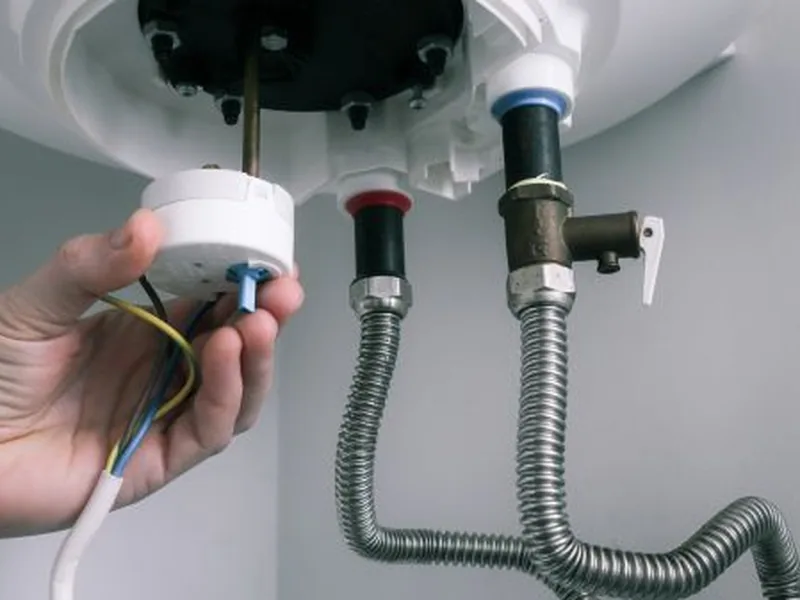
The 46260 ZIP covers north Indianapolis — mid-century ranches, split-levels, and brick traditionals whose electric water heaters are often 15 to 25 years old, working alongside renovated homes with new units. Thermostat failure is one of the most common service calls in this area: contacts worn from decades of switching, calibration drifted, sensing corrupted by sediment that has accumulated since the house was built. Homeowners notice lukewarm showers, shrinking capacity, scalding water, or the ECO reset button tripping again.
Water Heater Leak Repair Co. provides thermostat replacement in Indianapolis, IN 46260 for electric tank water heaters. We diagnose electrically — both thermostats and both elements tested with a multimeter, sediment and wiring assessed — then replace failed parts with correctly rated components, matched 120°F settings, and full-cycle verification. Call (833) 713-2101 and describe your symptoms.
In Short: In Indianapolis, IN 46260, thermostat failure presents as lukewarm water, shrinking capacity, scalding, or repeated ECO trips — though 46260's aging tanks make element burnout, deep sediment, and tired wiring equally likely. We prove the failure electrically before replacing, install correctly rated thermostats with matched settings, and verify through a full heating cycle in one visit.
How Thermostat Replacement Works in Indianapolis, IN 46260
46260's electric tanks run the dual-thermostat changeover design: upper thermostat and element heat the top, then control passes to the lower pair, with the ECO reset as overheat guard. Our diagnostic is electrical proof, because this ZIP's veteran tanks produce every mimic simultaneously.
Breaker off and verified, panels open — then systematic testing. Thermostat switching behavior, element resistance against nameplate values. In 46260's oldest tanks, compound failures are the norm: sediment-buried lower elements reading open, pitted thermostat contacts, corroded terminals — the meter condemns what it condemns, and we replace it all in one visit. In renovated homes with young heaters, single-component drift is the usual story.
Sediment assessment is critical here. Decades of unflushed hard water leave inches of mineral; drain valves clog on testing. Sediment buries elements, corrupts sensing, drives ECO-tripping overheating. When sediment is the engine, we recommend flushing with the service — new controls on a choked tank are short-lived, and we say so directly.
Failure signatures read electrically: upper stuck-open (lukewarm), upper stuck-closed (overheat, ECO trips), lower stuck-open (shrunken capacity), lower stuck-closed (bottom overheating). Precise replacement follows the signature — one thermostat, both, plus elements as diagnosed.
Installation is exacting: wires labeled and restored exactly, replacements matched to voltage and wattage per the data plate, sensing discs flat against clean tank steel under firm brackets, scale cleaned from mounting surfaces. Both thermostats to 120°F, matched, verified at the tap. Then the full-cycle proof: upper heats, changeover clicks, lower heats, both cut out at set point, ECO armed — demonstrated during your thermostat replacement in Indianapolis, IN 46260.
46260's Wiring Reality
North-side homes carry decades of electrical history: original panels, breakers tripped thousands of times, splices from multiple renovations, and in some cases aluminum branch wiring. Weak breakers nuisance-trip during recovery; voltage sag on long runs slows heating; corroded splices drop voltage to elements — all mimicking thermostat failure. Our diagnostic includes supply-voltage checks under load and terminal inspections, separating supply problems from control problems before parts are ordered. On renovated homes, we also verify the heater circuit was correctly sized for the installed elements — flips sometimes pair 5500W elements with undersized wiring.
Local Factors That Matter for Thermostats in Indianapolis, IN 46260
Veteran tanks define 46260's thermostat work: contact wear, deep sediment, tired wiring, and the honest repair-or-replace assessment built into every visit on tanks past 15 years.
Hard water accelerates all of it — sediment burial, sensing corruption, terminal corrosion. Annual flushing is the highest-value maintenance for 46260 electric heaters.
Renovation churn adds miswiring, mismatched elements, and wrong-size circuits from quick flips. We verify the entire control circuit against code and correct what flips got wrong.
Basement and crawlspace installations expose controls to dampness and temperature swings; terminal corrosion is common and inspected during service.
Repair or Replace on Veteran Tanks
On 46260's 20-year-old tanks, our rule: sound tank (no leaks, no rust, no rumbling, dry base) plus confined control failure equals sound repair economics. Failing tank signs mean honest counsel toward replacement rather than a short-lived control repair. You get the straight read, not a sales pitch.
The 46260 Electrical Audit: What We Check and Why
On 46260's veteran tanks, our thermostat service includes what amounts to an electrical audit of the heater circuit — because at this age, the circuit is as likely to be the problem as the controls. The audit has five parts. First, supply voltage under load: we measure voltage at the heater while an element is energized; significant sag indicates undersized wiring or a failing connection upstream. Second, breaker condition: we check for the heat discoloration and loose fit that mark a breaker past its prime, and we note any history of nuisance tripping.
Third, terminal and connection inspection: every wire nut, terminal screw, and splice in the heater's junction area gets examined for corrosion, heat damage, and tightness — loose connections arc microscopically with every cycle, and decades of arcing destroys terminals. Fourth, element-to-circuit matching: we confirm the installed elements' wattage matches what the circuit and thermostats are rated for, catching the mismatched elements that quick flips sometimes leave behind. Fifth, grounding verification: a grounded element (failed insulation leaking current to the tank) can heat uncontrollably and trip ECOs — we test for it electrically. This audit is why our 46260 thermostat visits so often uncover the real problem hiding behind the symptom.
46260's Breaker Replacement Signs
Knowing when a breaker is done saves 46260 homeowners the misdiagnosed thermostat call — here are the signs. Heat: a breaker that is warm to the touch (with the panel cover safely in place — never touch inside a live panel) is failing; breakers should run at ambient temperature. Discoloration: any browning or melting on the breaker body or the panel bus where it connects means replacement is overdue — this is visible with the dead-front cover removed by a qualified person only.
Behavioral signs: tripping during water-heater recovery that resolves after resetting, then recurs — especially if the heater's electrical tests all pass; breakers that trip at progressively lower loads over months; and any buzzing or crackling from the panel area (call an electrician immediately — do not investigate). Age: breakers past 25–30 years in 46260's original panels are living on borrowed time regardless of symptoms. The critical safety note: breaker replacement is electrician work, not homeowner work — the panel's main lugs stay energized even with the main breaker off. When our diagnostic points at the breaker, we show you the evidence and recommend a qualified electrician for the replacement; the thermostat was never the problem, and the panel deserves the professional it requires.
What Happens When You Call (833) 713-2101
Describe the symptoms — what the water does, when it changed, reset and breaker behavior. We will give a preliminary read and scalding precautions if needed.
On site: breaker-verified electrical diagnosis, sediment/wiring/supply assessment, correctly rated replacements, matched 120°F settings, full-cycle verification — usually one visit. Failed parts and readings shown and explained.
For thermostat replacement in Indianapolis, IN 46260, Water Heater Leak Repair Co. proves the failure first. Call (833) 713-2101 today.