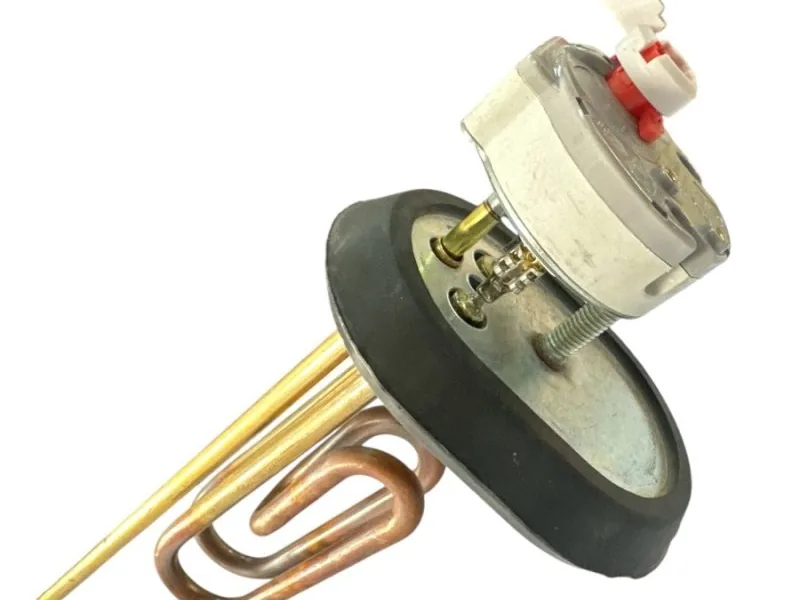
Lawrence, IN 46226 covers northeast Indianapolis — post-war brick ranches and split-levels whose electric water heaters are frequently the same age as the neighborhood. Thermostat failure here follows the veteran pattern: contacts worn from decades of cycles, calibration drifted, sensing fouled by sediment accumulated over twenty unflushed years. Lawrence homeowners call about lukewarm water, hot water that quits after one shower, scalding delivery, or the ECO reset button that will not stay set.
Water Heater Leak Repair Co. provides thermostat replacement in Lawrence, IN 46226 for electric tank water heaters. We diagnose electrically — both thermostats and both elements tested, sediment and wiring assessed — then replace failed parts with correctly rated components, matched 120°F settings, and full-cycle verification. Call (833) 713-2101 and describe your symptoms.
In Short: In Lawrence, IN 46226, thermostat failure shows as lukewarm water, fast-depleting hot water, scalding, or repeated ECO trips — with Lawrence's veteran tanks making element burnout, deep sediment, and aging wiring common co-causes. We prove the failure electrically before replacing, install correctly rated thermostats with matched settings, and verify through a full heating cycle in one visit.
How Thermostat Replacement Works in Lawrence, IN 46226
Lawrence's electric tanks use the dual-thermostat changeover design: upper thermostat and element heat the top first, then control passes to the lower pair, with the ECO reset as overheat guard. Our Lawrence diagnostic is electrical proof adapted to veteran tanks — because at this age, the failure is rarely a single clean component.
Breaker off and verified, panels open — then systematic testing: thermostat switching (continuity calling for heat, open when satisfied), element resistance against nameplate values. Lawrence's long-service tanks routinely produce compound findings: lower elements open from sediment burial, thermostat contacts pitted from hundreds of thousands of cycles, terminals showing heat discoloration from loose connections. The meter sorts it; we replace what it condemns — thermostat, element, terminals — in one visit.
Sediment assessment is inseparable from the work. Two decades of unflushed hard water is the Lawrence norm; drain valves clog, tank bottoms hold inches of mineral. Sediment buries elements, corrupts sensing, and drives the overheating behind ECO trips. When sediment is the engine, we recommend flushing with the service and explain the economics plainly: controls on a choked tank are a short-lived repair.
Failure signatures read electrically and replaced precisely: upper stuck-open (lukewarm), upper stuck-closed (overheat, ECO trips), lower stuck-open (shrunken capacity), lower stuck-closed (bottom overheating). The meter decides; the symptom merely suggests.
Installation is exacting: wires labeled and restored exactly (miswiring can parallel elements and overload circuits), replacements matched to voltage and wattage per the data plate, sensing discs flat against clean tank steel under firm brackets with scale cleaned from mounting surfaces. Both thermostats to 120°F, matched, verified at the tap. Then the full-cycle proof: upper heats, changeover clicks, lower heats, both cut out at set point, ECO armed — demonstrated during your thermostat replacement in Lawrence, IN 46226.
Lawrence's Post-War Electrical Systems
The same era that built Lawrence's homes wired them — and that wiring is now 50 to 70 years old. We encounter panels with breakers that have weakened from thousands of trips, splices buried in walls from long-ago remodels, and voltage sag on extended branch runs. A weak breaker tripping during recovery mimics control failure perfectly; we check supply voltage under load and breaker condition during diagnosis, separating supply problems from thermostat problems before any parts change. It is a Lawrence-specific step that saves misdiagnosed parts.
Local Factors That Matter for Thermostats in Lawrence, IN 46226
Veteran tanks are Lawrence's defining factor: contact wear, deep sediment, tired wiring, and the repair-or-replace assessment on every visit for tanks past 15 years.
Hard water is the accelerant — sediment burial, sensing corruption, terminal corrosion. Annual flushing is the highest-value maintenance for Lawrence electric heaters.
Post-war electrical infrastructure adds supply-side mimics: weak breakers, voltage sag, legacy splices. Our under-load voltage checks catch these.
Basement utility rooms keep failures hidden until the shower complains — months into the drift. Early attention to capacity changes keeps repairs simple.
The Honest Math on Old Tanks
On a sound 18-year-old Lawrence tank with a single failed thermostat, replacement is sensible. On a tank with compound control failure plus rumbling sediment, rusty water, or base dampness, the honest counsel is replacement of the tank — controls would buy months, not years. We do this math out loud with you, because the right answer depends on the tank in front of us, not a script.
Lawrence's Voltage-Sag Detective Work
Voltage sag is Lawrence's sneakiest thermostat mimic, and it deserves a full explanation because homeowners never suspect it. When branch wiring is undersized for the run length — common in Lawrence's post-war homes where heaters were added or upsized over the decades — voltage drops under the heater's 18-amp load. At 208 volts instead of 240, a 4500-watt element produces only about 3400 watts: recovery slows dramatically, the tank never quite satisfies, and the household experiences exactly the "lukewarm, runs out fast" pattern of thermostat failure. No control is broken; the heater is simply starved.
We detect it by measuring voltage at the heater terminals while an element is energized and comparing it to the panel voltage — a large difference means the branch circuit is the culprit. The fix is electrical, not plumbing: a dedicated, correctly sized circuit for the heater. We also check for the companion problem of shared circuits, where the heater shares a breaker with other loads (a code violation we still find in Lawrence's oldest homes) — any concurrent load drags voltage down further. When sag is the diagnosis, we explain it with the meter readings in hand: the thermostats are innocent, the wiring is guilty, and replacing controls would have changed nothing.
Lawrence's Dedicated-Circuit Case
The case for a dedicated water-heater circuit in Lawrence's older homes deserves a full hearing, because shared circuits are still out there. Electrical code requires the water heater on its own dedicated circuit — no other loads — for reasons that are practical, not bureaucratic. A 4500-watt heater draws over 18 amps continuously during recovery; sharing that circuit with anything else — basement lights, a freezer, receptacles — means concurrent loads stack onto the heater's draw, tripping breakers and sagging voltage exactly when the heater needs full power.
The symptoms of a shared circuit are maddeningly intermittent: the heater works fine for weeks, then the breaker trips on a morning when the heater and the basement freezer cycled together — diagnosed as "thermostat problems" by everyone who does not check the panel schedule. We check circuit dedication during our Lawrence diagnostic by tracing the breaker: if it feeds anything beyond the heater, that is a code violation and a likely contributor. The correction — a dedicated homerun circuit by an electrician — is straightforward work that ends an entire class of phantom heater problems. In Lawrence's oldest homes, where circuits were added informally over decades, the panel schedule audit is as important as the multimeter.
What Happens When You Call (833) 713-2101
Describe the symptoms — what the water does, when it changed, reset and breaker behavior. We will give a preliminary read and scalding precautions if needed.
On site: breaker-verified electrical diagnosis, sediment/wiring/supply assessment, correctly rated replacements, matched 120°F settings, full-cycle verification — usually one visit. Failed parts and readings shown and explained.
For thermostat replacement in Lawrence, IN 46226, Water Heater Leak Repair Co. proves the failure first. Call (833) 713-2101 today.