Noblesville, IN 46060 pairs a historic downtown of 19th-century homes with some of Hamilton County's newest subdivisions — and its electric water heaters fail on both timelines. In the historic district, veteran tanks bring worn contacts, deep sediment, and tired wiring; in the subdivisions, younger heaters bring early drift, sediment-buried elements, and high-cycle-count wear from large households. The symptoms cross both eras: lukewarm water, shrinking capacity, scalding delivery, or the ECO reset tripping repeatedly.
Water Heater Leak Repair Co. provides thermostat replacement in Noblesville, IN 46060 for electric tank water heaters. We diagnose electrically — both thermostats and both elements tested, sediment and wiring assessed — then replace failed parts with correctly rated components, matched 120°F settings, and full-cycle verification. Call (833) 713-2101 and describe your symptoms.
In Short: In Noblesville, IN 46060, thermostat failure spans two eras — contact wear and deep sediment in historic-district veterans, early drift and high cycle wear in subdivision heaters. We prove the failure electrically before replacing anything, install correctly rated thermostats with matched settings, and verify through a full heating cycle in one visit.
How Thermostat Replacement Works in Noblesville, IN 46060
Noblesville's electric tanks use the dual-thermostat changeover design: upper thermostat and element heat the top first, then control passes to the lower pair, with the ECO reset as overheat guard. Our diagnostic adapts to the era — wear and sediment on veterans, drift and cycle-count on younger units — with electrical proof as the constant.
Breaker off and verified, panels open — then systematic testing: thermostat switching behavior, element resistance against nameplate values. In historic-district veterans, compound failures are typical: pitted contacts, sediment-buried elements reading open, heat-discolored terminals — the meter condemns, we replace, one visit. In subdivision heaters, the findings run to drift (thermostat cutting out early), sediment-degraded lower elements, and occasionally miswired changeovers from construction.
Sediment assessment runs with the electrical work across both eras. Drain-valve flow checks reveal bottom buildup; Noblesville's hard water punishes unflushed tanks regardless of age. When sediment drives the failure, we recommend flushing with the service — new controls on a mineral-choked tank are short-lived.
Failure signatures read electrically and replaced precisely: upper stuck-open (lukewarm), upper stuck-closed (overheat, ECO trips), lower stuck-open (shrunken capacity), lower stuck-closed (bottom overheating). The meter decides.
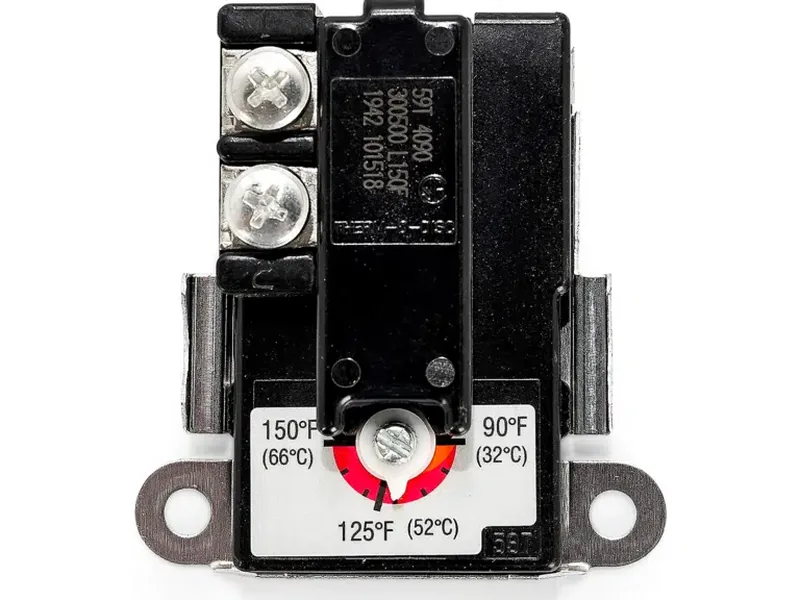
Installation is exacting: wires labeled and restored exactly, replacements matched to voltage and wattage per the data plate, sensing discs flat against clean tank steel under firm brackets with scale cleaned from mounting surfaces. Both thermostats to 120°F, matched, verified at the tap. Then the full-cycle proof: upper heats, changeover clicks, lower heats, both cut out at set point, ECO armed — demonstrated during your thermostat replacement in Noblesville, IN 46060.
Noblesville's Two-Era Diagnostic
What distinguishes Noblesville is the diagnostic split within a single town. A historic-district service call means expecting the worst and hoping for the best: we test thoroughly, assess tank condition honestly (leaks, rust, rumbling, base moisture), and deliver the repair-or-replace math out loud on tanks past 15 years. A subdivision call means hunting drift and cycle wear: we check calibration against delivered temperature, verify changeover logic, and assess sediment load relative to the tank's age. Same tools, different expectations — and the homeowner gets the read that fits their heater's era.
Local Factors That Matter for Thermostats in Noblesville, IN 46060
The historic-subdivision split defines Noblesville's thermostat work — era-adapted diagnostics, honest veteran-tank assessments, drift-hunting on younger units.
Hard water is the cross-era accelerant: sediment burial, sensing corruption, terminal corrosion. Annual flushing is the highest-value maintenance for Noblesville electric heaters.
Large subdivision households mean high cycle counts and earlier contact wear; heavy-use homes should watch for the slow capacity shrink as the earliest warning.
Finished basements hide heaters where drift develops unnoticed for months; early attention to hot-water changes keeps repairs to a single thermostat.
The Capacity Shrink: Noblesville's Early Warning
Across both eras, the slow loss of capacity — fewer showers per tank, over months — is the most-ignored early symptom in Noblesville. It signals lower-thermostat drift, element degradation, or sediment displacement, all cheapest to fix early. By the time the shower goes cold, the repair is often thermostat-plus-element-plus-flush. Noting the first short shower and calling then is the highest-value habit a Noblesville homeowner can adopt.
Noblesville Historic District: Legacy Wiring Meets Modern Heaters
Downtown Noblesville's 19th- and early-20th-century homes present an electrical archaeology that directly affects water heater thermostats. These houses have been rewired in layers across a century — original wiring replaced in the 1960s, panels upgraded in the 1980s, circuits spliced during every renovation — and the water heater circuit is often an afterthought in that history. We find heaters fed by circuits extended with junction boxes buried in walls, splices made with methods no longer acceptable, and panels where the heater breaker sits among a dozen others added over decades.
The practical consequences for thermostats: voltage drop from long, spliced runs starves elements and mimics control failure; loose legacy splices arc and overheat, damaging terminals at the heater; and breakers weakened by decades of service nuisance-trip during recovery. Our historic-district diagnostic therefore includes the full electrical audit — under-load voltage, breaker condition, terminal inspection, element-to-circuit matching — as standard, not optional. When the audit finds the circuit at fault, the honest repair is electrical work upstream, and we explain exactly what an electrician should address. A new thermostat cannot fix a century of wiring history, but a proper diagnosis can point to the real fix.
Noblesville's Subdivision Drift Watch
Noblesville's subdivision homeowners should run a drift watch — a simple seasonal routine that catches thermostat calibration loss months before failure. The routine has two measurements. First, the thermometer check: run full-hot at the nearest tap for a minute, measure with a cooking thermometer, compare to the 120°F setting, and log the number with the date. Second, the capacity check: note how many consecutive showers the tank handles comfortably — not precisely, just the household's normal sense of "enough."
Log both quarterly — a notes app, a calendar reminder, whatever survives. The drift signature is unmistakable in the log: temperature readings sliding downward a few degrees per quarter, capacity shrinking from four showers to three. When the log shows the slide, call for thermostat service at the drift stage — one thermostat, planned visit, no emergency. Without the log, the same slide gets noticed only when someone gets a cold shower, and the repair is urgent, possibly multi-part, and always more expensive. The drift watch costs two minutes a quarter; it is the cheapest diagnostic instrument a Noblesville homeowner owns, and it turns thermostat failure from a surprise into a scheduled event.
What Happens When You Call (833) 713-2101
Describe the symptoms — what the water does, when it changed, reset and breaker behavior — and the heater's approximate age. We will give a preliminary read and scalding precautions if needed.
On site: breaker-verified electrical diagnosis, sediment/wiring assessment, correctly rated replacements, matched 120°F settings, full-cycle verification — usually one visit, with honest tank assessment on veterans. Failed parts and readings shown and explained.
For thermostat replacement in Noblesville, IN 46060, Water Heater Leak Repair Co. proves the failure first. Call (833) 713-2101 today.