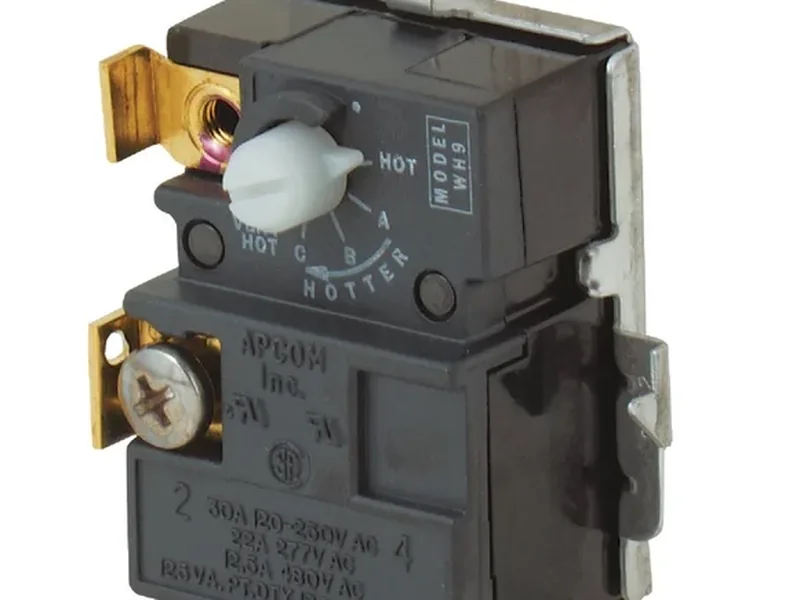
Plainfield, IN 46168 stretches from its historic downtown along White Lick Creek to the subdivisions and workforce housing of the logistics corridor — and its electric water heaters cover the same spread, from aging tanks in the original neighborhoods to young units in new developments. Thermostat failure in Plainfield shows the full range: worn contacts and deep sediment in the veterans, early drift and high-demand wear in the corridor homes. The symptoms are consistent — lukewarm water, shrinking capacity, scalding, or the ECO reset tripping repeatedly.
Water Heater Leak Repair Co. provides thermostat replacement in Plainfield, IN 46168 for electric tank water heaters. We diagnose electrically — both thermostats and both elements tested, sediment and wiring assessed — then replace failed parts with correctly rated components, matched 120°F settings, and full-cycle verification. Call (833) 713-2101 and describe your symptoms.
In Short: In Plainfield, IN 46168, thermostat failure appears as lukewarm water, rapid depletion, scalding, or repeated ECO trips — with elements, sediment, and wiring as common mimics across the town's wide heater-age range. We prove the failure electrically before replacing, install correctly rated thermostats with matched settings, and verify through a full heating cycle in one visit.
How Thermostat Replacement Works in Plainfield, IN 46168
Plainfield's electric tanks use the dual-thermostat changeover design: upper thermostat and element heat the top first, then control passes to the lower pair, with the ECO reset as overheat guard. Our Plainfield diagnostic is electrical proof across the age spread — wear and sediment on veterans, drift and demand-wear on younger units.
Breaker off and verified, panels open — then systematic testing: thermostat switching behavior, element resistance against nameplate values. In Plainfield's oldest tanks, compound failures dominate: pitted contacts, sediment-buried elements reading open, heat-stressed terminals. In corridor workforce housing with high occupancy, we see accelerated cycle wear — thermostats with the contact erosion of a 15-year-old unit in a 9-year-old heater, because the household runs twice the recovery cycles. The meter sorts each case; we replace what it condemns in one visit.
Sediment assessment runs with the electrical work. Drain-valve flow checks reveal bottom buildup; Plainfield's hard water punishes unflushed tanks at every age. When sediment drives the failure — burying elements, corrupting sensing, overheating toward ECO trips — we recommend flushing with the service and explain the economics: new controls on a mineral-choked tank are short-lived.
Failure signatures read electrically and replaced precisely: upper stuck-open (lukewarm), upper stuck-closed (overheat, ECO trips), lower stuck-open (shrunken capacity), lower stuck-closed (bottom overheating). The meter decides.
Installation is exacting: wires labeled and restored exactly, replacements matched to voltage and wattage per the data plate, sensing discs flat against clean tank steel under firm brackets with scale cleaned from mounting surfaces. Both thermostats to 120°F, matched, verified at the tap. Then the full-cycle proof: upper heats, changeover clicks, lower heats, both cut out at set point, ECO armed — demonstrated during your thermostat replacement in Plainfield, IN 46168.
Plainfield's High-Occupancy Factor
Workforce and multi-generational households near the logistics corridor put unusual demand on water heaters — more showers, more laundry, more dishes, more recovery cycles daily. Thermostat contacts wear by cycle count, so a heater serving eight people ages its controls twice as fast as one serving four. We flag this explicitly in Plainfield because "the heater is only eight years old" surprises high-occupancy homeowners whose controls have lived twelve years of cycles. Heavy-use homes should expect earlier thermostat attention and treat the slow capacity shrink as the early warning it is.
Local Factors That Matter for Thermostats in Plainfield, IN 46168
Demand intensity is Plainfield's defining factor: high-occupancy corridor households cycle controls harder, wearing thermostats by count rather than calendar.
Heater-age spread — downtown veterans to corridor young units — means the diagnostic flexes from wear-and-sediment to drift-and-demand, with honest repair-or-replace reads on the oldest.
Hard water accelerates everything: sediment burial, sensing corruption, terminal corrosion. Annual flushing is the highest-value maintenance for Plainfield electric heaters.
Damp basements near the creek corrode terminals from the outside; we inspect every connection during service.
Landlords: The Complaint Behind the Complaint
In Plainfield's rental stock, thermostat failure surfaces as tenant complaints — "no hot water" often means a tripped ECO from a stuck thermostat, a safety-relevant failure. We document findings clearly for property owners, prioritize scalding-water calls, and recommend proactive control checks between tenancies rather than reactive emergency calls.
Plainfield's High-Demand Thermostat Survival Guide
For Plainfield's high-occupancy households — multi-generational families, workforce housing, homes with frequent guests — thermostat survival requires demand-matched maintenance. The core principle: your heater's controls age by cycle count, so count your cycles. A household running four or more recovery cycles daily wears thermostats roughly twice as fast as the textbook rate; plan control attention on that timeline, not the calendar.
The survival guide has four rules. One: flush twice yearly — high throughput deposits sediment faster, and sediment is the accelerant for every control failure. Two: monitor the capacity trend monthly — the slow shrink is the early warning, and in high-demand homes the shrink from "enough" to "not enough" happens in weeks, not months. Three: keep thermostats at 120°F matched — the temptation to crank settings for more capacity backfires through faster scaling and contact wear. Four: when the heater can no longer meet demand even with healthy controls, accept the verdict — the household has outgrown the heater, and the answer is a larger tank or a second unit, not hotter settings or repeated control repairs. We give this counsel directly because the alternative is an endless cycle of parts replaced onto an undersized system.
Plainfield's Capacity Planning
Plainfield's high-demand households eventually face the capacity question honestly: is the heater big enough, or are we asking a 40-gallon tank to do a 75-gallon job? The planning math: a shower uses roughly 17 gallons of hot water (mixed), a dishwasher 6, a laundry load 7–15 depending on temperature. A household running three morning showers plus laundry needs 60-plus gallons of effective hot-water delivery — beyond a standard 40-gallon tank's first-hour rating, and straining a 50-gallon.
The signs the household has outgrown the heater: thermostats test healthy but capacity never satisfies; the heater runs recovery cycles nearly continuously during peak hours; and every control repair buys only months before complaints resume. The options, in order of sense: first, verify the existing heater is actually delivering its rated capacity (drift and sediment steal gallons — our diagnostic quantifies this); second, upsize the tank at replacement time; third, add a second heater for high-demand zones. What does not work: cranking thermostats past 120°F (scald risk, faster scaling, marginal gains) or replacing controls repeatedly on a system that is simply undersized. We do this capacity math openly with Plainfield homeowners because the right answer is sometimes a bigger heater, not another thermostat.
What Happens When You Call (833) 713-2101
Describe the symptoms — what the water does, when it changed, reset and breaker behavior — and household size if high. We will give a preliminary read and precautions.
On site: breaker-verified electrical diagnosis, sediment/wiring/supply assessment, correctly rated replacements, matched 120°F settings, full-cycle verification — usually one visit. Failed parts and readings shown and explained.
For thermostat replacement in Plainfield, IN 46168, Water Heater Leak Repair Co. proves the failure first. Call (833) 713-2101 today.