Speedway, IN 46224 — the town around the Indianapolis Motor Speedway — is full of older bungalows, cottages, and ranch homes whose electric water heaters have been in service for decades. Thermostat failure in Speedway follows the veteran pattern: contacts worn from hundreds of thousands of cycles, calibration drifted over the years, sensing fouled by sediment from a lifetime of hard water. Homeowners notice lukewarm showers, hot water that quits after one shower, scalding delivery, or the ECO reset button tripping repeatedly.
Water Heater Leak Repair Co. provides thermostat replacement in Speedway, IN 46224 for electric tank water heaters. We diagnose electrically — both thermostats and both elements tested, sediment and wiring assessed — then replace failed parts with correctly rated components, matched 120°F settings, and full-cycle verification. Call (833) 713-2101 and describe your symptoms.
In Short: In Speedway, IN 46224, thermostat failure on veteran tanks shows as lukewarm water, rapid depletion, scalding, or repeated ECO trips — with Speedway's aging tanks making element burnout, deep sediment, and legacy wiring common co-causes. We prove the failure electrically before replacing, install correctly rated thermostats with matched settings, and verify through a full heating cycle in one visit.
How Thermostat Replacement Works in Speedway, IN 46224
Speedway's electric tanks use the dual-thermostat changeover design: upper thermostat and element heat the top first, then control passes to the lower pair, with the ECO reset as overheat guard. Our Speedway diagnostic is electrical proof built for veteran tanks — where the failure is rarely one clean component.
Breaker off and verified, panels open — then systematic testing: thermostat switching behavior, element resistance against nameplate values. Speedway's long-service tanks produce compound findings as a matter of course: pitted contacts, sediment-buried elements reading open, heat-discolored terminals from decades of thermal cycling. The meter sorts the failure; we replace what it condemns — thermostats, elements, terminals — in a single visit.
Sediment assessment is central. Decades of unflushed hard water is the Speedway norm; tank bottoms hold inches of mineral, drain valves clog on testing. Sediment buries elements until they burn out, corrupts sensing so good thermostats misread, and drives the overheating behind ECO trips. When sediment is the engine, we recommend flushing with the service and explain plainly: new controls on a mineral-choked tank are short-lived, and a rumbling tank may be near its end regardless of controls.
Failure signatures read electrically and replaced precisely: upper stuck-open (lukewarm), upper stuck-closed (overheat, ECO trips), lower stuck-open (shrunken capacity), lower stuck-closed (bottom overheating). The meter decides.
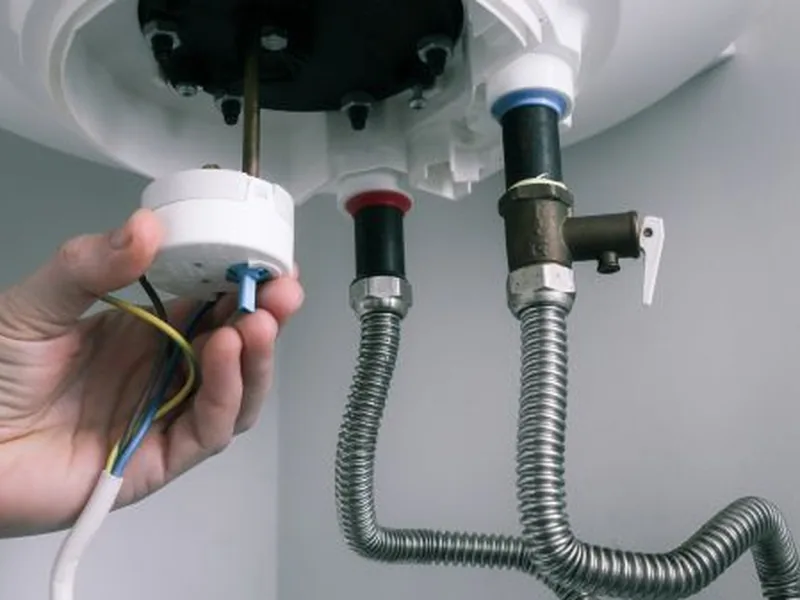
Installation is exacting: wires labeled and restored exactly, replacements matched to voltage and wattage per the data plate, sensing discs flat against clean tank steel under firm brackets with mounting surfaces cleaned and brackets re-tensioned. Both thermostats to 120°F, matched, verified at the tap. Then the full-cycle proof: upper heats, changeover clicks, lower heats, both cut out at set point, ECO armed — demonstrated during your thermostat replacement in Speedway, IN 46224.
Speedway's Legacy Wiring
The town's mid-century homes carry original-era electrical systems: panels with weakened breakers, splices from generations of remodels, and branch runs that sag voltage under the heater's load. A tired breaker tripping during recovery mimics thermostat failure exactly; we check supply voltage under load and breaker condition during diagnosis — a Speedway-specific step that prevents misdiagnosed parts. In the tight utility spaces of Speedway's bungalows, we also find thermostats replaced previously with incorrect wattage ratings, a legacy of quick fixes we correct during service.
Local Factors That Matter for Thermostats in Speedway, IN 46224
Veteran tanks define Speedway's thermostat work: contact wear, deep sediment, legacy wiring, and the honest repair-or-replace assessment on every visit for tanks past 15 years.
Hard water is the accelerant — sediment burial, sensing corruption, terminal corrosion. Annual flushing is the highest-value maintenance for Speedway electric heaters.
Legacy electrical systems add supply-side mimics: weak breakers, voltage sag, old splices. Under-load voltage checks separate these from control failures.
Compact bungalow utility spaces concentrate heat and make access tight; we work within them and verify terminal condition carefully.
Race-Season Demand Spikes
Speedway homes hosting guests during race season put sudden heavy demand on marginal heaters — and marginal thermostats fail under the spike. If your heater struggles every May with extra showers, the thermostats are telling you they are at their limit before the busy season, not during it. Pre-season attention beats a cold-shower weekend with a house full of guests.
Speedway Bungalow Heater Access Guide
Speedway's bungalows and cottages hide water heaters in the tightest utility spaces in our service area — closets barely wider than the tank, corners behind furnaces, crawlspace-adjacent nooks. Tight access affects thermostat service in concrete ways. First, thermostats run hotter in confined spaces with poor ventilation, and heat is the enemy of calibration — confined installations drift sooner. If your heater sits in a closet, keep the closet ventilated and never store belongings against the tank; airflow is part of the control system.
Second, tight spaces make the electrical audit harder but more important — connections in hot, cramped quarters loosen faster from thermal cycling, and we have found burned terminals in Speedway closets that went unnoticed for years because nobody could comfortably inspect them. Third, when we service a tight-space heater, we photograph the wiring before disassembly as a matter of course — in a closet where you cannot see all the terminals at once, the photo is the map that guarantees correct reassembly. Homeowners can help future service by keeping the heater's access panels reachable: the boxes stacked in front of the utility closet are the most common reason a simple thermostat visit takes twice as long.
Speedway's Pre-Season Heater Check
Speedway homes hosting race-season guests should run a pre-season heater check two weeks before the crowd arrives — not the day before. The check: run hot water at the farthest guest bathroom and confirm it arrives hot and stays hot through a full shower-length draw; verify the temperature at the tap (120°F, not scalding — guests unfamiliar with your plumbing are the most vulnerable to scalding); confirm the ECO reset is set; and listen for rumbling during recovery that signals sediment needing attention before heavy use.
If the check reveals weakness — slow recovery, fading temperature, any rumbling — call immediately, not after the guests arrive. Two weeks is enough time for scheduled service; two days is emergency territory. For households that host every May, make the pre-season check an annual April ritual alongside the rest of race-season preparation. The check also covers the less obvious: confirm the TPR discharge pipe is unobstructed and terminating visibly (a year of storage creep may have buried it), and verify the area around the heater is clear for ventilation. The goal is simple — the heater should be the last thing on your mind during race week, because you already checked it.
What Happens When You Call (833) 713-2101
Describe the symptoms — what the water does, when it changed, reset and breaker behavior. We will give a preliminary read and scalding precautions if needed.
On site: breaker-verified electrical diagnosis, sediment/wiring/supply assessment, correctly rated replacements, matched 120°F settings, full-cycle verification — usually one visit. Failed parts and readings shown and explained.
For thermostat replacement in Speedway, IN 46224, Water Heater Leak Repair Co. proves the failure first. Call (833) 713-2101 today.