Avon, IN 46123 has grown fast, and its water heaters tell the story of that growth: 1990s and 2000s subdivision tanks now hitting the age where TPR valves start weeping, alongside brand-new construction where closed plumbing systems and high municipal pressure put brand-new valves to the test. Whether your home sits in an established neighborhood off US-36 or a new development near the interstate corridor, a dripping temperature and pressure relief valve means your system is asking for a pressure or temperature problem to be solved.
Water Heater Leak Repair Co. provides TPR valve replacement in Avon, IN 46123 for gas and electric tank heaters. Our approach is diagnostic-first: we measure incoming pressure, verify expansion control, and check thermostat operation before the new valve goes in — then we install a correctly rated valve and bring the discharge piping up to code. Call (833) 713-2101 to describe what your valve is doing and get straight answers.
In Short: TPR valve drips in Avon, IN 46123 typically trace to thermal expansion in closed systems, failed expansion tanks in 15-to-25-year-old subdivision homes, or high municipal static pressure. We diagnose pressure through a full heating cycle, replace the valve with the correct BTU and pressure rating, and fix discharge piping so it terminates visibly and safely.
How TPR Valve Replacement Works in Avon, IN 46123
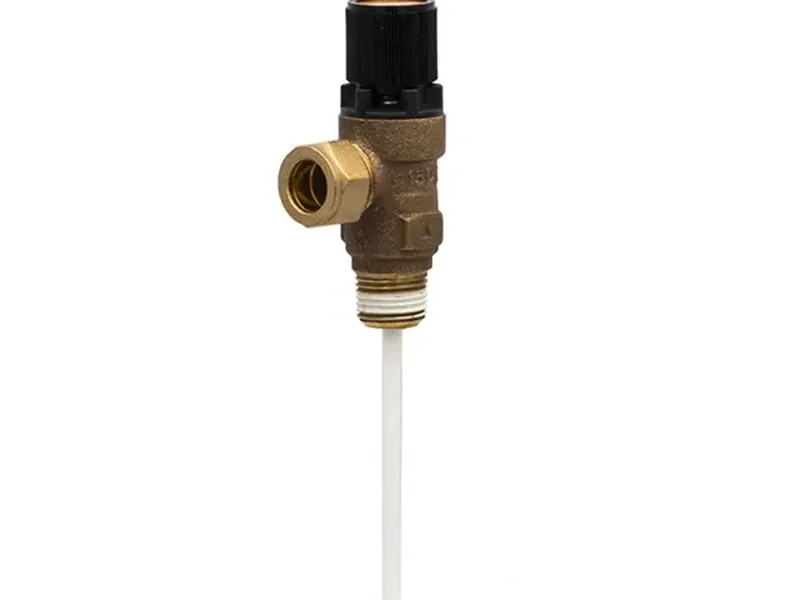
Your TPR valve is threaded into the tank and watches two things: pressure above 150 PSI and temperature above 210°F. When either limit is crossed, the spring-loaded disc lifts and hot water exits through the discharge pipe. Replacement in Avon follows a careful order because the valve is a safety device and the reason it opened matters more than the valve itself.
We begin with the heater's energy off and the cold-water inlet closed. After relieving pressure at the drain valve, we attach a gauge and record static pressure, then fire the heater and watch pressure climb through a recovery cycle. This live test is where Avon diagnoses get interesting: many homes here have pressure-reducing valves on the main set years ago, and those PRVs drift upward with age. A PRV that once held 65 PSI may now be passing 95 PSI, and the homeowner never notices until the TPR valve starts weeping after every long shower. We catch that drift with the gauge, not guesswork.
Expansion control gets its own check. Avon's newer homes almost always have expansion tanks; the 1990s subdivisions often do not, because they were built before closed-system awareness was common and many have since had check valves or PRVs added. We test existing expansion tanks by checking the air charge with a tire gauge on the Schrader valve (pump off, system depressurized) and by the tap test. A waterlogged expansion tank is dead weight on the system — it cannot absorb a single gallon of expansion — and it is one of the most common reasons we replace TPR valves in Avon twice in a few years when the tank was the real problem all along.
Valve selection is exact. We read the heater's data plate for input BTU and tank size, then choose a TPR valve with a BTU rating at or above the heater's input, 3/4-inch threads, and 150 PSI / 210°F set points. On gas heaters especially, an undersized valve cannot relieve energy fast enough in a runaway scenario, so matching the rating is a safety matter, not a formality. We remove the old valve with a wrench on the body flats, prep the tapping threads, and install the new valve with sealant rated for potable hot water.
Then the discharge pipe. Code is specific: full-size pipe, gravity-pitched downward, no valves, caps, threads, or reductions, terminating 6 to 24 inches above the floor or a drain where discharge is visible. In Avon's finished basements — and there are many — we find discharge pipes routed into floor drains behind finished walls, pipes that disappear into ceilings, and terminations hidden behind storage where a discharge would soak drywall for days before anyone noticed. During a TPR valve replacement in Avon, IN 46123, we reroute discharge lines to visible, compliant terminations, even in finished spaces, because a hidden discharge defeats the valve's warning function.
We refill the tank fully before restoring energy — a dry-fired electric element burns out in seconds — then run a complete heating cycle with the gauge attached. The new valve should sit bone-dry through the cycle. We operate the test lever to verify it opens and reseats crisply, and we show you the pressure readings so you understand what changed and why.
Avon's Most Common TPR Failure Patterns
Pattern one: the evening drip. The valve is dry all day, then weeps for an hour after dinner when the dishwasher runs and showers stack up. That is textbook thermal expansion — big hot-water draw, long reheat, pressure spike, valve weeps, pressure settles. The fix is expansion control (a working expansion tank), not just a new valve, though the old valve's seat is often damaged by repeated weeping and needs replacement too.
Pattern two: the constant seep. The discharge pipe is always damp and the floor beneath shows mineral staining. This points to sustained high static pressure or debris lodged on the valve seat. In Avon we often trace this to a failed PRV letting 90-plus PSI into the house around the clock, sometimes combined with a scaled seat from hard water that prevents resealing. Both get addressed: the pressure problem and the valve.
Pattern three: sudden discharge of very hot water, sometimes with the tank rumbling or popping. That is temperature, not pressure — a thermostat or gas control letting the tank overheat. Shut off the heater's energy supply and call (833) 713-2101 promptly. This is the emergency the valve exists for, and the underlying control failure must be repaired, not just the valve.
Local Factors That Matter for TPR Valves in Avon, IN 46123
Subdivision age splits Avon into two diagnostic profiles. In 1990s–early-2000s neighborhoods, original water heaters are now 20-plus years old; their TPR valves are often original too, with springs weakened by two decades of heat cycling and seats crusted with scale. These valves weep at pressures well below 150 PSI because the spring no longer holds rated tension. Replacement is straightforward, but we always assess the tank itself — a 22-year-old tank with a weeping valve is often telling you the whole unit is near the end.
In newer Avon developments, the heaters are young but the plumbing is closed: PRVs, check valves, and backflow preventers are standard, which means thermal expansion has nowhere to go without a functioning expansion tank. Builders install expansion tanks, but the pre-charge is sometimes wrong for the home's actual pressure, or the tank fails early. We see TPR weeping on 3-year-old heaters in new Avon homes, and the fix is correcting expansion control, with the valve replaced because repeated weeping has scored its seat.
Finished basements change the stakes. Avon has a high share of finished lower levels with the water heater tucked in a utility closet behind a louvered door. A weeping valve in that closet soaks carpet, baseboards, and drywall long before anyone opens the door. When we service these homes, we pay special attention to discharge termination visibility and we recommend a simple water alarm at the heater base — cheap insurance that catches the next weep before it becomes a flooring claim.
Hard water rounds out the picture. Avon municipal supplies carry moderate-to-high hardness, and without a softener, scale accumulates on valve seats and in tank bottoms. We find valves in Avon that pass the lever test but weep afterward because scale broke loose and lodged on the seat — and valves that fail the test entirely, frozen shut. Annual lever testing and periodic tank flushing are the two habits that keep TPR valves alive here.
What Happens When You Call (833) 713-2101
Tell us the pattern: drip timing, constant or intermittent, water temperature, heater age and fuel type. We will tell you whether to shut the heater down now or whether it can wait for a scheduled visit, and we will give you an honest read on urgency. Steady hot discharge or steam gets priority scheduling.
On site, expect a real diagnostic — pressure readings through a heating cycle, expansion tank check, thermostat verification — followed by valve replacement with a correctly rated unit and code-compliant discharge piping, all typically in one visit. We demonstrate the test lever, show you the readings, and explain any follow-up the system needs.
For TPR valve replacement in Avon, IN 46123, Water Heater Leak Repair Co. fixes causes, not just drips. Call (833) 713-2101 today.