Danville, IN 46122 blends a historic town square with the subdivisions that have grown up around it, and the water heaters across town span the same range — from 30-year-old tanks in century-old homes near downtown to new high-efficiency units in developments off the main corridors. Wherever your heater falls on that spectrum, a dripping TPR valve is delivering a message about pressure or temperature inside the tank, and in Danville's hard water that message deserves a prompt, proper diagnosis.
Water Heater Leak Repair Co. handles TPR valve replacement in Danville, IN 46122 for gas and electric tank heaters of all ages. We start with diagnosis — system pressure through a heating cycle, expansion control, thermostat function — then install a valve rated for your heater and bring the discharge piping up to code. Call (833) 713-2101 and tell us what your valve is doing.
In Short: TPR valve drips in Danville, IN 46122 commonly come from thermal expansion in closed systems, aging pressure-reducing valves, scaled seats in hard water, or failing thermostats in older tanks. We diagnose pressure live, replace the valve with a correctly rated unit, and correct discharge piping so any future discharge is visible and safe.
How TPR Valve Replacement Works in Danville, IN 46122
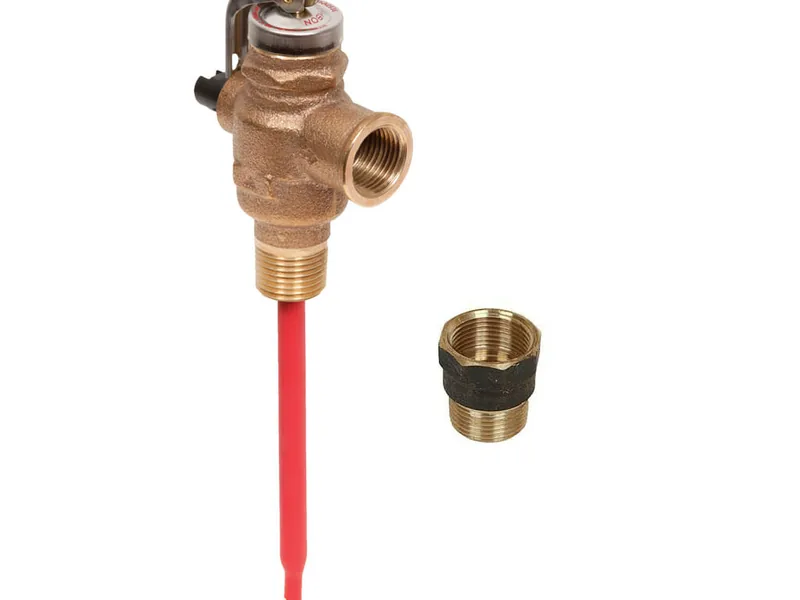
The TPR valve is threaded into your water heater tank, guarding 150 PSI and 210°F with a spring-loaded disc and a temperature probe immersed in tank water. When we replace one in Danville, the procedure is methodical: energy off, cold inlet closed, controlled depressurization — then the diagnostic that determines everything else.
We mount a pressure gauge and record the static reading, then fire the heater and watch pressure through a full recovery. Danville's older homes near the town center often show one pattern: moderate static pressure but dramatic spikes during recovery, the signature of a closed system (PRV or check valve at the main) with no working expansion tank. Newer subdivision homes show a different pattern: high static pressure from the start, sometimes 90 PSI or more, where even modest expansion pushes past the valve's limit. The gauge, watched through a live cycle, distinguishes these in minutes — and the fix differs, so the distinction matters.
On older Danville tanks, we pay special attention to the controls. Electric heaters from the 1990s and earlier may have original thermostats with contacts that stick, driving the tank toward the valve's temperature trip point. The discharge in these cases is scalding rather than lukewarm — a critical difference. We verify cut-out temperatures and test the ECO reset before replacing the valve, because a new valve on a heater with a sticking thermostat will discharge again, and the underlying control fault is the real hazard.
The replacement itself demands exact matching. We extract the old valve from the tank tapping using a wrench on the body flats — never on the outlet arm, which can crack the tapping — then install the new valve with potable-rated thread sealant. The new valve must carry a BTU rating at or above the heater's input rating, with 3/4-inch threads and 150/210 set points. We read the heater data plate and the valve stamping and match them; on Danville's older high-input gas units, this step is non-negotiable for safety.
Discharge piping is where Danville's older homes most often fail inspection. We find pipes reduced to 1/2 inch, pipes terminating inside walls or into crawlspaces, valves with no discharge pipe whatsoever, and — in a few memorable basements — discharge lines connected to garden hoses run to floor drains. Code requires full-size gravity-pitched pipe with no restrictions, terminating 6 to 24 inches above the floor or a drain, visible. During a TPR valve replacement in Danville, IN 46122, we rebuild the discharge line to that standard, because the valve's entire purpose depends on a clear, visible discharge path.
We then fill the tank completely — dry-firing destroys electric elements in seconds and damages gas units — restore energy, and run a full cycle with the gauge attached. The new valve should sit dry through recovery. We exercise the test lever for you: a strong burst, a clean reseat. Then we walk through the pressure readings and explain the root cause in plain language.
Danville Drip Patterns and What They Mean
A drip that appears after heavy hot-water use and stops within the hour is thermal expansion — the closed-system signature. A constant seep with white mineral crust at the pipe end suggests sustained high pressure or a scaled seat. Spitting synchronized with a softener or irrigation cycle points to pressure transients from those devices. A sudden gush of very hot water or steam, with the tank popping or rumbling, is temperature runaway — shut off the heater's energy and call (833) 713-2101 without waiting.
Scale deserves emphasis in Danville. The area's hard water bakes calcium onto valve seats and stiffens springs, and in tanks that have never been flushed, sediment migrates upward to foul the seat. A scaled seat weeps at normal pressure; a scaled-shut valve cannot open at all. We attempt the lever test on every old valve during diagnosis — a frozen lever is a failed safety device, and we say so plainly.
Local Factors That Matter for TPR Valves in Danville, IN 46122
Housing age diversity is Danville's defining factor. Century-old homes near downtown may have water heaters in stone basements with original galvanized discharge piping — corroded, undersized, or absent. Mid-century ranches often have heaters in utility rooms with PRVs added decades ago and no expansion tank. Newer subdivisions have young heaters but closed systems with builder-grade expansion tanks of uncertain pre-charge. Each era fails differently, and our diagnostic is tuned to the home's vintage.
Rural fringes run on wells. Outside town, private well systems with pressure tanks introduce the waterlogged-tank failure: the bladder fails or the air charge bleeds off, the tank fills solid, and every pump cycle hammers system pressure. The TPR valve becomes the expansion relief by default. When we service well-fed homes near Danville, we check the pressure tank's air charge with the pump off and the system drained — a five-minute check that prevents the new valve from inheriting the old drip.
Basement installations dominate in Danville's older housing, and many of those basements are damp. Chronic dampness corrodes valve bodies, discharge pipes, and tank fittings from the outside while hard water attacks from the inside. We inspect external condition carefully during service and replace compromised piping, not just the valve.
Finally, the DIY legacy. Danville's handy homeowners have, over the decades, produced creative plumbing — including capped discharge pipes and valves replaced with incorrect ratings. We never shame it; we just fix it. But if a previous repair left your TPR valve capped, plugged, or mismatched, that is a safety defect we correct immediately, and we explain why capping a relief valve is never acceptable.
What Happens When You Call (833) 713-2101
We start with questions: drip pattern, water temperature, heater age and fuel, well or municipal water. Your answers set the urgency — scalding discharge or steam means shutting down now and priority scheduling; an intermittent weep means a prompt visit.
On site, expect a real diagnostic — live pressure readings, expansion and thermostat checks — followed by valve replacement with a correctly rated unit and code-compliant discharge piping, typically in one visit. We demonstrate the test lever, show you the readings, and explain any related needs honestly.
For TPR valve replacement in Danville, IN 46122, Water Heater Leak Repair Co. fixes the cause behind the drip. Call (833) 713-2101 today.