Fishers, IN 46038 is one of Indiana's fastest-growing cities, and its water heaters are mostly young — but young does not mean trouble-free. In Fishers' subdivisions of 1990s, 2000s, and 2010s homes, dripping TPR valves are remarkably common, and the causes are modern: closed plumbing systems with check valves and pressure-reducing valves at every meter, builder-grade expansion tanks with lost pre-charge, and municipal pressure that runs high in several zones. A weeping temperature and pressure relief valve in Fishers is rarely about an old valve — it is about system pressure that needs managing.
Water Heater Leak Repair Co. provides TPR valve replacement in Fishers, IN 46038 for gas and electric tank heaters. Our diagnostic-first approach measures your pressure through a live heating cycle, verifies expansion control, and checks thermostat operation — then we install a correctly rated valve and bring the discharge piping up to code. Call (833) 713-2101 for a straight answer about your drip.
In Short: In Fishers, IN 46038, TPR valve weeping on relatively young heaters usually traces to thermal expansion in closed systems, failed or mis-charged expansion tanks, or high municipal static pressure. We diagnose with live pressure readings, replace the valve with one matched to your heater's BTU rating, and correct discharge piping to a visible termination.
How TPR Valve Replacement Works in Fishers, IN 46038
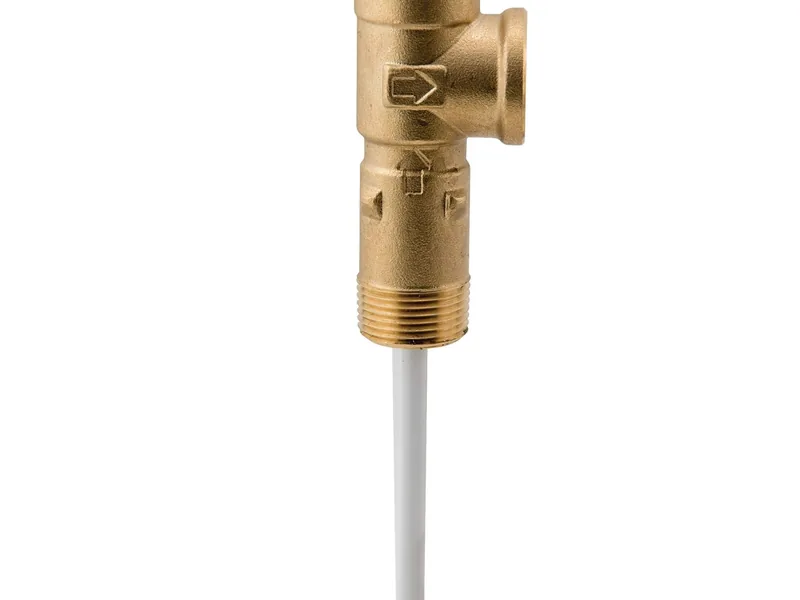
Your TPR valve threads into the water heater tank and guards two limits: 150 PSI and 210°F. A spring holds the disc shut; a probe senses water temperature. When we replace a valve in Fishers, we follow a disciplined sequence — energy off, cold inlet closed, controlled depressurization — because the diagnostic that follows determines whether the new valve will last.
We attach a gauge and log static pressure, then run the heater through a full recovery cycle. Fishers homes frequently show the new-construction pattern: static pressure of 75 to 95 PSI (high but not alarming), then a climb past 150 PSI during recovery as heated water expands against a closed system. The culprit is almost always expansion control — either no expansion tank (in older Fishers homes later fitted with check valves) or an expansion tank that has failed. We test expansion tanks at the Schrader valve with the system depressurized: the air charge should match static pressure, and a tank that reads water pressure at the air valve or thuds solid when tapped is waterlogged and finished.
An important Fishers-specific check is expansion tank pre-charge versus actual pressure. Builders set pre-charge to a nominal value, but if the home's PRV was later adjusted — or drifted — the pre-charge no longer matches, and the tank cannot absorb expansion until pressure exceeds the pre-charge. We have fixed chronic TPR weeping in Fishers simply by correcting pre-charge, though a valve that has wept for months usually needs replacement too, since repeated weeping scores the seat.
Valve installation is exact. We remove the old valve with a wrench on the body flats, prep the tapping, and install the new valve with potable-rated sealant. The replacement's BTU rating must meet or exceed the heater's input — we verify against the data plate. On the high-input gas units common in Fishers' larger homes, correct rating is a safety requirement, not a nicety.
Discharge piping in Fishers' finished basements needs particular care. Code demands full-size pipe, gravity pitch, no restrictions, termination 6 to 24 inches above the floor or a drain — visible. We find discharge lines in Fishers utility rooms that end behind the furnace, pipes routed into wall cavities during basement finishing, and terminations hidden by storage. During a TPR valve replacement in Fishers, IN 46038, we reroute to visible, compliant terminations, because a hidden discharge can soak a finished basement for days before discovery.
After installation, we fill the tank fully, restore energy, and run a complete cycle with the gauge on. The new valve should remain dry; we then exercise the test lever in front of you and review the pressure log together, so you see exactly what was happening and what changed.
Decoding Fishers Drip Patterns
The evening weep — dry all day, damp after dinner's showers and dishwasher — is thermal expansion in a closed system, Fishers' signature complaint. The constant seep with crust at the pipe end points to high static pressure or a scaled seat. Spitting that syncs with irrigation or softener cycles indicates pressure transients. A sudden blast of scalding water or steam is temperature runaway: shut off the heater's energy and call (833) 713-2101 immediately. Note your pattern's timing before calling — it focuses our diagnosis.
Local Factors That Matter for TPR Valves in Fishers, IN 46038
Closed systems are the norm, not the exception. Fishers' municipal infrastructure includes backflow prevention that closes residential plumbing systems, which means thermal expansion must be managed inside the home. Any Fishers home whose expansion tank was never installed, was installed with wrong pre-charge, or has failed will eventually weep at the TPR valve. Our service treats expansion control as part of the valve job, not an upsell.
High static pressure zones affect several Fishers neighborhoods. Elevation and distribution design put some areas at 85 to 100 PSI at the meter. PRVs manage this, but builder-grade PRVs drift over 10 to 15 years. We test PRV function during TPR service — a PRV passing 95 PSI static is often the root cause of the drip, and adjusting or replacing it solves the problem at its source.
Finished basements are everywhere in Fishers, and water heaters hide in utility closets behind finished walls. A weeping discharge in that closet damages drywall, baseboards, and carpet silently. We terminate discharge lines visibly and recommend a water alarm at the heater base — a ten-minute addition that turns future weeps into immediate alerts.
Water softeners are common in Fishers and genuinely extend valve life — when maintained. We ask about softener salt and settings during diagnosis because a bypassed or exhausted softener lets hardness through to scale the valve seat. Homes that added softeners years after construction often have valves already damaged by the pre-softener years; those valves need replacement regardless of current water quality.
What Happens When You Call (833) 713-2101
Describe the pattern — when it drips, how much, how hot — plus heater age, fuel type, and whether you have a softener or expansion tank (we will verify on site regardless). We give you an honest urgency read: scalding discharge or steam means shutting down now; an intermittent weep means a prompt scheduled visit.
On site, you get live pressure diagnostics, expansion verification, thermostat checks, valve replacement with a correctly rated unit, and code-compliant discharge piping — usually in a single visit. We demonstrate the test lever and explain the findings plainly, including any PRV or expansion tank needs.
For TPR valve replacement in Fishers, IN 46038, Water Heater Leak Repair Co. diagnoses first and fixes right. Call (833) 713-2101 today.