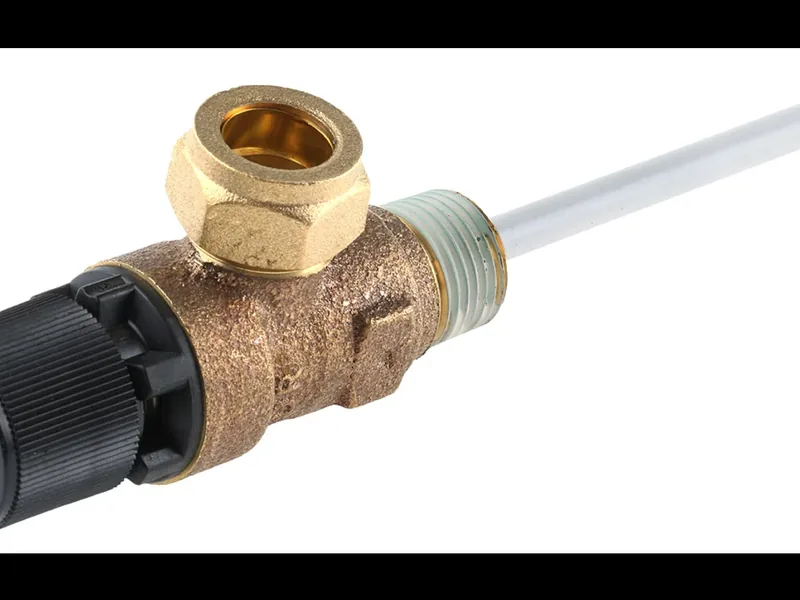
Greenfield, IN 46140 is Hancock County's seat, with a historic downtown surrounded by neighborhoods that span every era of American homebuilding — Victorian-era houses, post-war ranches, 1970s split-levels, and new subdivisions on the town's edges. That range shows up in TPR valve calls: century-old homes with original galvanized discharge piping, mid-century houses with PRVs added decades ago and no expansion tank, and new builds with closed systems and builder-grade expansion tanks. A dripping temperature and pressure relief valve in any of them is reporting a pressure or temperature condition worth diagnosing properly.
Water Heater Leak Repair Co. provides TPR valve replacement in Greenfield, IN 46140 for gas and electric tank water heaters. We diagnose first — live pressure readings through a heating cycle, expansion control verification, thermostat checks — then install a correctly rated valve and bring the discharge piping up to code. Call (833) 713-2101 and describe what your valve is doing.
In Short: In Greenfield, IN 46140, TPR valve drips typically come from thermal expansion in closed systems, aging PRVs passing high pressure, or mineral-scaled seats — with older homes adding corroded discharge piping to the list. We diagnose pressure live, install a valve matched to your heater's BTU rating, and rebuild discharge piping to a visible, code-compliant termination.
How TPR Valve Replacement Works in Greenfield, IN 46140
The TPR valve screws into your water heater tank and stands watch over 150 PSI and 210°F. A spring holds the disc shut; a probe senses tank temperature. Our Greenfield replacement process starts with energy off and the cold inlet closed, then a controlled depressurization — and then the diagnostic that makes the repair last.
We mount a gauge and record static pressure, then run the heater through a full recovery cycle while watching the needle. Greenfield's housing eras produce distinct signatures: pre-1980 homes often show moderate static pressure with violent recovery spikes (closed system, no expansion tank); 1990s–2000s homes show high static pressure from drifting PRVs; new builds show expansion-tank failures on young heaters. The live pressure log identifies the pattern in minutes, and the companion repair — expansion tank, PRV service, or both — follows the pattern.
On Greenfield's older electric heaters, thermostat verification is essential. Original thermostats with decades of heat cycling can stick closed, driving the tank toward the valve's temperature trip point. That produces scalding discharge rather than a pressure weep — a different and more dangerous failure. We verify cut-out temperatures and ECO function before replacing the valve, because a temperature-driven discharge means the control is the primary repair.
The valve installation itself is precise. We extract the old valve with a wrench on the body flats, clean the tapping threads, and install the new valve with potable-rated thread sealant. The replacement's BTU rating must meet or exceed the heater's input — confirmed against the data plate. On Greenfield's older high-input gas units, this matching is a safety requirement.
Discharge piping is where Greenfield's older housing stock most often fails. We find galvanized lines corroded to paper thinness, pipes reduced to half inch, uphill runs that trap water against the valve, and terminations inside walls, crawlspaces, or — in one memorable basement — into a bucket. Code requires full-size gravity-pitched pipe with no restrictions, terminating 6 to 24 inches above the floor or a drain, visible. During a TPR valve replacement in Greenfield, IN 46140, we rebuild the discharge line to that standard, because the valve's warning function depends entirely on a clear, visible path.
We fill the tank completely before restoring energy, run a full cycle under gauge observation, confirm the new valve stays dry, exercise the test lever in front of you, and review the pressure readings and root cause in plain language.
Reading Drip Patterns
Weeping that follows heavy hot-water use and fades within the hour is thermal expansion — the closed-system signature. Constant seepage with mineral crust points to sustained high pressure or a scaled seat. Discharge synchronized with a well pump indicates a waterlogged pressure tank on rural properties. Sudden scalding discharge or steam with tank rumbling is temperature runaway: shut off the heater's energy and call (833) 713-2101 immediately. Note your pattern's timing — it focuses our diagnosis.
Local Factors That Matter for TPR Valves in Greenfield, IN 46140
Housing era diversity drives everything. Victorian and early-20th-century homes near downtown may have heaters in stone basements with original piping and no expansion control whatsoever. Post-war ranches commonly gained PRVs in the 1980s–90s without expansion tanks — the classic weeping-valve setup. New subdivisions have young heaters but closed systems with expansion tanks of uncertain pre-charge. Our diagnostic reads the home's era and tests accordingly.
Rural well systems ring the town. Outside Greenfield proper, private wells with pressure tanks are common, and waterlogged tanks — failed bladders, lost air charge — remove the system's expansion cushion. The TPR valve becomes the relief by default, dripping with every pump cycle. We check pressure-tank air charge on well-fed homes as a matter of routine.
Hard water is a constant. Greenfield-area water scales valve seats and stiffens springs over a heater's life; in unflushed tanks, sediment migrates to foul the seat. Annual lever tests catch valves scaling shut before they fail silently, and periodic flushing extends both valve and tank life.
Basement dampness in older homes corrodes valve bodies and discharge piping from the outside while hard water attacks from within. We inspect external condition during every service and replace compromised piping — not just the valve — as part of the job.
Expansion Tanks: Greenfield's Most Overlooked Component
If there is one device that decides whether your new TPR valve survives in Greenfield, it is the expansion tank — and it is also the device most homeowners have never looked at. The expansion tank hangs on the cold-water line near the heater: a small steel tank with a rubber diaphragm inside, an air cushion on one side and system water on the other. When heated water expands, it pushes into the tank and compresses the air instead of spiking system pressure. When the diaphragm ruptures or the air charge bleeds away, the tank fills solid with water and stops working — silently. Nothing leaks, nothing alarms; the TPR valve just starts weeping, and homeowners blame the valve.
During our Greenfield service we test every expansion tank we find: air charge at the Schrader valve with the system depressurized (it should match your static water pressure), plus the tap test — hollow ring at the top, dull thud at the bottom means a live air cushion; a solid thud throughout means waterlogged and finished. We also check sizing, because an undersized tank on a large heater saturates early in recovery and hands the job back to the TPR valve. In Greenfield's 1990s subdivisions, where original tanks are now 20-plus years old, we replace failed expansion tanks as often as we replace the valves they were supposed to protect. A new valve on a dead expansion tank is a countdown, not a repair — which is why the tank check is built into our diagnostic, not offered as an afterthought.
What Happens When You Call (833) 713-2101
We ask about the drip pattern, water temperature, heater age and fuel, and water source. Scalding discharge or steam means shutting down now with priority scheduling; an intermittent weep means a prompt visit.
On site: live pressure diagnostics, expansion and thermostat verification, replacement with a correctly rated valve, code-compliant discharge piping, and a demonstrated lever test — usually in one visit. You get the old valve, the readings, and an honest explanation of the cause and any related needs.
For TPR valve replacement in Greenfield, IN 46140, Water Heater Leak Repair Co. fixes the cause behind the drip. Call (833) 713-2101 today.