McCordsville, IN 46055 has transformed from a quiet crossroads into one of Hancock County's fastest-growing towns, and nearly every water heater here is young — installed in the subdivisions that now define the area. Yet dripping TPR valves are a common service call in McCordsville, because new does not mean correctly configured: closed plumbing systems with check valves at every meter, builder-installed expansion tanks with incorrect pre-charge, and municipal pressure that runs high in parts of town put young valves under exactly the stress that makes them weep.
Water Heater Leak Repair Co. provides TPR valve replacement in McCordsville, IN 46055 for gas and electric tank heaters. We diagnose first — live pressure readings through a heating cycle, expansion tank verification, thermostat checks — then install a correctly rated valve and bring discharge piping up to code. Call (833) 713-2101 for a straight diagnosis of your drip.
In Short: In McCordsville, IN 46055, TPR valve weeping on young heaters usually traces to thermal expansion in closed systems, expansion tanks with wrong pre-charge or failed diaphragms, or high municipal static pressure. We diagnose with live pressure readings, replace the valve with one matched to your heater's BTU rating, and correct discharge piping to a visible termination.
How TPR Valve Replacement Works in McCordsville, IN 46055
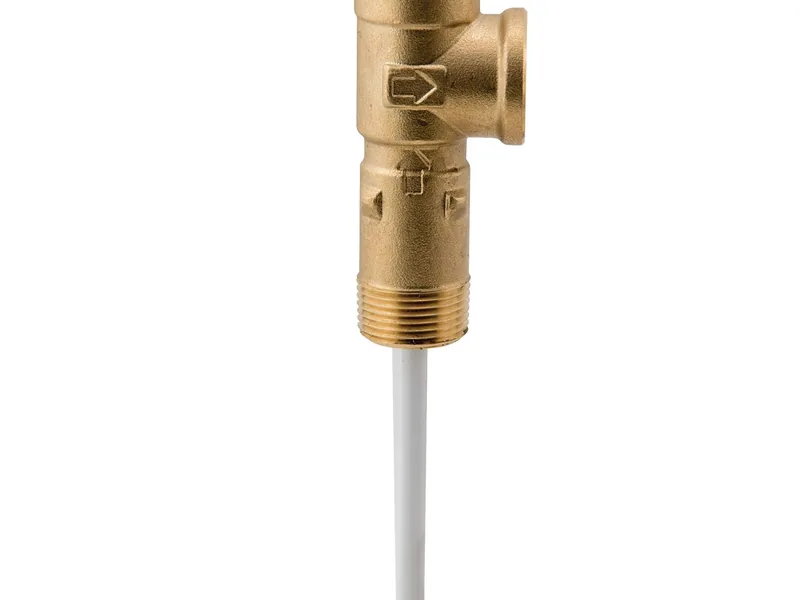
The TPR valve threads into your water heater tank and guards two limits: 150 PSI of pressure and 210°F of temperature. A spring holds the disc shut; an immersed probe senses water temperature. Our McCordsville replacement process starts with energy off and the cold inlet closed, then a controlled depressurization — and then the diagnostic that determines whether the new valve will last or start weeping within months.
We mount a gauge and log static pressure, then run the heater through a full recovery cycle. McCordsville's new-construction homes show a distinctive signature: static pressure of 75 to 95 PSI — high but not alarming — climbing past 150 PSI during recovery as heated water expands against a closed system. The culprit is almost always expansion control. Builder-installed expansion tanks are present in most McCordsville homes, but their pre-charge was set to a nominal value at construction; if the home's PRV was later adjusted or drifted, the pre-charge no longer matches static pressure, and the tank cannot absorb expansion until pressure exceeds the pre-charge setting. We have resolved chronic TPR weeping in McCordsville simply by correcting pre-charge — though a valve that has wept for months usually needs replacement too, since repeated weeping scores the seat.
We also test for failed diaphragms: air charge checked at the Schrader valve with the system depressurized, plus the tap test. A tank that thuds solid throughout is waterlogged and finished — dead weight on the pipe that protects nothing. On heaters as young as three or four years old, failed expansion tanks are a leading cause of TPR weeping in McCordsville, and replacing the valve without addressing the tank guarantees a repeat visit.
Valve installation is exact. We extract the old valve with a wrench on the body flats, prep the tapping threads, and install the new valve with potable-rated thread sealant. The replacement's BTU rating must meet or exceed the heater's input rating — verified against the data plate. On the high-input gas units common in McCordsville's larger homes, correct rating is a safety requirement.
Discharge piping in McCordsville's finished basements needs care. Code requires full-size pipe, continuous gravity pitch, no valves, caps, threads, or reductions, terminating 6 to 24 inches above the floor or a drain — visible. We find discharge lines that end behind furnaces, pipes routed into wall cavities during basement finishing, and terminations buried behind storage. During a TPR valve replacement in McCordsville, IN 46055, we reroute to visible, compliant terminations, because a hidden discharge can soak a finished basement for days before anyone notices.
After installation, we fill the tank completely — dry-firing destroys electric elements in seconds — restore energy, and run a full cycle with the gauge attached. The new valve should remain dry through recovery. We exercise the test lever in front of you and review the pressure log together, so you see exactly what was happening and what changed.
McCordsville's Signature Complaint: The Evening Weep
The call we hear most from McCordsville: the valve is dry all day, then damp every evening after showers, laundry, and the dishwasher run back to back. That is textbook thermal expansion — large hot-water draw, long reheat, pressure spike against a closed system, valve weeps, pressure settles. The pattern is so consistent in McCordsville's subdivisions that we can often predict the pressure log before attaching the gauge — but we attach the gauge anyway, because the companion fix depends on the numbers: pre-charge correction, tank replacement, or PRV adjustment.
The second pattern is the constant seep with mineral crust at the pipe end — sustained high static pressure or a scaled seat. The third, rarer and urgent, is sudden scalding discharge or steam: temperature runaway. Shut off the heater's energy and call (833) 713-2101 immediately if you ever see that.
Local Factors That Matter for TPR Valves in McCordsville, IN 46055
New-construction closed systems are the defining factor. McCordsville's municipal infrastructure includes backflow prevention that closes residential plumbing, so thermal expansion must be managed inside each home. Every McCordsville house needs working expansion control — no exceptions — and our service treats the expansion tank as part of the valve job.
Pre-charge mismatch is McCordsville's specific failure mode. Unlike older towns where expansion tanks are simply absent, McCordsville has tanks that are present but wrongly charged. The fix is often a pressure adjustment rather than a replacement — but only the gauge tells us which, so we measure before we act.
Finished basements are standard in McCordsville's subdivisions, with heaters tucked into utility closets behind louvered doors. A weeping discharge in that closet damages drywall and flooring silently. We terminate discharge lines visibly and recommend a battery water alarm at the heater base — cheap, loud, effective.
Water softeners are common and help valve longevity — when maintained. A softener run dry on salt for months lets hardness through to scale the seat. We ask about softener maintenance during diagnosis because it predicts seat condition.
What a Weeping Valve Costs Beyond the Drip
A valve weeping a cup an hour wastes over 400 gallons monthly — heated water, paid for twice. Worse, the chronic overpressure behind the weep stresses washing machine hoses, toilet fill valves, faucet cartridges, and the tank shell itself. Correcting expansion control when the valve is replaced protects the whole system, not just the heater — which is why our diagnostic always includes the pressure log.
What Happens When You Call (833) 713-2101
Describe the pattern — timing, volume, temperature — plus heater age and fuel. Scalding discharge or steam means shutting down now with priority scheduling; an intermittent weep means a prompt visit.
On site: live pressure diagnostics, expansion tank verification and pre-charge correction, thermostat checks, valve replacement with a correctly rated unit, compliant discharge piping, demonstrated lever test — usually one visit. You get the readings and a plain explanation of the cause and any related needs.
For TPR valve replacement in McCordsville, IN 46055, Water Heater Leak Repair Co. diagnoses first and fixes right. Call (833) 713-2101 today.